The majority of U.S. citizens favor low taxes because they want to decide how to spend their money rather than letting the U.S. government decide. However, most Americans don't realize that taxes are useful not just for raising revenue but also for discouraging undesirable choices. For example, gas taxes discourage gas consumption, which reduces our payments to countries that sponsor terrorism, reduces pollution and emission of GHG, and increases national security by preparing America for future gas shortages. If the proceeds from these taxes are used to remedy other chronic societal problems, and in doing so increase the quality of life of all Americans, we get a win-win situation. For example, the three E's of sustainability are environment, economy, and equity. Raising gas taxes is an investment in the environment, and it improves the economic situation of the federal government, making it more sustainable. If the revenue is used to provide health insurance and education to poor children, we've made a wise investment in human capital and increased equity, making our society more sustainable. Many people would rather not have to pay the gas tax, and use the money they save to buy stuff like HDTV's. But that use of money is not in the best interests of society, or even of those individuals. I believe that the benefits of having a healthy, educated citizenry far outweigh the benefits of having more unnecessary stuff. Would you give up the chance to upgrade to an HDTV if it meant you might live longer (due to reduced pollution)? That you would pay less for your healthcare because hospitals would not have to charge the insured to cover the uninsured? That as an employer you could more easily find well-educated workers, which would improve your bottom line? That all Americans would benefit because a better educated citizenry would make our country more competitive in the global marketplace and our workers more valuable in the global workforce? And since we are now competing globally, a better educated, healthier workforce would make all U.S. companies more competitive and richer, which would make their employees richer, which would increase the amount of tax revenues flowing to the government, which might result in future tax reductions. Thus our choice to raise gax taxes and invest the money in people rather than stuff improves environment, economy, and equity, making the whole country more sustainable. Yes, not all taxes reap so many benefits, but we have to acknowledge that they have the potential to, and therefore be willing to pay them, recognizing that they are simply another form of investment. Wouldn't you rather invest in people rather than stuff?
Monday, February 22, 2010


Wednesday, February 17, 2010
The Failure of the U.S. Government to Address Sustainability
The U.S. Government will fail to adequately address sustainability issues, and American citizens will have to abandon the top-down approach and rely on a bottom-up approach to solving these problems that affect our national security. I say this because Congress and the public have become so polarized along ideological lines that compromise and political progress have become impossible. As a result, moderate members of Congress are choosing to leave rather than run for reelection. On February 16, 2010 when moderate Evan Bayh (D-Ind.) announced that he would not seek reelection after two terms, he stated that "there is too much narrow ideology and not enough practical problem-solving" on Capitol Hill (Kellman and Jackson, AP, 2/17/2010). Nowhere was this more apparent than when the Senate in January rejected a bipartisan deficit commission that could have forced Congress to make painful budget decisions. Members of Congress are unable to agree to reduce capital outflows, but they refuse to increase capital inflows by raising taxes because that is politically unpopular. Most telling was the fact that some Republicans who originally supported the commission changed their votes after President Obama endorsed it. Clearly these members of Congress were acting in the interests of their political party rather than of the country they serve.
By rejecting the establishment of a commission that could have taken the heat for such unpopular decisions, Congress essentially sealed the economic fate of the federal government. This plot shows the federal deficit over time. The total area under the annual deficit bars is a measure of the total deficit, i.e., the economic overshoot = outflows - inflows, which is also shown by the cumulative deficit line that is now approaching $6 trillion. The federal budget is seriously out of balance, but even worse, in most cases these deficits were planned. Unbalanced proposed budgets are passed every year now.

In this plot I've shaded Republican administration years red and Democratic administration years blue. Notice that until Barack Obama took office in 2009 the red area was much greater than the blue area, meaning that until 2009 Republican administrations contributed more to the deficit than Democratic administrations. Of all of the Presidents since 1970 only Bill Clinton managed to balance the budget, ringing up surpluses in his last three years of office. In contrast, President George W. Bush changed the budget surplus of his first year in office, which was budgeted by Clinton, and turned it into record deficits within two years.
As a result of the economic recession in President Obama's first year in office in 2009 the annual federal budget deficit rose to the highest level ever. It remains to be seen if the benefits of the money spent on the economic stimulus package to stave off the recession outweigh the harms resulting from the increase of the deficit, but if the trend continues, the federal government will soon be unable to meet its financial obligations, and this will likely result in an economic collapse. Most economists predict that interest payments on the budget deficit will consume 80% of all federal revenues by 2020 (Tom Raum, AP, 2/15/2010).
And it will only get worse. In January the U.S. Supreme Court, dominated by political ideologues, voted to eliminate any limits to political contributions by corporations or lobbies. Most American citizens believe that members of Congress are already in the pockets of corporations. Now these corporations will have unlimited influence. The fate of bills will be decided by who has the deepest pockets. And when it comes to the three ABCs of unsustainability, who do you think will win when Congress tries to regulate Automobile, Beef, and Coal producers? Will members of the Senate ever vote to limit CO2 emissions when wealthy oil companies are paying them not to? Congress is losing its integrity and its independence. Soon it will lose its economic power and therefore its influence. We can't rely on Congress to fix our problems.
Tuesday, February 16, 2010
Do snowstorms disprove global warming?
The two snowstorms that hit the U.S. east coast in the past few weeks have been touted by many climate change contrarians as proof that the theory of global warming is incorrect. Much of the focus was on Washington, DC, because that's where media people and contrarian politicians are concentrated. Here I examine the many errors associated with this line of thinking.
First, contrarians argued that snow equals cold, and therefore that an unusually large amount of snow means unusually cold. Of course this is a logical fallacy: anyone who has lived in a snow-prone area like my hometown of Buffalo, NY knows that unusually cold means less snow, because very cold air holds less moisture. Large snowfalls are usually associated with warm, moisture-rich air. In Washington DC it is usually cold in enough in January and February to snow, so what was unusual about the two snowstorms was how much snow fell, not how cold it was. Thus, people were confusing precipitation and temperature. In fact, the theory of global warming predicts more intense storms, because the atmosphere has more energy, and greater amounts of precipitation, because the atmosphere is warmer and therefore can hold more moisture. The storms on the east coast resulted from warm moist air from the Gulf of Mexico moving northeast and hitting cold dry air from Canada. This caused the warm moist air to cool, and because cold air can hold less moisture than warm air, the excess moisture fell as snow. This was expected because El Nino has been active off the U.S. west coast, and this typically causes more precipitation in the southern and eastern U.S. (note that El Nino events are expected to become more frequent and intense as warming continues).
Contrarians were also confusing local and global. They were committing the logical fallacy of over-generalizing when they inferred from observations on the U.S. east coast the condition of weather globally. They don't seem to understand that it's possible to be unusually cold in some areas but unusually hot in the rest. For example, looking at a global map of temperature anomalies for the month of December 2009 (data from NASA), we can see that it was unusually cold in the U.S. and Siberia, but unusually warm in the rest of the world:
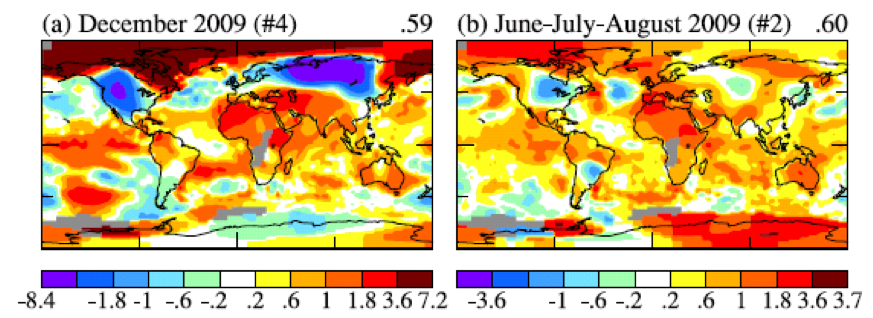
Finally, contrarians were confusing weather and climate. On the short term of weather (days, months) it is entirely possible to have unusually cold temperatures; warming just makes them slightly less probable. But over the long term of climate (years, centuries, millennia) the trend is towards increasing average global temperatures.
So when arguing that snowstorms on the U.S. east coast refute global warming, contrarians were confusing precipitation and temperature, local and global, weather and climate. Is it possible to get any more confused about global climate change?
For more information see http://www.npr.org/templates/story/story.php?storyId=123671588
For humorous takes see http://www.thedailyshow.com/watch/wed-february-10-2010/unusually-large-snowstorm
and
http://www.colbertnation.com/the-colbert-report-videos/264085/february-10-2010/we-re-off-to-see-the-blizzard
Wednesday, June 17, 2009
Eco-Cities and Eco-villages
When people think of “green”, they think of forests and grasslands with few people. But for a given number of people, it is more green to all live in one small space rather than spread out. High population density leads to many efficiencies: resources and wastes only have to be transported to one location rather than many; distances to work, school, and stores are shorter; electrical power is transmitted shorter distances, meaning less line loss and greater efficiency. Water and sewage pipes, cable, phone, and power lines all become shorter per capita as housing density increases, making basic services more affordable and less resource-intensive. High-density housing in mixed-use developments also makes sustainable living easier because public transportation becomes feasible, and people can walk and bike to work and school. In fact, residents of Manhattan use less energy and fewer resources than anywhere else in America ([1], pp. 228-9). And if people take up less space by living in cities, that leaves more space for ecosystem services and preservation of biodiversity. Finally, because more than half of the world's population now lives in cities, it makes sense to focus on making cities more sustainable.
Some cities in North America have been at the forefront of planning for sustainability. One of the greenest cities in the world is Vancouver, British Columbia. I was there in summer of 2008 and was truly impressed by the beauty of the natural setting but also by the forward-thinking policies of the government and developers. The majority of Vancouver’s residents live downtown in high-rises and compact communities [1], p. 231). The city is designed for pedestrians and bicycles, and many residents have given up their cars. I rode all over the city in buses and found it remarkable easy and enjoyable. By avoiding urban sprawl, Vancouver has become one of the world’s most livable cities. Preparations for the 2010 Olympic Games that it is hosting are making Vancouver even more impressive.
Not everyone can live in the city. How can we make smaller communities sustainable? Enter the concept of the eco-village. Just by coincidence I live very close to one of the most widely publicized eco-communities in the world, The Farm, located in Summertown, TN (http://www.thefarm.org/). It includes the Farm Ecovillage Training Center, which offers regular courses on sustainable living. The Farm was founded in 1971 when a group of hippies left San Francisco looking for the right place to start their experiment in communal living. The right place was the area with the cheapest land, and that's why they ended up in middle Tennessee.
I went there for a tour one day, during which they briefly described the history of the farm. It started as a socialist society, but eventually the practice became unsustainable because there were too many freeloaders. So in the mid-1980's they abandoned socialism, causing a large segment of the residents to leave. They now have a cooperative system in which they work together to develop shared resources and pay dues. It now seems to operate as a sustainable capitalist community, with many of the residents operating businesses that manufacture radiation detectors, publish books, sell mushroom growing kits, produce video, and offer midwife services and classes. The residents regularly offer classes on mushroom farming, yoga, organic gardening, and other topics. But touring the Farm was somewhat disappointing to me. The residents are good at self-promotion on the web, but the Farm itself is a small collection of run-down buildings and unused fields. As a farm it is a dismal failure, with most of the land left to pasture but no animals (they are all vegetarians) and only one commercial crop, soybeans, which they make into soy milk and ice cream (which is quite delicious). I think the reason is that though they were idealistic, the hippies were ignorant about farming practices, and also many/most of them do not like manual labor. I wanted a demonstration of how they managed to live sustainably, but I never got a glimpse, making me suspect that their community isn't truly sustainable. Even the mushroom growing demonstration was simply a slideshow accompanied by partially coherent, rambling pronouncements on politics by someone who seemed to have partaken of too many mushrooms in his lifetime (I fell asleep). We never even saw where they grow the mushrooms! I could view a slideshow on my computer without driving 40 miles. But to their credit, the residents of The Farm live more simply and have much smaller ecological footprints than most Americans. They understand that you don’t have to have a lot of money and “stuff” to be happy.
Perhaps a more successful eco-village is Gaviotas, located in the llanos (grasslands) of Colombia and well-described by Alan Weisman in his book “Gaviotas: A Village to Reinvent the World” [2]. Like The Farm, it was founded in 1971, but it seems they made greater progress because the founder, Paolo Lugari, had the foresight to bring a team of scientists and engineers to tackle the problems of sustainable living. This team came up with many novel solutions, including a special water pump that could extract groundwater from greater depths and with less effort than with traditional pumps. This pump was connected to a see-saw to put the energy of children’s play to good use. They also developed solar water heaters, the sale of which became a major source of income. Finally, the planting of 1.5 million trees returned part of the llanos back to its preexisting state of tropical jungle by trapping the moisture in a microclimate [2]. The villagers of Gaviotas tap the trees and sell the resin. The genius of the residents of Gaviotas enabled them to succeed in a harsh climate in a country bordering on anarchy.
So when choosing a place to live, you should seriously consider the city. Your ecological footprint will be smaller if you live there. And when gas prices and transportation costs skyrocket, you’ll be glad that you moved there.
1. Steffen, A., ed. World Changing: A User's Guide for the 21st Century. 2006, Abrams: New York, NY. 596.
2. Weisman, A., Gaviotas: A Village to Reinvent the World. 1999: Chelsea Green Publishing Company 1-890132-28-4.
Tuesday, June 16, 2009
Collect and Purify Water
During short- and long-term emergencies, the most critical resource for you and your family will probably be potable water, especially if you live in an arid region. To prepare for such emergencies, and also to conserve water, you can practice rainwater harvesting. Rainwater harvesting is one of the easiest ways to move towards self-sufficiency. Because we need water to survive, it is important not to rely completely on the system to provide it; redundancy is desirable in critical life-support systems such as water supply [1].
Because evaporation purifies water, rainwater is usually the purest water in the hydrologic cycle; you can therefore use it to water gardens without treatment. The simplest solution is to place a rain barrel (usually a 55-gallon drum with a valve) underneath the downspout of a rain gutter; the barrel should be placed as high as possible, keeping in mind that any support structure such as a stack of cinder blocks must be able to withstand the 450 pounds of a full barrel. Connect a hose to the valve and place it in your garden. The greater the height difference between the rain barrel valve and the hose outlet in the garden, the greater the pressure that drives the flow, and therefore the faster the water will come out of the hose. Rain barrels should have screens at the top to prevent debris or animals from entering the barrel [2]. Detains on how to construct a rainbarrel are given in [1], or you can purchase one prefabricated.
If during an emergency bottled or municipal tap water are not available and you plan to use rainwater for drinking or food preparation, you will need to go through some extra steps to make sure the water is not contaminated. Waterborne diseases cause nearly 15 million deaths each year. Disinfection kills the pathogens (bacteria, protozoa, parasites, and viruses) that can cause disease. Sterilization kills all living organisms in the water, bad or good. Purification removes potentially harmful chemicals in the water. A simple example makes the distinctions clear. You can disinfect water by pasteurizing it, which requires heating it to 149°F (65°C) for six to twenty minutes ([3], pg. 174). To sterilize the water, simply heat it to a hard boil in a covered pot. Boiling the water requires more energy for heating than pasteurization, but you can reduce the amount of energy required by tightly covering the pot to reduce heat loss. Pasteurization and boiling kill pathogens but do not remove dissolved chemicals such as the salts in seawater. To purify the water, you can remove the dissolved chemicals by boiling the water in an uncovered pot and collecting the condensed steam. Again, this is a very energy-intensive process. Below we will look at a few safe alternatives that require less energy.
The first step in water purification is to filter out suspended sediments that can hold chemical and biological contaminants by forcing the water through clean cheesecloth [2] or by temporarily placing the turbid water in a container to let the sediment settle out. Next, you need to remove biological contaminants that can cause disease. Boiling for ten minutes is the easiest solution. However, if you don't have enough fuel to treat all of your water this way, a more energy-efficient method is to use solar disinfection, termed SODIS ([1], [3]). Ultraviolet light kills the pathogens, and becomes more effective at high temperatures. Simply fix some shelves to a piece of metal painted black, then place bottles filled with water on the shelves and expose them to sunlight for six hours. You can paint the back of the bottles black so they will more effectively absorb sunlight and heat up to higher temperatures, killing the pathogens in as little as one hour [1]. In emergencies or while backpacking you can use iodine tablets, tincture of iodine 2%, betadine, or chlorine bleach to chemically treat water; see Lundin [3] and many other sources for detailed instructions on how to do this safely. There are other ways to kill pathogens, but most of them use high-tech devices such as UV lamps that need to periodically replaced or require electricity and are therefore unsustainable.
After filtering the water and killing the pathogens, most water will be safe to drink. For example, collected rainwater generally has very low concentrations of chemical contaminants, so it usually does not need to be treated to remove them. This is fortunate because it is much more difficult to remove dissolved inorganic chemicals from water. However, if you have reason to believe that your water contains chemical contaminants, you can use sunlight to evaporate the water and then collect the purified condensed water, a form of solar "still" ([4] pg. 471). The Watercone has an ingenious design that allows it to purify 1.6 quarts per day; it can even desalinate seawater ([5], pp. 193-4); see http://www.mage-watermanagement.com/. Or you can set up a still to collect steam produced by boiling water, as described above.
Following the simple procedures described above can help you provide potable water for you and your family during short- and long-term emergencies.
1. Kellogg, S. and S. Pettigrew, Toolbox for Sustainable City Living. 2008, Cambridge, MA: South End Press. 241
2. Bates, A., The Post-Petroleum Survival Guide and Cookbook: Recipes for Changing Times. 2006: New Society Publishers. 236 978-0-86571-568-4.
3. Lundin, C., When All Hell Breaks Loose: Stuff You Need to Survive When Disaster Strikes. 2007, Layton, Utah: Gibbs Smith. 449
4. Tawrell, P., Camping & Wilderness Survival. Second ed. 2006, Lebanon, New Hampshire: Paul Tawrell. 1080 978-0-9740820-2-8.
5. Steffen, A., ed. World Changing: A User's Guide for the 21st Century. 2006, Abrams: New York, NY. 596.
Monday, June 15, 2009
Composting
Household garbage often contains a large amount of organic debris that contains stored energy. One of the easiest and most satisfying ecological practices is to compost your waste and produce valuable humus, the organic-rich component of soil that is rich in nutrients and microbes and is essential for fertile soil. At our first house my wife and I bought a large plastic container for composting, but at our second house we used a more environmentally friendly and cheaper approach by building a compost container out of stakes and metal screens used for gardens (Fig. Compost_pile). If designed and maintained properly, compost bins do not usually smell badly, but to be safe we placed ours at the back of our yard. The disadvantage is that we have to walk a few hundred yards to dispose of waste in our compost pile, so we reduce the number of trips by using a small container that we fill and then carry to the compost pile. This is about the only effort required for passive composting, which takes about one year to completely breakdown organic debris into humus. Active composting can produce humus much more quickly, but requires much more effort, and in general I prefer the easy approach. We occasionally stir and water the pile, and then remove soil from the bottom of the pile for our gardens. And we follow some simple rules. First, we add no meat or fatty foods like butter that can attract animals and smell when they spoil. We try to use ½ green, wet material such as tree and bush trimmings and grass clippings that are nitrogen-rich, and ½ brown, dry material (decayed leaves, straw, wood chips) that is carbon-rich ([1], pp. 111-121), in addition to any compostable food waste we produce (banana and orange peels, used coffee grinds and tea leaves, eggshells, corn husks, artichoke leaves, and spoiled fruit and vegetables). We add these materials in layers. It’s better to have too much brown than green material, as too much green can cause formation of molds and bad smells. We don’t add weeds to our compost so as to avoid adding their seeds to our gardens when we add composted soil. Compost bins do not need sunlight, so we placed ours in a shady corner of our yard.
Start your compost pile by mixing together yard litter and foodstuffs, mixing in a small amount of soil that contains the necessary microorganisms, and adding a little water. Little may happen in the first few weeks, but once the microorganisms multiply and establish healthy colonies they will start digesting the waste, extracting energy for their metabolic processes and releasing some of the energy as heat. You will know that your compost pile is working when you feel it giving off heat. When oxygen is present the breakdown of organic matter can be described by the reverse of our model chemical reaction for photosynthesis:
C6H12O6 + 6O2 = 6 CO2 + 6 H2O
The heat comes from the energy of the sun, temporarily stored in organic molecules by plants utilizing photosynthesis. Essentially the same reaction occurs in our bodies when we consume food; respiration releases the energy stored in the food so our bodies can use it. Oxygen is present under aerobic conditions, and the microorganisms use it to breakdown (oxidize or combust) the organic molecules to extract their energy, but if the oxygen they use is not replaced, then eventually it will all be consumed, and under such anaerobic conditions the above reaction grinds to a halt. What happens next is that anaerobic fermentation reactions begin to breakdown the organic molecules and produce alcohol, the same process that we use to make bread and beer with yeast (the alcohol escapes from the bread during cooking). Anaerobic respiration also produces lactic acid in our muscles when we strenuously exercise: the body cannot replace the oxygen fast enough, so it begins to break down sugars and fats anaerobically (http://www.scientificamerican.com/article.cfm?id=why-does-lactic-acid-buil). The problem with alcohol production in the compost pile, however, is that alcohol is a disinfectant, so it sterilizes the pile, wiping out the microbial communities. And anaerobic respiration tends to produce odors from compounds like hydrogen sulfide, which gives the “rotten egg” smell you associate with swamps, where it is produced in the same way.
Finished compost should be dark brown. If it is black, your compost pile does not have enough oxygen; you need to add less water, and aerate the pile by turning it over. A simple approach to solve both of these problems is to place perforated PVC pipes, ones that are slightly greater in length than the diameter of your pile, at various heights in the pile. The pipes will suck air in to provide oxygen to aid decomposition, and drain off excess water.
Creating your own soil by composting is one more way to move yourself toward sustainability and independence [1]. And composting, combined with recycling, has greatly reduced the amount of waste we put in garbage cans.
1. Kellogg, S. and S. Pettigrew, Toolbox for Sustainable City Living. 2008, Cambridge, MA: South End Press. 241
Sunday, June 14, 2009
Buy Green and Encourage Sustainable Design
Besides avoiding purchases of disposable products and junk that is designed to break, and repairing rather than replacing, you should try to purchase products that are designed sustainably, made from renewable resources, and manufactured locally (to reduce carbon emissions from transportation and to help your local economy). When contemplating a purchase, ask yourself, “Do I really need this product? Will it add value to my life? Was the product manufactured in an eco-friendly way? Will its use harm the environment?”
When making purchases, avoid greenwashing, the practice of attaching a green label to a product that is not eco-friendly ([1], pp. 38-9). A perfect example is the Ortho Ecosense line of insecticides http://www.scotts.com/smg/brand/ecosense/brandLanding.jsp, where the word "Ecosense" is displayed in large green letters, but in smaller letters underneath it says "not intended to imply environmental safety either alone or compared to other products". So why are the letters in green and the prefix "Eco" in the name? Because it helps sell the product, even if for the wrong reasons.
New sustainably designed products are hitting the market, but if no one buys those products, then we will lose the opportunity to help make the market more eco-friendly. Consumers have the power to make the market more green by choosing eco-friendly products.
Simple rules should guide the design of sustainable products. Consumers should look for products that follow these rules. For example, Edwin Datschefski (in “The Total Beauty of Sustainable Products”, Rotovision, 2001) states simply (see [1], p. 86) “that things must be cyclic, solar, and safe”, and that “an object’s total beauty should not be undermined by hidden impacts.”
There are many examples of home interior products that are designed sustainably. Bamboo is becoming a popular choice for wood flooring because this fast-growing wood is beautiful, durable, and renewable. For carpeting check out DuPont’s Smart-Strand, which is made from corn, is recyclable and biodegradable, and costs no more than comparable nylon carpeting. Using renewable corn instead of non-renewable oil to make the plastic saves a gallon of gas for every seven square yards of carpet. Eco by Cosentino is a durable surface made of 75% recycled content composed of post-industrial or post-consumer materials bound by an environmentally friendly resin which comes in part from corn oil (See http://www.pr.com/press-release/158589). Vetrazzo’s recycled glass countertops contain 85% recycled glass by weight. The glass comes from curbside recycling programs, post-industrial usage, windows, dinnerware, stemware, automotive windshields, stained glass, laboratory glass, reclaimed glass from building demolition, and other unusual sources such as decommissioned traffic lights. Ivy Coatings make a zero VOC, non-toxic paint that can help improve indoor air quality. Finally, Ultra Touch Insulation is made from recycled denim jean (also http://www.pr.com/press-release/158589).
Designing sustainably takes creativity. As stated by the inventor Edwin Land, creative and effective design requires the “sudden cessation of stupidity” ([1], p. 84). When you encounter a creative sustainable design for the first time, the usual reaction is to say, ‘why didn’t anyone think of this before?” because it is better in every respect than the old design, and yet it is simple. A design I recently encountered, the parking lot swale, elicited that reaction from me. Parking lots often flood because asphalt and concrete are impermeable. They need a sink for water to flow into and infiltrate into the ground during heavy rain events. The only permeable surfaces in parking lots are the islands, which are usually raised beds surrounded by concrete barriers. Water does not flow to the islands because it does not flow uphill. A smart and simple alternative is to make the islands depressions into which water will flow (Fig. Parking_swale_schematic.jpg). The depressions do not need to be surrounded by concrete barriers, and they effectively drain water from the parking lot (Fig. Parking_lot_drainage.jpg). And the parking spots themselves can be partially carpeted with grass (Fig. Green_parking_lot_Ikea.jpg) or porous concrete. These measures reduce the risk of flooding, allow water to infiltrate and recharge the aquifer, reduce the “heat island” effect caused by the high heat absorption and thermal mass of asphalt, and reduce the amount of rainwater shunted into storm systems, which saves energy used to pump and treat the water. Also, by increasing the amount of plants, they help increase water retention, remove pollutants, act as windblocks and noise mufflers, and beautify the parking lot. And all of these benefits come for free, because the sustainable design costs no more than the old unsustainable design.
One of the goals of the sustainability movement is to close the manufacturing loop. Currently most products track a linear path from resource extraction to manufacture to use to disposal. In a closed loop products are never disposed of; they are either reused or recycled. How do we know if sustainable practices were followed at each step in the lifecycle of a product? One way is to see if the product has been certified. For example, a Cradle to Cradle (C2C) platinum certified product is produced sustainably, and at the end of its usable life can be recycled, or is biodegradable, as described in “Cradle to Cradle: Remaking the Way We Make Things” by William McDonough and Michael Braungart (North Point Press, 2002).
1. Steffen, A., ed. World Changing: A User's Guide for the 21st Century. 2006, Abrams: New York, NY. 596.