Showing posts with label Science. Show all posts

Sunday, August 26, 2012

What is the root cause of denialism?

denialism (usually uncountable; plural denialisms)

  1. describes the position of those who reject propositions that are strongly supported by scientific or historical evidence and seek to influence policy processes and outcomes accordingly[1].

In recent years the messages of politically conservative groups in the US have become increasingly at odds with scientific findings. The latest example is the recent claim by US Rep. Todd Akin, R-Mo., that “legitimate rape,” in his words, rarely causes pregnancy. I initially thought this was a brain-addled individual making things up on the fly during a radio interview. However, I’ve since learned that this is the official position of American Right to Life, The American Family Association, and the Human Family Research Center, three anti-abortion groups (Dan Horn, “Science Suffering in the Debate Over Rape,” The Cincinnati Enquirer, 8/26/2012). The groups make this claim because they believe it will make it easier to pass legislation that bans abortion without exceptions for rape and incest, but the scientific evidence does not support their claim that rape is less likely to result in pregnancy. As in other current controversies involving social issues, conservative groups not only ignore scientific evidence when it doesn’t support their views, but make claims that are at odds with the evidence.

Increasing numbers of politically and religiously conservative groups are adopting this anti-science approach. The conservative John Birch society started the anti-Agenda 21 movement opposed to sustainable development and the anti-fluoridation campaign[2]. The Tea Party gave birth to the “Birthers” movement that claims President Obama is not a US citizen because he was born in Kenya, despite the overwhelming evidence that he was born in Hawaii. Currently the most important scientific claim that deniers dispute is that the Earth is warming due to release of the greenhouse gas CO2 during burning of fossil fuels, again despite overwhelming evidence supporting this claim.

How did this all start? I believe that conservatives embarked on the slippery slope of denialism beginning with the Creationist movement that arose in response to the scientific theory of evolution. Motivated by their religious beliefs, which are rooted in a literal interpretation of the bible, fundamentalist Christians either passively choose to ignore evidence of evolution or actively fight to stop the teaching of evolution in public schools. It seems that once people become accustomed to denying evidence, they become increasingly adept at it. No amount of evidence will convince active climate change deniers that climate change is occurring. Based on my personal observations (I would love to see a study that tests this claim), it seems that most climate change deniers are politically conservative, fundamentalist Christians who also deny the reality of evolution. Such individuals will crow about scientific findings that support their views, but will ignore or attack findings that are at odds with their views rather than change their views. This dogmatic approach is rooted in political ideology. Recent studies suggest that the only way to persuade climate change deniers to adopt climate change mitigation measures such as cap and trade is to convince them that even if climate change claims are false, mitigation measures will have a positive effect on social welfare such as greater technological and economic development[3]. While this may treat the symptoms of denialism, it doesn’t address the causes. What can cure the disease of denialism? Effective teaching of evidence-based science in public schools is a start, but society needs to find new ways to stem the spread of denialism, which is making our country less competitive and harming future generations.


[1] http://en.wiktionary.org/wiki/denialism

[2] The John Birch Society also opposed the civil rights movement and promotes claims that the UN is plotting to take over the world.

[3] http://www.nature.com/nclimate/journal/v2/n8/full/nclimate1532.html

Thursday, May 20, 2010

Simple Science is Sometimes the Best Science

Many people think that important science always involves sophisticated mathematics, high-powered supercomputers, or expensive technical instruments. A recent book demonstrates that this is not always the case. David MacKay, Professor of Physics at Cambridge University, published a very influential book in 2009 titled "Sustainable Energy: Without the hot air", available for free download at http://www.withouthotair.com/. A review in Physics World stated it is 'a book every budding physicist should read - and perhaps also ... the one every working physicist would like to have written.' This book has probably had a greater impact on science and society than any other scientific publication in the last couple of years, but it involves physics no more complicated than application of Newton's laws of motion. MacKay uses data, logic, and simple math to arrive at important conclusions. He systematically calculates the maximum amounts of energy that can be produced by renewable energy sources in Britain and shows that it is not physically possible to meet Britain's energy needs using renewable energy alone. This conclusion is very important, but MacKay also shows why some forms of renewable energy such as solar are much more promising than others such as biofuels. His conclusions will help determine where future scientific research funds will be funneled and therefore what path research on renewable energy will take. Though the science MacKay used is simple, the conclusions are important enough that he was appointed as the chief scientific advisor to the UK Department of Energy and Climate Change shortly after the book was published. Britain is now conducting studies to decide whether to support large-scale deployment of tidal power, the form of renewable energy that MacKay most strongly endorsed for Britain in his book.

The enormous impact of MacKay's book may help dispel some misconceptions about science. Important science doesn't need to be expensive or complicated, and sometimes it is published in books rather than scientific journals (remember "The Origin of Species" by Charles Darwin and "PhilosophiƦ Naturalis Principia Mathematica" by Isaac Newton?). Society needs clear-headed thinkers like David MacKay to show us how to address some of the pressing scientific problems of our time such as global climate change and peak oil. And the general public can learn a lot about the future of society by reading MacKay’s book.

Wednesday, March 31, 2010

A Message to Science Educators and Students about Global Climate Change

A recent poll of climate scientists by the University of Illinois found that 97% now accept that human activity is causing climate change (http://www.cnn.com/2009/WORLD/americas/01/19/eco.globalwarmingsurvey/index.html). Yet many high school and university science educators who are not climatologists remain skeptical, and pass that skepticism on to their students. What science educators need to realize is that they are teaching their students to be skeptical not about one scientific theory, but the entire scientific process. If science educators don't accept the overwhelming consensus of scientific experts, why should their students or the public? My concern isn't so much whether students learn and accept the scientific consensus on global warming; my concern is that they will conclude that science isn't a legitimate source of knowledge, and that it shouldn't play a role in public policy decisions. If scientists don't trust science, if they don’t believe it is the most effective method for discerning the truth, then why should anyone else? Frankly, I feel sorry for science educators who dedicate their lives to a process that they don't trust. They do science and their students a disservice by not having an unbiased expert present the facts so that their students can form their own opinions.  All of us should avoid giving opinions on subjects we are not qualified to evaluate.

Now climate contrarians are allying with creationists to keep the teaching of global climate change and evolution out of the public schools (see “Darwin Foes Add Warming to Targets”, Kaufman, published March 3, 2010 http://www.nytimes.com/2010/03/04/science/earth/04climate.html). For over a century creationists and their predecessors have fought against earth scientists about the age of the earth, biologists about evolution, and astronomers about the age of the universe. Now the same anti-science groups are fighting climatologists about global climate change. Scientists in these fields need the support of other scientists; we need them to take the time to learn about these issues; we don't need them to undercut science by voicing their opinions rather than presenting the facts to students.

Students of science: Don't believe anyone who states opinions about scientific issues without presenting supporting facts, including me. If your teacher or Professor makes an unsubstantiated statement challenging the consensus scientific view, be it on evolution, global climate change, or any other topic, challenge them to explain what evidence they base their opinions on. On global climate change, ask them why they think they know better than the 97% of climatologists who believe the evidence shows that the earth is warming. Ask them how all of those climatologists could be wrong. If the response is not based on science, but on something else like politics or religion, call them on it. If they claim that the scientific experts in that field are unreliable or have all committed fraud, ask them why you should trust any scientific authority.

Wednesday, February 17, 2010

The Failure of the U.S. Government to Address Sustainability

The U.S. Government will fail to adequately address sustainability issues, and American citizens will have to abandon the top-down approach and rely on a bottom-up approach to solving these problems that affect our national security. I say this because Congress and the public have become so polarized along ideological lines that compromise and political progress have become impossible. As a result, moderate members of Congress are choosing to leave rather than run for reelection. On February 16, 2010 when moderate Evan Bayh (D-Ind.) announced that he would not seek reelection after two terms, he stated that "there is too much narrow ideology and not enough practical problem-solving" on Capitol Hill (Kellman and Jackson, AP, 2/17/2010). Nowhere was this more apparent than when the Senate in January rejected a bipartisan deficit commission that could have forced Congress to make painful budget decisions. Members of Congress are unable to agree to reduce capital outflows, but they refuse to increase capital inflows by raising taxes because that is politically unpopular. Most telling was the fact that some Republicans who originally supported the commission changed their votes after President Obama endorsed it. Clearly these members of Congress were acting in the interests of their political party rather than of the country they serve.

By rejecting the establishment of a commission that could have taken the heat for such unpopular decisions, Congress essentially sealed the economic fate of the federal government. This plot shows the federal deficit over time. The total area under the annual deficit bars is a measure of the total deficit, i.e., the economic overshoot = outflows - inflows, which is also shown by the cumulative deficit line that is now approaching $6 trillion. The federal budget is seriously out of balance, but even worse, in most cases these deficits were planned. Unbalanced proposed budgets are passed every year now.

clip_image001

In this plot I've shaded Republican administration years red and Democratic administration years blue. Notice that until Barack Obama took office in 2009 the red area was much greater than the blue area, meaning that until 2009 Republican administrations contributed more to the deficit than Democratic administrations. Of all of the Presidents since 1970 only Bill Clinton managed to balance the budget, ringing up surpluses in his last three years of office. In contrast, President George W. Bush changed the budget surplus of his first year in office, which was budgeted by Clinton, and turned it into record deficits within two years.

As a result of the economic recession in President Obama's first year in office in 2009 the annual federal budget deficit rose to the highest level ever. It remains to be seen if the benefits of the money spent on the economic stimulus package to stave off the recession outweigh the harms resulting from the increase of the deficit, but if the trend continues, the federal government will soon be unable to meet its financial obligations, and this will likely result in an economic collapse. Most economists predict that interest payments on the budget deficit will consume 80% of all federal revenues by 2020 (Tom Raum, AP, 2/15/2010).

And it will only get worse. In January the U.S. Supreme Court, dominated by political ideologues, voted to eliminate any limits to political contributions by corporations or lobbies. Most American citizens believe that members of Congress are already in the pockets of corporations. Now these corporations will have unlimited influence. The fate of bills will be decided by who has the deepest pockets. And when it comes to the three ABCs of unsustainability, who do you think will win when Congress tries to regulate Automobile, Beef, and Coal producers? Will members of the Senate ever vote to limit CO2 emissions when wealthy oil companies are paying them not to?  Congress is losing its integrity and its independence. Soon it will lose its economic power and therefore its influence. We can't rely on Congress to fix our problems.

Tuesday, February 16, 2010

Do snowstorms disprove global warming?

The two snowstorms that hit the U.S. east coast in the past few weeks have been touted by many climate change contrarians as proof that the theory of global warming is incorrect. Much of the focus was on Washington, DC, because that's where media people and contrarian politicians are concentrated. Here I examine the many errors associated with this line of thinking.

First, contrarians argued that snow equals cold, and therefore that an unusually large amount of snow means unusually cold. Of course this is a logical fallacy: anyone who has lived in a snow-prone area like my hometown of Buffalo, NY knows that unusually cold means less snow, because very cold air holds less moisture. Large snowfalls are usually associated with warm, moisture-rich air. In Washington DC it is usually cold in enough in January and February to snow, so what was unusual about the two snowstorms was how much snow fell, not how cold it was. Thus, people were confusing precipitation and temperature. In fact, the theory of global warming predicts more intense storms, because the atmosphere has more energy, and greater amounts of precipitation, because the atmosphere is warmer and therefore can hold more moisture. The storms on the east coast resulted from warm moist air from the Gulf of Mexico moving northeast and hitting cold dry air from Canada. This caused the warm moist air to cool, and because cold air can hold less moisture than warm air, the excess moisture fell as snow. This was expected because El Nino has been active off the U.S. west coast, and this typically causes more precipitation in the southern and eastern U.S. (note that El Nino events are expected to become more frequent and intense as warming continues).

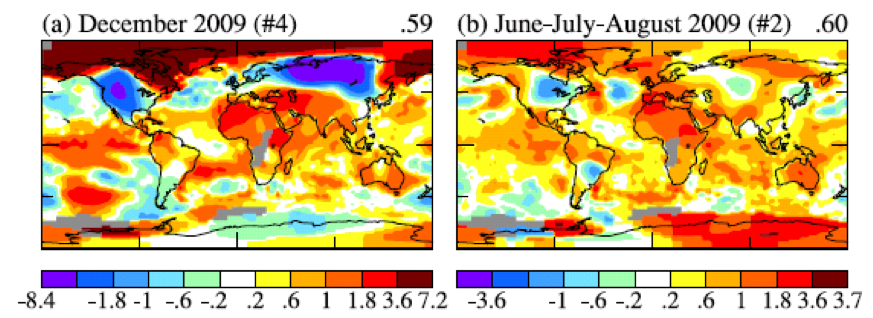
Contrarians were also confusing local and global. They were committing the logical fallacy of over-generalizing when they inferred from observations on the U.S. east coast the condition of weather globally. They don't seem to understand that it's possible to be unusually cold in some areas but unusually hot in the rest. For example, looking at a global map of temperature anomalies for the month of December 2009 (data from NASA), we can see that it was unusually cold in the U.S. and Siberia, but unusually warm in the rest of the world:

clip_image002

Finally, contrarians were confusing weather and climate. On the short term of weather (days, months) it is entirely possible to have unusually cold temperatures; warming just makes them slightly less probable. But over the long term of climate (years, centuries, millennia) the trend is towards increasing average global temperatures.

So when arguing that snowstorms on the U.S. east coast refute global warming, contrarians were confusing precipitation and temperature, local and global, weather and climate. Is it possible to get any more confused about global climate change?

For more information see http://www.npr.org/templates/story/story.php?storyId=123671588

For humorous takes see http://www.thedailyshow.com/watch/wed-february-10-2010/unusually-large-snowstorm
and
http://www.colbertnation.com/the-colbert-report-videos/264085/february-10-2010/we-re-off-to-see-the-blizzard

Wednesday, June 10, 2009

Our Relationship with Nature

*Please note: I haven’t been posting recently because there have been so few comments that I was not convinced anyone was reading my entries. If you read this entry, please post a comment (click the “Comment” link at the end). You don’t even have to write anything; I just want to use the number of comments to estimate how many people are reading. If no one is reading these, then I’m not going to bother posting any more. Thanks, John

Till now man has been up against Nature; from now on he will be up against his own nature.  ~Dennis Gabor, Inventing the Future, 1964

There is a basic antagonism between the philosophy of the industrial age and the philosophy of the conservationist. – Aldo Leopold

Environmental problems develop when there is an unhealthy relationship between humans and the environment. The ways people approach, treat, and think of nature depend on their self-image. According to Wilson [1] there are two competing types of human self-image, exemptionalist and naturalist. Exemptionalists believe that humans exist apart from environment and hold dominion over it. In western civilization, most believe that God made the environment for our benefit, and that we have the freedom to use it as we see fit. Using technology, we can improve our current environment or adapt to any new environments. In contrast, naturalists believe that humans have perfectly adapted to our environment through millions of years of evolution, but that we are now rapidly destroying that environment. However, we can only be happy when we live in our original, natural environment because it is prescribed in our genes. The basic principle of organic evolution called habitat selection states that species prefer and gravitate to the environment in which their genes were assembled. Thus, we are completely dependent on our environment, including other species.

Wilson supports the Naturalist view. He states that the failures of the Biosphere 2 project (http://en.wikipedia.org/wiki/BioSphere_2) show that we and our environment are fragile and that our current technology cannot be used to create artificial sustainable environments. Exemptionalists claim that new technologies (power of the human mind) and free-market economies will provide adequate resources for the growing population; however, Wilson points out that there are limits to the amounts of water, arable land, oil, and food (including seafood), that can support us, and all of this is complicated by global warming. Exemptionalists are taking a gamble when they advise pressing forward with current policies and assume that technology will provide solutions to these growing problems before they become disasters. Ecologists like Wilson don’t like these gambles because they know that if we lose, we lose everything.

Wilson [1] believes that economists, who generally take the exemptionalist point of view, promote policies that are inconsistent with sustainability. Their economic models ignore human behavior, and they ignore the environment. A big problem is that they assume that there are adequate resources for all countries to have the same standard of living as the U.S.. However, the U.S. can only maintain its standard of living by using the resources of other countries (“economic miracles are not endogenous”), which we will demonstrate in detail later. Finally, economists do not use full-cost accounting, i.e., they don’t include the loss of natural resources. In this book I advocate a naturalist approach to solving environmental problems and achieving future sustainability.

The different approaches to nature are illustrated in J.R.R. Tolkien’s “The Lord of the Rings” trilogy. Elves lived symbiotically with nature and are presented as pure and good, while the ugly and evil orcs used resources like trees in a non-renewable way and transformed their environment into a wasteland. Clearly, to Tolkien it was evil to destroy the beauty of nature. In the Lord of the Rings some humans sided with elves and some with orcs, just as today humanity is divided between naturalist and exemptionalist camps (I’m not trying to say that exemptionalists are as ugly as orcs).

I am a naturalist rather than an exemptionalist, so I believe it is most effective to work with rather than against nature. You must always keep in mind that Nature is a powerful force; it is constantly at work, and while your short bursts of work may be more intense, and the use of energy from oil can magnify your efforts, eventually Nature will win because it has limitless time. How did streams cut through mountains to create water gaps? How did ancient mountains almost completely erode away? In ”The World Without Us”, Alan Weisman [2] describes what would happen to our structures (cities, buildings) if humans disappeared. It wouldn’t take long for nature to completely erase the evidence of our existence.

1. Wilson, E.O., Consilience: The Unity of Knowledge. 1998, New York, NY: Vintage Books. ISBN 367 0-679-45077-7.

2. Weisman, A., The World Without Us. 2007, New York, NY: Picador. ISBN 416 978-0-312-42790-0.

Tuesday, May 26, 2009

Industrial Agriculture

The American farm is not what it once was. Agriculture is now a commercial operation, not a family operation. On the modern industrial farm, monocultures (a single crop, usually corn) have replaced polycultures, and farm animals are often nowhere to be found. In the past, we took animal waste and used it to fertilize the crops that fed the animals; this comprised an efficient closed loop system. Now we house animals in feedlots, where the waste is no longer a resource but a pollutant, and at the farm we have to use fossil-fuel fertilizer in place of manure.

Unfortunately industrial agriculture is now firmly entrenched in the U.S.. Pollan [1] gives an excellent introduction to the problems of industrial agriculture, which is entirely reliant on fossil fuels, less healthy for us and the environment, consumes more resources, and is therefore less sustainable than old-style agriculture. As noted before, it now takes 10 calories of fossil-fuel energy to produce one calorie of food, whereas in the 1940's it only took 0.4 calories to produce on calories of food energy. Pollan [1] points out that unless we make the food system more dependent on renewable solar energy than non-renewable fossil fuel energy, it will be difficult or impossible to make progress in the U.S. on health care, energy independence, or climate change.

The use of monocultures and loss of agricultural biodiversity in industrial agriculture is particularly troubling. For example, long ago there were many varieties of bananas grown in the tropics. But consumer preference soon led to the predominance of a single cultivar (bananas are grown by propagation because they are seedless) named Gros Michel. That cultivar was wiped out in the 1950’s by Panama disease (http://en.wikipedia.org/wiki/Bananas) and was replaced by the Cavendish, which is very popular because it is grown year-round and has long shelf-life. However, because of the way it is grown, it lacks genetic diversity, which makes it vulnerable to disease, and it therefore could be wiped out like its predecessor Gros Michel. Growers are concerned that the Cavendish could be wiped out in a pandemic, perhaps caused by the black sigatoka fungus, within the next twenty years, and there are no similar plants to replace it. This would be a huge loss because the banana is the most popular fruit and the fourth most important food crop worldwide ("A future with no bananas?". New Scientist. 2006-05-13. http://www.newscientist.com/channel/earth/dn9152-a-future-with-no-bananas.html). Thus, high biodiversity gives us food security.

Like our monoculture lawns, monoculture crops are unnatural and therefore require lots of energy to maintain. Modern grain crops are annuals rather than perennials, and modern varieties did not develop over millions of years in perfect tune with the local climate. Rather, they were developed quickly through breeding and genetic engineering to grow fast, not to be hardy. They are not as well adapted to the local environment as the weeds, which is why the weeds take over if we don't fight on behalf of the crop. The less hardy and well-adapted a crop is, the more energy that is required to make it grow. To reduce the amount of oil-derived energy used to produce crops you must work with rather than against nature. Use perennials as crops rather than annuals. Choose natural varieties that are well-adapted to the local environment (known as heirlooms), even if they have lower yields. The resulting increase in genetic diversity will increase our food security. And decreasing our reliance on oil in agricultural production now will better prepare farmers and our society for the post-oil world. We will discuss these solutions in more detail later in the section on Organic Agriculture, but where you can have the most influence on changing the food production system is in the choices you make as a consumer.

Consumers drive the food production system. Americans want cheap food, and they tend to prefer sweet and highly processed foods. Also, they don’t want to know how their food was produced, and they don’t want to have to cook; it’s too much effort. So why do we often feel fat and stupid? Our ancestors used to spend much of their day growing, preparing, and cooking food. Today food is an afterthought. Most parents don’t ask the question “what will we have for dinner tonight” until they get home from work. They don’t have the time or energy to pick fresh vegetables and prepare a balanced meal. For breakfast, our grandparents took the time to make eggs, bacon and toast every morning; our parents replaced that with the convenience of cereal and milk. Now we don’t even leave enough time to eat a bowl of cereal, often rushing out the door with an instant breakfast or a protein bar.

To me the protein bar symbolizes everything that’s wrong with American food culture. Families used to sit together at the table, talk, and enjoy their food. Now we don’t have time for that, so we choose to rush off to the car with a bar that looks like a turd and tastes like cardboard. Protein bars are highly processed, so we don’t recognize the taste of any of the ingredients. And no wonder! If you read the list of ingredients, you will find that it is extraordinarily long, and that you don’t recognize the names of most of the ingredients. Most of them are synthetic chemicals. If you gave your grandparents a protein bar they would probably frown, take one bite and spit it out. They would not consider a protein bar to be food because it contains no recognizable ingredients, and therefore has no recognizable taste. And when you told them how much it cost per ounce, they would laugh at you. The more processing it takes to make a food, the more expensive it becomes per ounce, and the more profit the food manufacturer makes. So of course, food companies try hardest to sell their most highly processed foods by heavily advertising them. So why do people buy them? For the convenience (I think protein bars would survive a nuclear war), and because we think they are good for us. However, in my experience the people who rely on highly processed foods such as protein bars are less healthy than people who eat “real” food. Protein bars are just another type of fast food, and we all know that fast food is unhealthy. The trend towards increasing proportions of fast food and processed foods in our diets has led to an epidemic of obesity and type II diabetes in the U.S..

One of the most damning indictments of industrial agriculture is that it is unethical. People sometimes joke about where the meat in their hot dog came from, usually agreeing “you don’t want to know”. We sometimes hear from animal rights groups about atrocities committed in slaughterhouses, but those groups have lost credibility in the eyes of much of the public, and the average person can’t just walk into a slaughterhouse to verify the claims. It’s amazing to me that animal feedlots have not been subjected to greater public scrutiny. Part of the problem may be that the American public still has a soft spot in their hearts for farmers, and they don’t want to hassle them, but again it is not family farmers but large corporations that run CAFOs. Why do the media and the public handle them with kid gloves? I’ve read about reporters being turned away at the doors of CAFOs (e.g., [2]), but that never stopped investigative journalists in the past. As a result, I don’t know as much about CAFOs, slaughterhouses, and food processing as I should (I almost wrote “As I would like”, but I’m not sure I would like to know, which may explain the public being satisfied to be left in the dark). But I have read about what happens to egg-laying chickens [2], and it so upset me that ever since I read about it I have paid 4x as much for cage-free eggs.

In conclusion, the food production system in the U.S. is seriously flawed because it harms human health, it degrades the environment, and it is unethical. It is broken because the federal government’s subsidy system rewards the overproduction of corn. These subsidies make processed foods made from corn inexpensive, leading to the expansion of fast food companies such as McDonald’s. In fact, McDonald’s is probably the primary beneficiary of farm subsidies. The goal of our food production system is to maximize productivity, so we subsidize Happy Meals but not healthy meals. In 1973 we decided as a country to produce as many calories per acre as possible, and that is when America started getting fat. We now live in the "age of plenty", eating more calories than in 1970 but spending only half as much of our salaries on food (currently on average we use 16-17% of our salaries to buy food compared to about 30% in 1970). On the plus side, industrial agriculture requires fewer people to produce food, freeing people to do other things, and very few people in the U.S. are starving. But is industrial agriculture good for us? And is it good for the environment? I think the answer to both questions is no.

Pollan [1] lists some simple principles for improving agriculture in the U.S.. Improved Food Policies should: 1) strive to produce a healthful diet for all people; increase the quality and diversity of calories rather than the quantity. 2) aim to improve the resilience, safety, and security of our food supply. 3) reconceive agriculture as part of the solution to environmental problems like climate change. He notes that "while there are alternatives to oil, there are no alternatives to food". To make food production more sustainable he recommends that we resolarize farms, reregionalize the food system, and rebuild America's food culture. He ends by listing "21st century's most urgent errands: to move into the post-oil era, to improve the health of the American people, and to mitigate climate change." As noted by Brown [3], “"The wildcard in the food prospect is climate change. Crop ecologists estimate that for each 1-degree-Celsius rise in temperature above the norm during the growing season, we can expect a 10-percent decline in grain yields."

What changes can we make in agriculture to make sure that it can feed the 10 billion people predicted to be on the planet in 2010? Is it even possible to adequately feed that many people? It depends on what they eat [4]. If everyone on earth becomes a vegetarian, then it may be possible.

Until the Green Revolution the limiting factors on agricultural yield were nutrient availability and soil moisture. Using energy from oil, farmers erased these constraints by applying oil-derived fertilizers and pumping water for irrigation. An eleven-fold increase in fertilizer use combined with a three-fold increase in irrigated area and the adoption of high-yielding hybrids of corn, wheat, and rice led to a tripling of world grain harvest [3] (Fig. World Grain Production and Consumption). However, in many areas this high-intensity agriculture is unsustainable because it relies on the non-renewable resources oil and deep groundwater. Like oil, on a human timescale deep groundwater is a single-use resource: once we use it, it's gone. And oil and water shortages are appearing nearly simultaneously, giving farmers a double-whammy. This may cause grain production to actually decrease in the near future. Since demand continues to increase due to the annual addition of roughly 70 million people per year and the expanding use of grains as biofuels, the outlook is for increasing grain prices and increasing numbers of hungry poor people. In addition to grain shortages, we must also worry about the decline in the world fish harvest due to the recent collapse of some marine fisheries. The per capita wild fish harvest is now lower per capita than at any time since the early 1960’s (Fig. World Wild Fish Harvest Per Person). Catastrophists point to these trends and claim we are facing a global food crisis, but their predictions in the past have frequently proved inaccurate. For example, catastrophist Brown made the following food supply predictions that are obviously inaccurate: "Farmers...can no longer keep up with rising demand; thus the outlook is for chronic scarcities and rising prices" (Brown 1974); "Global food insecurity is increasing...the slim excess of growth in food production over population is narrowing" (Brown 1981). However, we have to admit that the current trends are troubling, and that we have to come up with new solutions to prevent a global food crisis and sustainably produce an adequate food supply for 10 billion people.

Perhaps the biggest problem in affluent countries like the U.S. is that we now take food for granted. As observed by Smil [4]: “When judged by the allocation of labor force, ours are predominantly service economies. They depend, however, no less than millennia ago, on adequate food production. I find it astonishing that this truism is so widely, and so easily, discounted. Saving, as so many economists do, that agriculture does not matter as much as it used to because it now accounts for just a few percentage points of the GDP betrays a touchingly naive trust in arbitrary accounting procedures and the most profound ignorance of the real world. Our postmodern’ civilization would do quite well without Microsoft and Oracle, without ATMs and the WWW—but it would disintegrate in a matter of years without synthetic nitrogen fertilizers, and it would collapse in a matter of months without thriving bacteria. Our first duty is to take care of these true essentials.”

How can we expand agricultural yield in a sustainable way? One approach is to breed crop varieties that we can grow in arid and cold regions that are currently not farmable. Another is to multicrop, i.e., to grow two or three crops each year rather than harvesting one and then leaving the land bare and unproductive for the rest of the year. China has used some of these methods to greatly increase their food production. Some catastrophists like Brown predicted widespread starvation in China in the 1980's-1990's (see [4]), but China is now a grain exporter.

To avoid future global starvation we need to stabilize world population, change our buying and eating habits (pay the true cost of food by being willing to pay extra for organic foods), move down the food chain by becoming vegetarian (eat foods from lower trophic levels in the food chain), stop growing crops for fuel, develop less energy-intensive forms of agriculture such as no-till farming, and use water in a sustainable way (no deep groundwater mining) by raising water productivity [3]. These topics will be explored in later chapters.

1. Pollan, M., The Food Issue: Farmer in Chief, in New York Times. 2008: New York, NY

2. Pollan, M., The Omnivore's Dilemma: A Natural History of Four Meals. 2007.

3. Brown, L., Plan B 3.0: Mobilizing to Save Civilization. 2008, New York, NY: W.W. Norton & Co., Inc.

4. Smil, V., Feeding the World: A Challenge for the Twenty-first century. 2000, Cambridge, Mass.: MIT Press.

Wednesday, May 20, 2009

The Nuclear Waste Disposal Problem

What, then, are our options for disposing of nuclear waste? Since our focus is on evaluating fission reactors as a viable source of energy in the future, we will examine the properties of and disposal options for SNF, and ignore storage of defense waste (from decommissioned nuclear warheads, etc.).

One option that nuclear proponents discuss is the use of breeder reactors to recycle the waste. On the surface, recycling sounds like a good choice from an environmental standpoint, as it would reduce the amount of waste that needs to be disposed of, and it would reduce the required amount of environmentally harmful Uranium mining. However, the Carter administration chose in 1977 to ban the use of breeder reactors due to the enhanced risk of nuclear proliferation (breeder reactors produce Plutonium, which is ideal for making nuclear bombs). France uses breeder reactors to recycle their fuel, but I’ve been told by experts at Vanderbilt that breeder reactors are so complex that they frequently break down and have poor safety records [1]), so France has started to decommission their plants. Breeder reactors are not a panacea to the waste disposal problem.

Geological storage is widely considered to be the safest method for storage of SNF [2]. Until recently, the goal was to isolate SNF from the surface environment for at least 10,000 years, which was considered long enough for the total radiation level to decrease to acceptable levels. However, a court ruling in 2006 (?) increased the mandatory safe storage duration to 1,000,000 years. Considering humans have yet to build any structure that has lasted more than 5,000 years, there clearly is no way to guarantee that a HLNW disposal structure could maintain its integrity and confine the waste for one million years.

Yucca Mountain is a logical choice to store SNF because it is so dry. The primary objective of SNF storage is to keep the waste away from water. Why? Because water is the strongest known solvent, and it is mobile. The fear is that water would dissolve the waste and transport it a densely populated area such as Las Vegas, which is where groundwater from Yucca Mountain was originally thought to flow. Yucca Mountain has the lowest water table in the continental U.S.; to get well water there, you would have to drill a well 2,000 feet deep. The idea was to bury the waste 1,000 feet deep so that 1,000 feet of rock would protect it from the groundwater below and any infrequent precipitation events at the surface. Furthermore, it was discovered that Yucca Mountain is in an isolated hydrologic basin, so even in the worst-case scenario where the waste contaminated the groundwater, it would still be isolated within that small, uninhabited basin. Yucca Mountain is located at the edge of the Nevada Test Site, where 928 atomic bombs were detonated between 1951 and 1992, so it is already contaminated by radiation. Finally, the low population density and suitable host rock (volcanic tuff) make Yucca Mountain well suited for disposal of SNF.

Evidence that geological storage of SNF is relatively safe comes from natural analogues such as the Oklo natural reactor in Gabon. In this location 1.7 billion years ago a natural uranium ore deposit formed. At that time natural uranium had a higher proportion of 235U, the fissile isotope, so the uranium did not have to be artificially enriched like today to generate a self-sustaining nuclear reaction. Isotopic analyses show that the ore body is highly depleted in 235U, and has the same proportions of isotopes as SNF, so we infer that the ore body acted as a natural fission reactor (http://www.ocrwm.doe.gov/fact/Oklo_Natural_Nuclear_Reactors.shtml). In fact, 15 separate reactors have been discovered at the site. When the reactors were active 1.7 BYBP, groundwater acted as neutron moderator, slowing neutrons so that they could fission 235U nuclei. The heat released by fission reactions caused the groundwater to boil off, which shut down the chain reaction. Groundwater would then fill up the reactor again, and the cycle repeated. The fission reactions consumed 6 tons of 235U, producing 15,000 megawatt-years of energy over 500,000 years and heating rocks to ~400°C. Yet in the 1.7 BY since the reactors stopped operating, the original uranium and all of the fission-product nuclides have remained immobile, even though the host rocks are permeable and were likely often filled with flowing water. This is very strong evidence that SNF can be stored safely underground.

Some of my own research can be applied to the problem of safe SNF storage. To answer the question of what material can safely immobilize the components of SNF, geologists look to nature for the answers. They look for minerals that can hold high concentrations of radioactive elements like uranium and thorium for long periods of time. The mineral that holds the longevity record, the Methuselah of all Earth materials, is zircon (ZrSiO4). The oldest solid material ever found on the surface of the earth is a 4.4 BY old fragment of a zircon crystal. How do we know it is 4.4 BY old? Zircon concentrates uranium in its structure, and once a zircon crystal grows it traps the uranium so that it can’t escape. Over time, the uranium decays to lead at a very low but constant rate, so that today we can measure the proportions of uranium and lead isotopes and estimate the amount of time elapsed since crystallization. This “isotopic clock” works because zircon also traps the lead after it forms from uranium decay, and because zircon does not incorporate any lead when it forms. Zircon can last 4.4 BY because it is very stable and therefore insoluble in natural waters, as shown by measurements made by myself and others. All of this suggests that zircon would be a good “wasteform” for storage of uranium in SNF. The problem is that zircon actually incorporates < 1 wt.% uranium in it structure, and we need something that can incorporate much higher concentrations. Another problem is that over time high radiation levels destroy the zircon structure [3], turning the zircon crystals into glass, which is much more soluble in natural waters and therefore much less effective at immobilizing the uranium [4].

A better candidate for storage of uranium and thorium is the mineral monazite, which is a rare earth element phosphate (REEPO4). Although the geological evidence suggests that monazite is not quite as durable as zircon, it can hold much higher concentrations of Th (up to 10 wt.% ThO2) without experiencing significant radiation damage and still last for billions of years. In the laboratory, I have studied the solubility of monazite in natural waters at elevated temperatures and pressures, and found its solubility to be very low at near-neutral pH. In field studies, I have investigated the stability of monazite in rocks, and have developed methods for using monazite to date the infiltration of water into rocks [5]. Although this research was “pure science” because the primary objective was to develop a better understanding of how the Earth works, it has implications for storage of SNF. History shows that most technological advances were enabled by research in pure science, and since it is primarily advances in technology that fuel the economic engine, particularly in the U.S., and that in the future may provide answers to how our society may become sustainable, it would be unwise for the U.S. to stop investing in pure science.

I am confident that further research into durability of crystalline wasteforms and the geology of potential waste disposal sites will give us the technological ability to safely dispose of SNF in the future. However, we do not and may never have the political or societal will to deal with the problem. Even if we as a society face the situation, agree on a site, and fund the building of a facility, it will take too long to make nuclear power a short-term fix to our energy needs. Abandoning Yucca Mt. means that we won't have a SNF disposal site for at least 20 years. Given the possibility that they will be stuck with more SNF in the future, utility companies are less likely to start building new power plants. In addition, since it takes about 20 years to build a new reactor, U.S. capacity to generate electricity through nuclear fission is unlikely to increase for at least 30 years.

To sum up, what are the advantages of nuclear power plants? They have near-zero CO2 and pollutant emissions. What are the disadvantages? Radiation is released to the environment at every stage of the nuclear fuel cycle. There is a very small but real risk of nuclear reactor accidents (e.g., Chernobyl). Terrorists or hostile countries could steal enriched uranium destined for fission reactors or plutonium from breeder reactors to make nuclear bombs. The U.S. has no safe SNF disposal facilities, and won’t have any for at least twenty more years. We have a limited supply of minable uranium, so nuclear power is a non-renewable energy source (we have enough U ore to deploy 1000 new reactors in the next 50 years and maintain for 40 years [6]). Finally, nuclear power is not cost-effective. In a nutshell, nuclear power is a very complicated, expensive, centralized form of energy production that requires a lot of government involvement (regulation and oversight), has a very vocal opposition, and big potential problems, while decentralized, renewable energy sources pose fewer risks and may be more cost effective.

In general, I am advocating a move from centralized to decentralized, from hard path to soft path, from non-renewable to renewable, and from fossil fuels to alternative energy sources. Nuclear is centralized, and we don't have a solution to the waste problem, so I am not recommending it as an energy source, unless it is the only way we can eliminate fossil fuels.

1. Charman, K., Brave Nuclear World? Part II. World Watch Magazine, 2006: p. 12-18.

2. Macfarlane, A.M. and R.C. Ewing, eds. Uncertainty Underground: Yucca Mountain and the Nation's High-Level Nuclear Waste. 2006, The MIT Press: Cambridge, Massachusetts. 431.

3. Farnan, I., H. Cho, and W.J. Weber, Quantification of actinide [agr]-radiation damage in minerals and ceramics. Nature, 2007. 445(7124): p. 190-193. http://dx.doi.org/10.1038/nature05425

http://www.nature.com/nature/journal/v445/n7124/suppinfo/nature05425_S1.html

4. Grambow, B., Nuclear Waste Glasses - How Durable? Elements, 2006. 2: p. 357-364.

5. Ayers, J.C., et al., In situ oxygen isotope analysis of monazite as a monitor of fluid infiltration during contact metamorphism: Birch Creek Pluton aureole, White Mountains, eastern California. Geology, 2006. 34(8): p. 653-656. http://geology.geoscienceworld.org/cgi/content/abstract/34/8/653

6. Ansolabehere, S.e.a., The Future of Nuclear Power: An Interdiscplinary MIT Study. 2003, Massachusetts Institute of Technology. p. ix-x, 1-16.

Tuesday, May 19, 2009

Why Not Nuclear?

Nuclear power has always been controversial. The fear of nuclear power plants is usually irrational, but the danger posed by nuclear waste is real. Unlike most environmentalists, for most of my life I have been pro-nuclear. Nuclear power plants produce about 20% of electricity in the U.S. [1] (15% globally), but that number has not increased since the 1980’s. Three obstacles prevented growth of nuclear power in the U.S.. First, a large part of the public resists expansion of nuclear power because they fear all things nuclear. Nuclear power will always be associated in people’s minds with the use of nuclear bombs in WWII and the fear associated with proliferation of nuclear warheads during the Cold War. Furthermore, radioactivity is particularly frightening to people because it is invisible and outside of their normal experience. Fear makes people irrational, and as a result, I have never been able to convince any opponents that nuclear power is safer than other forms of energy, even though I have the statistics to prove it (see section on “Risk”). In the U.S. the only significant nuclear power plant accident ever was the Three Mile Island accident in central Pennsylvania in 1979, a minor accident that released very little radioactivity into the environment. Both Three Mile Island and the more serious accident in Chernobyl, USSR resulted not from technology problems but human error. Despite the fear it invokes, nuclear power has a remarkable safety record. Second, electricity generated using nuclear fission reactors is more expensive than electricity produced using natural gas or coal. Finally, we have no site to store the radioactive Spent Nuclear Fuel (SNF) from fission reactors. For these reasons, no electric utility companies have applied to the Nuclear Regulatory Commission for a license to operate a new nuclear power plant in over 20 years. However, the recent recognition of the need to reduce CO2 emissions has reopened the debate: should we expand the use of nuclear power in the U.S.? Nuclear reactors do not emit CO2 or any other pollutants, giving them a decided advantage over fossil fuel-powered plants. Moreover, if we start to tax energy produced by burning fossil fuels, then nuclear power may become economically competitive. President Obama's proposed cap and trade program to reduce CO2 emissions would internalize the social cost of carbon emissions, increase the cost of fossil fuels, and make nuclear energy more economically feasible. That would leave only one problem: Can the U.S. choose a site and build a facility for storage of SNF? And if the cost of waste disposal is factored in, would nuclear energy still be cost-effective?

I think the answer to both questions is no. After the federal government spent $13.5 Billion dollars developing a high-level nuclear waste disposal site at Yucca Mountain, about 100 miles northwest of Las Vegas, Nevada, newly elected President Obama announced that the government was abandoning the project (http://www.nevadaappeal.com/article/20090306/NEWS/903069981/1070). When the President’s science advisor was asked why, after waffling for several minutes he finally said, “We can do a better job.” Considering that our country spent over 30 years developing the Yucca Mountain site, and that 30 years later it will be even harder to find a site that is acceptable to all parties (the NIMBY syndrome), I am not holding my breath. The Yucca Mountain project fell victim to politics. Senate majority leader Harry Reid represents southern Nevada, where resistance to the Yucca Mt. project has always been strong, and he had previously vowed to kill the project. This is an example of how some individuals gain too much power and abuse it by appeasing narrow interests and disregarding the greater good. Perhaps Harry Reid thought that it was his duty to do what his constituents asked (though I doubt it), but the same will happen with every state that is chosen in the future, making it almost impossible to build a facility. Nevadans named the 1982 Nuclear Waste Policy Act that named Yucca Mountain as the nation’s waste disposal site the “Screw Nevada Bill”, but now < 1% of the population got what they wanted and screwed the rest of the country.

I know many people who are still asking, “why not nuclear power”? However, I bet none of those people would be willing to have a nuclear power plant or waste disposal facility sited in their community. NIMBY is a powerful force in the U.S.. As always, the Golden Rule applies: do unto others as you would have them do unto you. Don’t ask others to shoulder the burden to satisfy your energy needs.

Even if the U.S. had followed through and built the Yucca Mountain facility, it would not have been large enough to accept all of the waste we would have by the time it opened. The U.S. currently has 103 operating nuclear power plants [1]. By law, the capacity of the Yucca Mountain facility was limited to 70,000 tons, of which 63,000 tons were designated for SNF and 7,000 tons for defense waste. However, it is estimated that by 2050 the U.S. will have 84,000 tons of SNF [2]. The U.S. now has SNF at over 100 sites in 42 states [3], and we have now eliminated our only option for safely disposing of it. And the federal government now pays fines of ?/year to the utility companies for breach of contract: they had promised to take the SNF off the hands of the utility companies by ?, but the waste still sits at the site of each nuclear reactor that produced it.

*Next post: The Nuclear Waste Disposal Problem

1. Wallace, M.J., Testimony before the U.S. Senate Committee on Energy and Natural Resources, Hearing on the Department of Energy's Nuclear Power 2010 Program. 2005.

2. Carter, L.J. and T.H. Pigford, Getting Yucca Mountain Right. The Bulletin of the Atomic Scientists, 1998. March/April.

3. Long, J.C.S. and R.C. Ewing, YUCCA MOUNTAIN: Earth-Science Issues at a Geologic Repository for High-Level Nuclear Waste. Annual Review of Earth and Planetary Sciences, 2004. 32(1): p. 363-401. http://arjournals.annualreviews.org/loi/earth

Saturday, May 16, 2009

Case Study: Ducktown, Tennessee

One of my favorite environmental stories centers on Ducktown, Tennessee, where native copper was discovered in 1843, and where since 1854 metal sulfides mined from the Copper Basin were smelted in ovens to separate the copper [1], [2]. Trees from the local hardwood forests fueled the ovens, which emitted sulfur oxides that combined with water in the air to form sulfuric acid. The acid stung the eyes, damaged the lungs, killed local vegetation, and leached nutrients from the soil. Without vegetation, the soil eroded away, leaving behind a thin layer of hard, red, infertile soil covering the rocks. Thus, the area surrounding Ducktown looked like the surface of Mars for many decades; U.S. astronauts said it was one of the most recognizable features on the surface of the earth. For environmentalists the good part of the story is that, by 1903, the mining companies figured out how to reduce the environmental damage caused by smelting and at the same time make more money. They simply collected the sulfur oxides released during smelting, added water to make sulfuric acid, and then sold the acid for more money than they made from selling the copper. This is an example of one of those rare “win-win” situations that businesses should always look for.

Since the 1930’s the government has been trying to revegetate the Ducktown area to reduce erosion and the amount of toxic heavy metals being dissolved and transported into local streams [2]. However, the soil is so acidic and infertile that almost nothing will grow in it except a few hardy pine species.

1. Keller, E.A., Introduction to Environmental Geology. 3rd ed. 2005: Pearson Prentic Hall. 583.

2. Kaufman, D.S., The Effect of Pine Afforestation on Copper and Iron Movement Through the Recovering Soils of the Copper basin Mining District, Ducktown, Tennessee, in Geology. 1999, Vanderbilt University: Nashville, TN. p. 135.

Thursday, May 14, 2009

Change Your Transportation

Transportation has a huge environmental impact, so society must focus on reducing that impact. Consider the environmental impact of a single automobile that travels an average of 100,000 miles in its lifetime. There is the damage that results from the manufacturing of the car and the mining and processing of the raw materials; from the drilling, transporting, and refining of the oil and gas that it uses; and from the emission of green house gases, NOx that contributes to acid rain, and ozone that causes photochemical smog. There are many other problems associated with automobiles. Driving a car is one of the riskiest activities we engage in, and cars make walking and bicycling much more dangerous on shared roads. Much of our country has been paved over by roads and parking lots, which has increased flooding risks but also uglified our landscape (I love Joni Mitchell’s song “They Paved Paradise and Put up a Parking Lot”). Driving in heavy traffic is very stressful, often leading to episodes of “road rage”. Yes, driving in the countryside without other cars can be very relaxing and enjoyable, but how often does that happen today, and is it worth all of the problems it creates? My prediction is that the most significant lifestyle change in the U.S. in the next two decades will be the abandoning of the car culture. That lifestyle won’t disappear completely, but it will become less prevalent as the price of fuel dramatically increases (due to peak oil and carbon taxes). The change may be traumatic, as 88% of workers in the U.S. travel to work by car, making the U.S. particularly vulnerable to peak oil [1]. People will choose smaller cars, cars that do not run on fossil fuels, or other modes of transportation including moped, bicycle, and mass transit. They will move closer to their jobs to decrease their transportation costs (I hope to buy a home within walking distance of my work before peak oil makes the cost unaffordable). They will take fewer long trips, and they will go to school closer to home. They will travel less for work, as companies try to cut costs. Telecommuting will become even more widespread, and in many cases, videoconferencing will make travel to meetings unnecessary. All of these changes will reduce traffic congestion and pollution, increase our national security by decreasing our dependence on foreign oil, reduce CO2 emissions contributing to global warming, and I would argue, increase our health (more walking) and quality of life (less time wasted in traffic, better scenery).

Change What You Drive

The technology of automobiles hasn’t changed dramatically over the last 100 years. Most still use a standard internal engine fueled by gasoline. Throughout my life, U.S. auto manufacturers have presented prototypes of cars that were supposed to change the way we drive, but none of them ever came to fruition. Production and leasing of the EV-1 in the 1990’s signaled a potential shift to electric cars, but GM aborted that foray into new technology by confiscating all of the cars and destroying them, as documented in the film “Who Killed the Electric Car?”. However, contrary to general wisdom and the claims of some environmentalists, electric cars currently are not better for the environment. That is because the electricity used to power them comes primarily from the burning of fossil fuels, especially coal. Also, they are inherently less efficient, because any time you convert energy from one form to another you lose some energy. Converting fossil fuels into electricity to fuel automobiles is much less efficient than using them to fuel the car with an internal combustion engine directly. The same argument holds true for the now heralded hydrogen cars, which use electricity to produce hydrogen gas H2, which in a fuel cell in the car reacts with oxygen gas O2 to produce H2O, releasing energy in the process. Although the hydrogen-fueled car emits only water, the process of producing the hydrogen requires lots of energy that usually comes from the burning of fossil fuels, which emits large amounts of CO2 and other pollutants. So how can we make cars less harmful to the environment? First we must convert our primary source of energy from fossil fuels to renewable forms like wind and solar. Then we should use the electricity that is produced to fuel plug-in gas-electric hybrid cars, or eventually to produce H2 gas for hydrogen-fueled cars.

Hybrid cars like the Toyota Prius have already raised the bar for energy efficiency. Hybrids have both a gasoline engine and electric motor. They produce electricity through regenerative braking, and automatically shut off the engine when idling. Another promising development is cars that run on biofuels such as ethanol and biodiesel. Flex cars can use ethanol or gasoline, but this is not a new technology, as it dates back to the original flex-fuel vehicle, the Model T, built in the 1910s. Many have concluded that production of ethanol from corn is not energy efficient, with some estimates showing that it requires more fossil fuel energy to produce the ethanol than is obtained from burning it. In addition, use of corn for ethanol production has increased the price of corn worldwide, which is a serious problem for the poor who depend on it for food. An increase in the price of corn causes increases in the price of all products for which corn is used as a feedstock. This problem of using food for fuel can be avoided by producing ethanol using switchgrass and wheat straw, which are also more energy efficient than corn.

So what can you do now? First, make every effort to decrease the number of miles you travel. Combine your errands. Never idle you car. Make sure your car is in tune and properly inflate the tires to maximize gas mileage. Carpool whenever possible. Make purchases online rather than driving to the store. Accelerate and decelerate slowly, and try to maintain a constant top speed. Ask your boss if you can telecommute one day per week. Vacation locally, or consider purchasing carbon offsets for the miles that you travel for vacation [2].

When the time comes to change your ride, buy a fuel-efficient hybrid as soon as you can, or even better, switch to mass transit. Encourage your employer to pay for your mass transit costs (like my employer, Vanderbilt University, they may be willing to do so because it means they will save money by building fewer parking garages). Imagine how much money you would save if you didn’t have monthly car and car insurance payments.

In the future, I envision a decentralized system of energy production for fuel-efficient homes and cars. Picture a windmill in your yard, and solar panels on your roof. The wind and the sun that power these energy sources are free and limitless. The electricity that they produce could be used to power your home and your plug-in electric car, or to produce hydrogen for the fuel cell in your car, all with zero CO2 emissions or pollution.

1. Brown, L., Plan B 3.0: Mobilizing to Save Civilization. 2008, New York, NY: W.W. Norton & Co., Inc.

2. Jeffery, Y., L. Barclay, and M. Grosvenor, Green Living for Dummies. 2008: For Dummies.

Wednesday, May 13, 2009

Book Abstract

The environmental impacts of increasing human population, consumption, and technology are now widely recognized and global in scale. Humanity is now bumping up against the limits defined by earth’s carrying capacity. Rising costs of many natural resources reflect the combined effects of shrinking supplies and increasing demand. Global production of oil has peaked and is now declining, portending long-term cost increases for fuel and food. Global production of other resources such as marine fish are also declining. Global warming threatens supplies of food and water and may make many locations uninhabitable. Overconsumption and pollution have led to water shortages in many countries. The global reserve of grain has shrank for the last eight years, and during that time the price of grains has increased 2-4x (*check). The global ecological footprint is now 1.3 Earths, meaning that the growing human population and economy have overshot the capacity of earth to regenerate resources and absorb waste by 25%. Humanity was last sustainable in the 1980's, and most global human welfare indicators have declined since the 1980's. The only solution to these multiple threats is for humanity to adopt sustainable living practices that help to preserve People, Prosperity, and the Planet and guarantee that future generations can live as well as we do today. First, we must switch energy production from fossil fuels to renewable energy sources such as wind and solar. This soft approach of decentralized use of renewable resources that do not emit CO2 is preferred over the hard approach of centralized energy production using non-renewable resources because it is sustainable and increases our energy security, and it would make the use of electric and hydrogen-fueled cars truly CO2-free. A drastic reduction in the number of coal-fired power plants can reduce the problems of CO2 emissions, acid rain, and unsafe fly ash and coal slurry ponds. Power plants that continue to burn fossil fuels could capture and sequester CO2 in the ground. Water conservation and decentralized purification or privitization can help ensure adequate, safe drinking water supplies.

In the last 100 years, cheap oil has fueled rapid global and particularly U.S. economic growth and helped us to produce the food needed by an exploding human population. As oil production drops, oil prices will rise, and so will the cost of food and nearly every product on the market. Of greatest concern is the potential increasing cost and scarcity of food. Current agricultural practice requires 10 calories of oil energy for production of one calorie of food energy. Global warming, decreasing biodiversity, and water scarcity will compound the problems of energy and food shortages. In this declining world, people will need to adapt to living with fewer resources and less wealth.

The changes that are required to make our society sustainable may be too great to achieve through action of a centralized government, particularly because the U.S. government relies on continuous economic growth and is beholden to corporate interests. On the other hand, decisions made collectively by individuals can greatly reduce the ecological footprint of societies. High prices will force people to make sustainable lifestyle choices, including purchasing fuel-efficient vehicles and decreasing miles traveled by moving to high-density housing close to the workplace. This will lead to a reversal of the decades-long migration from cities to the suburbs, eventually resulting in the rebirth of cities and decay of the suburbs. Anticipating these changes can help individuals make smart investment decisions.

The goal of this book is to convince you that change is coming. You can try to ignore or deny change, but you will be better off if you anticipate change and adapt to it. Because the change will involve resource shortages, you can best adapt by limiting your resource use. Stop living large! Reduce your consumption, and reuse and recycle everything. By reducing your ecological footprint and living sustainably, you can be happy while living on less, and because you will incur less damage on your environment, it will be able to provide you with more. On the other hand, if you continue to take more from the environment, it will have less to give you in the future. You can be happier if you simplify your life and live sustainably. Once you have reformed your own lifestyle, you can help to reduce the ecological footprint of others. Protest the opening of any new coal-fired power plants. Convince your community to switch to compact fluorescent lights or even ban incandescent lights. Try to move your workplace toward sustainability by starting recycling programs and discouraging the use or sale of disposable products such as bottled water. The more positive changes you make, the better chance our society has for survival, and the better life will be for us and our children.

Tuesday, May 12, 2009

My writing style and the use of Wikipedia

I am aiming this book at the average person who knows little about environmental science. I therefore hope to publish it in a popular press, not a specialized academic press. In addition, I would like to make it available as an inexpensive PDF file. To make the material accessible to a larger audience I am writing the book in an informal, conversational tone, using the first and second person and active voice, rather than the third person and passive voice like the scientific literature.

I have used Wikipedia quite a lot for my preliminary research. However, I recognize the need to fact-check, i.e., check the original sources to verify the claims, and cite those sources in the final version. Wikipedia makes this easy because it usually contains hyperlinks to the original sources. The need to check sources was well-illustrated by an AP story on May 12, 2009, in which an Irish college student posted a fake quote on the Wikipedia page of Maurice Jarre hours after the composer died (see http://www.msnbc.msn.com/id/30699302/). Many newspapers published the quote, demonstrating that many journalists rely on Wikipedia for information but do not verify the accuracy of that information.  The good news is that Wikipedia editors discovered the fraud within hours of it being posted and deleted it.  My plan has been to use Wikipedia as a preliminary reference; usually I use it to confirm what I already know, and so far, I've found it to be quite accurate. In fact, in 2005 the journal Nature conducted a study comparing science entries in Wikipedia and The Encyclopedia Britannica and found them to have similar levels of accuracy [1]. Wikipedia is especially useful because I can include links to its articles in my blogs, while many of the original sources are not online. During the revision stage of writing my book, I plan to fact-check and cite the original sources rather than Wikipedia. One reason I won't cite Wikipedia in my book is that the content of Wikipedia pages always changes, and future versions of a cited Wikipedia page may not support the claim I make when I cite it.

1. Giles, J., Special Report Internet encyclopaedias go head to head. Nature, 2005. 438: p. 900-901. http://www.nature.com/nature/journal/v438/n7070/full/438900a.html

Tuesday, May 5, 2009

Is Our Current Lifestyle Unsustainable?

Human population is estimated to increase from 6 to 9 billion by 2050, but humans already use over half of accessible runoff and about 40% of plant growth for the energy stored in plants by photosynthesis [1]. We have created large holes in the ozone layer and increased the concentration of CO2 in the atmosphere by more than a third. The rate of species extinctions is growing exponentially (we are actually in the midst of earth's 5th mass extinction event, primarily caused by humans), and the percentage of fisheries fully exploited is nearly 80%. How many humans can Earth support? In this chapter, we look at sustainability as a balance between ecological resource supply and demand.

The ecological footprint is a measure of your resource demand. It is an attempt to estimate how much of earth’s resources you consume, and how much of an impact you have on the environment. There are many ways of calculating the size of your footprint, as you will find if you search the Internet for ecological footprint calculators. One way to express the size of a footprint is as the number of Earths that would be required to support the world’s population if all humans consumed resources at the same rate, i.e., the global ecological footprint. One problem with this approach is that the number of Earths then depends on the global population, which is exponentially increasing. It is thus a moving target. In spite of this problem, it is still a useful way to compare qualitatively the environmental impact of different lifestyles. Another more accurate method is to estimate the area of earth and sea that are required to support an individual’s lifestyle by regenerating renewable resources and absorbing wastes. If measured in productive land area, the global ecological footprint in acres per capita is 6.8, while citizens of the U.S. require 23.5 [2]. I like to think that I could sustain my family of four on our relatively large suburban yard of 1 acre, but to live like average U.S. citizens we would need 4*23.5 = 94 acres!

The concept of the ecological footprint is clearly Malthusian. It assumes that there is a fixed amount of resources available. It raises an important question: What is the carrying capacity of the Earth, the number of humans that Earth can support sustainably? Estimates range between 4 and 10 billion, depending on the average environmental impact of humans [3]. Remember that I = P*C*T. Assuming T is equal to one (*elsewhere we will debate whether T is smaller or greater than one, i.e., whether technology increases or decreases our environmental impact), then one Earth can sustainably withstand a maximum level of human impact Imax = P*C. If we reduce consumption C, we can increase population P and still maintain the equality. If all humans minimized C by becoming vegetarians and we farmed all arable land, then the maximum population that Earth could support Pmax = Imax/Cmin = 10 billion people. However, currently our consumption rate is closer to Cmax, and in this case Pmin = Imax/Cmax is about 4 billion. The current global population is 6 billion. According to the Living Planet Report 2008 [2], the current global ecological footprint of that 6 billion people is 1.3 planet Earths (See Fig. Global ecological footprint from [2]). This means that humanity uses ecological services 1.3 times faster than Earth can renew them. We are in “ecological overshoot”, i.e., our population and impact have grown so much that the earth can no longer support us sustainably. In order to live sustainably, humanity must reduce its total ecological footprint to one earth, either by reducing consumption or population. We can choose now to reduce consumption, but if we don’t act then eventually nature will make the choice for us and without mercy, and global population will decrease until it reaches a sustainable level.

The maximum amount of ecological services and resources that Earth can provide is termed the biocapacity. It is a measure of supply, expressed as the amount of land available for production per capita. The global biocapacity is -0.6 hectares per capita, again indicating that we have a global ecological overshoot (see Fig. Footprint and Biocapacity factors that influence overshoot from [2]). For the U.S. it is -4.4 hectares per capita [2], which explains why the U.S. has to import so many goods. Our use of ecosystem services and resources is sustainable when we demand less than the Earth can supply, i.e., when the global ecological footprint equals or is less than the global biocapacity. Unfortunately, the footprint now exceeds the biocapacity, and the gap between the two is increasing. The Figure Ecological footprint Biocapacity Overshoot [2] illustrates an optimistic scenario in which we act quickly to close the gap between supply and demand. In the unsustainable situation when demand is greater than supply, as it is now, we build up an ecological debt. If we decrease the demand until it is less than the supply, then we can build up a reserve.

Cornucopianists argue that advances in technology could make the term T in I = P*C*T vanishingly small, so that both population and consumption are relatively unconstrained. To understand their reasoning I give the following quote from Edward O. Wilson’s Consilience, in which Wilson uses the term “Exemptionalist” synonymously with Cornucopianist: “Of course the exemptionalists will say that new technology and the rising tide of the free-market economy can solve the problem. The solution, they explain, is straightforward: Just use more land, fertilizer, and high-yield crops, and work harder to improve distribution. And, of course, encourage more education, technology transfer, and free trade. Oh, and discourage ethnic strife and political corruption. All that will certainly help, and should have high priority, but it cannot solve the main problem, which is the finite resources of planet Earth. It is true that only 11 percent of the world’s land surface is under cultivation. But that already includes the most arable part. The bulk of the remaining 89 percent has limited use, or none at all.” [3]

1. Speth, J.G., The Bridge at the Edge of the World: Capitalism, the Environment, and Crossing from Crisis to Sustainability. 2008, New Haven, CT: Yale University Press. 295.

2. Hails, C., ed. Living Planet Report. 2008, WWF, ZSL, and the Global Footprint Network. 48. http://www.footprintnetwork.org/download.php?id=505

3. Wilson, E.O., Consilience: The Unity of Knowledge. 1998, New York, NY: Vintage Books. 367.

Monday, May 4, 2009

Case study: DuPont Plant, New Johnsonville, TN

For a number of years I took students in my graduate course Aqueous Geochemistry to tour the DuPont Plant in New Johnsonville, TN, about two hours west of Nashville. The plant manufactures Titanium Dioxide TiO2 by mining the mineral ilmenite FeTiO3 and reacting it Hydrochloric acid HCl as follows: FeTiO3 + 2HCl = FeCl2 (aq) + TiO2 + H2O. The Titanium dioxide is a pigment that gives Kilz paint, Oreos, and many types of toothpaste their brilliant white color. There are two problems with this process. One is that the product solution is still very acidic. The other problem is that ilmenite contains many toxic heavy metals that are soluble in the acidic solution. In the 1960’s when people didn’t know better, DuPont was allowed to dispose of hundreds of thousands of gallons of this toxic acid solution directly into the Tennessee River, which of course killed all fish and bottom feeders downstream. Later they switched to the more environmentally friendly but more expensive process of deep-well injection. They drilled wells between 1000-2000 feet deep and then pumped the acidic waste into a confined, deep limestone layer. The thinking was that the limestone (which contains calcite CaCO3 and dolomite CaMg(CO3)2) would neutralize the acid: CaCO3 + 2H+ = Ca2+ + H2O + CO2. The confining (impermeable) layer above would keep the waste isolated from shallow aquifers that supplied drinking water. Once again, there were two problems with this plan, which my class would remind the DuPont engineers of every year, and every year they would claim ignorance. First, the acidic solution dissolves the limestone, which results in the formation of large caves deep underground. Eventually the weight of the overlying rock layers causes them to collapse, breaking into pieces, falling, and filling the caves. This shatters the confining layer and makes it permeable, so that the wastes can rise up into the aquifers. The other problem is that, as shown in the reaction, limestone dissolution produces CO2 gas, and the pressure of that gas can build until it shatters the overlying rock and escapes. Either way, it seemed likely that the confining layer would eventually be compromised. So, to their credit, DuPont came up with a new solution that was even more environmentally friendly but (they claimed) even more expensive. Since around the year 2000 DuPont has been reacting the ilmenite with sodium carbonate, and according to the DuPont engineers the only by-product is harmless FeCO3 (the mineral siderite), which is used to make bricks for construction. However, recently it was learned that this process produces dioxin as a by-product. Pure Dioxin is the strongest poison known to man (it is the neurotoxin in Agent Orange), and the New Johnsonville Plant is the fourth-largest producer of dioxin in the U.S..

This case study illustrates many different points. First, it is difficult to anticipate all of the potential outcomes of a complex industrial process. That is why ecologists advocate the precautionary principle. Second, industrial chemistry sorely needs to be “greened”. Green chemistry is a field just now coming into its own, and it has the potential to reduce greatly the environmental impact of the chemical industry. Third, despite repeated attempts at trying to “green” the chemical process, the production of Titanium Dioxide still causes serious environmental problems. DuPont is being sued by numerous plaintiffs who live near or work at their Titanium Dioxide plant in DeLisle, Mississippi, who claim that dioxin has seriously damaged their health or caused the death of loved ones (http://video.google.com/videoplay?docid=-7693391300780002092). At New Johnsonville, TN, many citizens are afraid to talk about the health risks posed by the DuPont plant because they work for the plant, their livelihood depends on its success, and they fear retaliation (http://www.dupontsafetyrevealed.org/newjohnsonville.htm). This raises many questions: Should we allow chemical companies to manufacture goods like Titanium Dioxide that are nonessential (it is simply used for aesthetic reasons) but that cause great harm to human health and the environment? Or should we close the plants, even if it meant that thousands of people would lose their jobs? The plants in New Johnsonville DeLisle are by far the largest local employers, so closing them would be an economic disaster for those communities. In fact, years ago when DuPont reapplied to the State of Tennessee for a permit for deep well injection, a representative of the Tennessee Environmental Council asked me if I would testify against the application. I refused, saying that deep well injection seemed to be the best of the alternatives known at the time, and that I couldn’t bear the thought of helping to put all of those people in New Johnsonville out of work. Yes, I am pro-environment, so I believe we should always be looking for ways to protect the environment, but the overall benefits of change have to outweigh the overall negatives, and in this case, the economic vitality of New Johnsonville seemed to me to outweigh the potential risks of deep-well injection.

Sunday, May 3, 2009

Environmental Risk

Here’s an example of how knowledge can sometimes make life more difficult. In the morning, I am often confronted with the question of whether to empty the water out of the teapot and refill it with fresh water. It seems wasteful to dump the water in the pot down the drain, and furthermore that water has degassed its fluorine (although all fluorine probably degasses during boiling anyway). However, the water may have leached heavy metals from the pot while in contact with it for several days, or perhaps bacteria have begun to grow in the water. Also, I am impatient, and prefer to fill the pot with hot water so it takes less time to boil. So I dump the water out and then run the tap water for one minute before filling the pot because water standing in our pipes overnight may have leached metals from our pipes (this is unlikely to be a problem for us, though, because the practice is designed to avoid lead that leaches from solder that connects Copper pipes, and most of our pipes are galvanized steel). Is it better to save energy by using the water already heated in my hot water heater rather than heating cold water on my stove until it boils? Or is it better to save water by not running it until the water gets hot, which in my house takes roughly one minute? There are so many considerations that go into making such a simple decision, that complex decisions can seem overwhelming. Am I overanalyzing every situation? Wouldn’t life be simpler if I always did what was easiest, but perhaps at a slightly higher level of risk? Are the perceived dangers great enough to warrant my concern? Won’t I become unhappy if I have to assess a list of threats for every decision I make? Thinking about the world this way does make it seem to be a dangerous place.

The best approach to this problem of “too much information” is to only concern yourself with the greatest potential threats. The problem is that human perception of risk in the modern world is notoriously inaccurate. Stone Age humans faced essentially the same risks that their ancestors faced may thousands of years previously. Natural selection caused humans to evolve, preparing them to better deal with these risks and reducing their chances of succumbing to those risks. Also, they could pass on survival strategies orally from generation to generation. My guess is that Stone Age humans’ perception of risks in their environment was largely accurate. However, our society and environment is now changing so rapidly that evolution does not have time to prepare us for the many new risks we are faced with. Furthermore, the risks our generation faces are different from the risks faced by our parents, so the wisdom they impart to us is not sufficient, and we have to rely on other sources of information to adequately deal with these new risks. In this new world, how well do our new coping strategies prepare us for risk? Not very well. A famous study published in Science (*v. 236, 1987) examined the perception of risk by groups such as college students and The League of Women Voters. They were asked to rank risk associated with twenty different activities. Their rankings were then compared with the actual risks, defined as the mortality rate for that activity (number of deaths per year associated with that activity, probably normalized to the number of people participating in that activity *check). These two groups rated “nuclear power” as the highest risk, when in reality it was the lowest risk. Studies like this have led to several generalizations about risk perception:

1. We are genetically predisposed to worry about risks, because worrying about risk increases our chances of survival. However, it is possible to worry too much.

2. We tend to overestimate the risk associated with high-impact, low probability events (e.g., nuclear power plant disasters)

3. Man-made risks worry us more than natural ones (e.g., radiation from power lines & cell phones are less dangerous than radiation from the sun)

4. New (unfamiliar) risks worry us more than old risks.

A good example of point 2 is air travel. Many people are so afraid of traveling on airplanes that they refuse to fly. However, per mile traveled, the risk of dying in an automobile is much greater than in an airplane.

So what are the risks associated with global warming, peak oil, and water pollution? We will examine that question in the following chapters.

Friday, May 1, 2009

The Behavior of Water Pollutants

In their textbook "Ecological Economics" (2004), Herman Daly and Joshua Farley say that the limits to human population growth may lie not in resource depletion, but in the waste absorption capacity of the environment. This can be understood with the following analogy. Water purification filters usually contain a resin that turns color when it becomes saturated, i.e., it cannot absorb any more pollutants. The interface between the two colors of resin (the reaction front) will migrate through the column from the inlet towards the outlet. Water flowing from the outlet will be purified until the interface reaches the end of the column, at which point the column resin is saturated in pollutants and cannot absorb any more. From that time on the outlet water will be just as polluted as the input water. In this case, the waste absorption capacity of the filter has been exceeded. Our environment acts as a filter, purifying water that passes through it, but eventually the filter will become saturated.

Let’s examine this in a little more detail. What happens when the concentration of a pollutant in a sediment-water system (lake or stream) keeps increasing? Examine langmuir 10-007. Imagine that we pour uranium U into a beaker containing water and sediment. Some of the U will dissolve in the solution, but some will adsorb onto the surface of mineral grains in the sediment. At first the proportions of U in solution and adsorbed to sediment will be constant as the total U concentration increases (move along a straight line away from the origin). As concentrations get higher the number of available sites for U to sorb onto mineral surfaces begins to decrease, and a greater proportion of U enters the fluid, causing the adsorption isotherm to level off and approach a slope of zero when the adsorption sites become “saturated”. Eventually even the solution becomes saturated, i.e., it can’t dissolve any more U. What happens then? Any additional U added to the system will precipitate out as a U-rich mineral (in this case Schoepite) that is added to the sediment and therefore causes the sediment concentration of uranium to begin increasing again. Note that as long as the solutions remains saturated in Schoepite, any additional U we add will go into the sediment, increasing the U concentration in the sediment. Conversely, no matter how much additional U we add, the concentration of U in the solution is fixed at its highest possible concentration. In this case, we have saturated our filter.

Let’s look at some slightly more complicated models in which the sediment but not the solution becomes saturated. Polluted water enters a beaker with sediment, equilibrates with the sediment, and then is replaced with another batch of polluted water. At first, a large proportion of the pollutant will sorb onto the sediment, causing the concentration in the solution to decrease substantially. As more batches of polluted water equilibrate with the sediment, the concentration of pollutant in the sediment will increase, and therefore the concentration of pollutant in the water that exits the beaker will increase in direct proportion. As the sediment approaches “saturation”, it can sorb less pollutant, so most of the pollutant remains in solution, and our sediment filter become increasingly ineffective.

What if we stop polluting? Can the system recover? Start adding batches of fresh water. You would observe that the water that exits the beaker would at first have high concentrations of pollutant because our sediment filter was saturated in pollutants. But with time, the concentration of pollutant in the sediment and in the exiting fluid would decrease and eventually go to zero. Thus, we can “flush” pollutants out of a sediment-water system such as a stream or lake, but it may take a long time and a lot of fresh water to remove all of the pollutant, especially if the pollutant strongly sorbs to the sediment (which is why PCB’s are still in Hudson River sediments after many decades).

Now imagine a reservoir such as a swamp with one stream entering and one stream exiting. If the stream entering the swamp is polluted, sediments near its entrance point will strip pollutants out of solution. With time, a concentration gradient will develop across the swamp, with high pollutant levels near the input stream and low levels near the output stream. As polluted water flows across the swamp, it encounters sediments with decreasing pollutant concentrations, so the concentration of the pollutant in the solution will continuously decrease. The water becomes increasingly pure as it traverses the swamp. In nature, swamps do an excellent job of filtering pollutants from water. However, if pollutants continue to enter the swamp, the total pollutant concentration in the swamp will keep increasing. Eventually sediments near the input stream will become saturated, and that “saturation front” will slowly migrate across the swamp until it reaches the output stream. At that point the entire swamp system has become saturated, and the output water will be just as polluted as the input water. As in our beaker example, if we stop polluting and the water in the input stream becomes pure again, then over time the process will be reversed, and the pollutants will slowly be flushed out of the swamp.

Thursday, April 30, 2009

How Much Oil in Alaska?

*Note: my spring semester is over, so I will be publishing at a much greater frequency.

My goal is to dispel the falsehoods spread by talk show hosts and politicians. Last night an acquaintance said he had heard from several sources that there is about 60 years of oil for the U.S. in the Alaskan National Wildlife Refuge ANWR. I told him that what I had heard was that, given our current oil consumption rate, it was more like a two year supply (if it was our only source of oil).  To last 60 years the ANWR would have to contain more oil than Saudi Arabia ever had, and that gave him pause.

The problem is that people listen to talk-show hosts and believe everything they say. The talk-show host is not an expert on the subject, and what he says may be totally unreasonable, but many people accept his statements uncritically, and don't make an effort to find out for themselves.

When I got home that night, I looked up the statistics. According to Wikipedia (http://en.wikipedia.org/wiki/Arctic_Refuge_drilling_controversy) "the total production from ANWR would be between 0.4 and 1.2 percent of total world oil consumption in 2030. Consequently, ANWR oil production is not projected to have a large impact on world oil prices..[24] … In 1998, the USGS estimated that between 5.7 and 16.0 billion barrels (2.54×10⁹ m3) of technically recoverable crude oil and natural gas liquids are in the coastal plain area of ANWR, with a mean estimate of 10.4 billion barrels (1.65×10⁹ m3), of which 7.7 billion barrels (1.22×10⁹ m3) lie within the Federal portion of the ANWR 1002 Area.[17] … In 2007, the United States consumed 20.68 m bbls of petroleum products per day."

Using the mean estimate of 10.4 billion barrels, and an annual consumption rate of 20.68E6*365=7.54E9 barrels per year, it would take only 10.4E9/7.54E9=1.38 years to consume all of the oil. For the upper limit of 16 billion barrels we would have 16E9/7.54E9=2.1 years. Considering our rate of consumption of oil is continuously increasing, an estimate of two years supply is a reasonable upper limit.  So regardless of what Sarah Palin says, no, we don't have enough oil in Alaska to solve our energy problem.  In addition, if we do open the ANWR up to drilling, it would not contribute significantly to domestic crude oil production until 2018 (Wikipedia).