Showing posts with label Global warming. Show all posts

Thursday, February 17, 2011

Global Climate Change: Theory and Evidence

Perhaps the greatest challenge to sustainability is Global Climate Change (GCC). Burning fossil fuels releases carbon dioxide (CO2), a known greenhouse gas, into the atmosphere. This has led to a steady rise in the concentration of CO2 in the atmosphere. At the same time, average global temperature has risen 0.76°C (1.4°F) since 1850, a phenomenon known as Anthropogenic Global Warming (AGW). “Business as usual” models project global temperatures to rise an additional 3°C (5.4°F) by 2100. The consequences of such rapid and dramatic global change are largely unknown, but preliminary estimates suggest that sea level will rise a little over 3 feet by 2100, and that weather hazards will become more severe. Economic losses are estimated in the trillions of dollars and loss of life in the hundreds of millions. A 3°C rise in average global temperature could put 30-50% of plants and animals at risk of extinction (IPCC 2007). Risks can be magnified if global climate passes a tipping point that leads to irreversible change. The high level of uncertainty about the effects and consequences of GCC demands that we apply the precautionary principle and reduce carbon emissions. In this blog post we will review the theory behind AGW and the supporting evidence.

First we have to make clear what we mean by “climate.” Climate is what you expect, but weather is what you get. Climate is the long-term characterization of the 'average' weather. It changes over decades, while weather changes on a daily and even hourly basis. We often overgeneralize, in space and time, the short-term changes in weather. An example of overgeneralizing in a geographic sense is "we had a wet summer, so everyone in the U.S. had a wet summer." We overgeneralize in a temporal sense when we say "this week is the coldest I can remember; we must be entering a new Ice Age.” We make both types of mistake when we generalize short term changes in local weather to long-term changes in global climate, e.g., "this summer in Nashville is the hottest I can remember; it must be global warming.”

GCC has happened often during earth’s long history. Much of what we know about these changes comes from the study of ancient climates as preserved in rocks, sediments, and ice cores. These changes resulted from natural processes such as variation in solar output, in the earth’s orbit around the sun, in the spatial distribution of the continents, in oceanic circulation patterns, and the rates of volcanic activity. However, never has climate change resulted from human activity, until now. The greenhouse gas carbon dioxide (CO2), which is emitted during burning of fossil fuels, is believed to be responsible for a sudden rapid increase in average global surface temperatures in the last century. Average global temperature has risen by 0.76°C (1.4°F) since 1850 and is projected to increase another 0.5-1.0°C (0.9-1.8°F) due to greenhouse gases we have already added to the atmosphere (Dawson and Spannagle 2009). These changes are irreversible over a timescale of 1,000 years because it would take longer than 1,000 years for the artificially warmed oceans that moderate climate to cool off (Solomon, Plattner et al. 2009). Because the rate of temperature change is greater than at any other time in the last 22,000 years when natural processes determined the global temperature (Joos and Spahni 2008), we infer that a new, non-natural process is responsible for these changes, so we name it anthropogenic global warming (AGW).

The idea of global warming is really quite simple. Energy in sunlight passes through earth’s atmosphere and heats the surface, which warms and gives off heat. Without greenhouse gases like CO2 in the earth’s atmosphere, that heat would radiate into space and be lost, and the average surface temperature of the earth would be only -18°C (0°F), meaning that all water on the earth’s surface would be frozen (Faure 1998). Life would not be possible. Fortunately, the greenhouse gases in our atmosphere absorb and trap the heat, increasing the average observed surface temperature of the earth to a very hospitable 15°C (59°F). We are fortunate to have greenhouse gases in our atmosphere. However, like Goldilocks we need it not too cold and not too hot, but just right. If the concentration of greenhouse gases gets too high, it will be too hot for us.

Recognition of the greenhouse effect goes back to Joseph Fourier in the early 19th century, and the role of carbon dioxide (CO2) was identified in 1859 by John Tyndall. No scientists dispute that CO2 is a greenhouse gas: scientists have repeatedly verified that through experiment. It was Svante Arrhenius in 1896 who predicted that human activities could contribute to the greenhouse effect, but it wasn’t until the 1970’s that scientists like Roger Revelle and Wallace Broecker began to raise the alarm. Their concern was based on measurements by Charles Keeling, who showed that CO2 concentration in the atmosphere was increasing at an alarming rate. Atmospheric concentrations of CO2 (Figure 1) show both seasonal fluctuations related to plant growing seasons, and a long-term trend of steadily increasing CO2. So how is this related to human activity? In the Peak Oil chapter, we described how oil contains the energy of sunlight that fell on earth millions of years ago, trapped in organic molecules manufactured by plants using photosynthesis. The simplified chemical reaction is:

clip_image001

Figure 1. Atmospheric concentration of carbon dioxide at Mauno Loa, Hawaii, USA (ppm) and average annual global surface temperature anomaly (°C) between 1958 and 2010. Temperature data from Hansen (2010), atmospheric CO2 concentration data from Keeling (2009).

Eq. (1) CO2 + H2O + energy from sunlight = CH2O + O2

The molecule CH2O represents the organic matter that stores the energy in fossil fuels. When we use fossil fuels, we undo the work of photosynthesis, promoting the reverse reaction by heating the organic matter in the presence of atmospheric oxygen so that they react and liberate the stored energy, a process called combustion. The troubling product of this combustion is CO2, which accumulates in earth’s atmosphere, leading to the observed steadily increasing atmospheric CO2 concentration (Figure 1).

Equation (1) illustrates the delicate balance between plant photosynthesis (forward reaction) and combustion (reverse reaction) that determines the concentrations of oxygen and carbon dioxide in the earth’s atmosphere. From Eq. 1 above we can see that combustion consumes O2 while producing CO2. Thus, we would predict that increasing CO2 concentration should be balanced by decreasing O2 concentration in the atmosphere, which is what we observe (IPCC 2007).

The current atmospheric O2 concentration of 21% is just right for trees: If O2 rose to 25%, forests would burn after every lightning strike, but if it fell to 13%, we could not start a fire. In fact, it is life that regulates the composition of the atmosphere, as illustrated vividly by James Lovelock’s conception of Gaia. He posits that earth behaves like an organism because its components act in concert to maintain life-support systems at optimal levels. Just as our body maintains a constant temperature of 98.6°F, the earth can maintain global temperatures within a narrow range that is conducive to life. How does it accomplish this? Eq. (1) gives us some insight. Because temperature positively correlates with atmospheric CO2 concentration, when CO2 is increased, then temperature increases, and these changes combine to create a greenhouse that promotes plant growth through photosynthesis (Eq. 1). This causes plants to extract greater amounts of CO2 from the atmosphere, decreasing atmospheric CO2 concentration and therefore temperature. This is an example of a balancing negative feedback loop. Thus, life helps to regulate the composition of the atmosphere and maintain an optimal temperature, and the earth system of which life is a part is self-regulating (homeostatic). Essentially, the solid earth and atmosphere (geochemistry) and life (paleontology) have co-evolved.

The rapid increase in human population coupled with the rapidly rising rate of combustion of fossil fuels since the Industrial Revolution has destroyed the balance. Where atmospheric concentrations of CO2 and O2 were in a steady state prior to the Industrial Revolution, they are now rapidly changing. As noted by E.F. Schumacher in “Small is Beautiful (1973),” “The system of nature, of which man is a part, tends to be self-balancing, self-adjusting, self-cleansing. Not so with technology.” As we pump increasing amounts of CO2 into the atmosphere and temperature rises, the earth acts more and more like a greenhouse and plants grow faster, acting as a sink for CO2 according to Eq. (1). However, this negative feedback is not sufficient to keep atmospheric CO2 concentrations from increasing (Figure 1). Although life absorbs some CO2 we emit through fossil-fuel burning, it won’t absorb all of it. Atmospheric CO2 concentration will continue to increase, but not as much as it would without photosynthetic plants. Another negative feedback is dissolution of atmospheric CO2 in seawater. As atmospheric CO2 concentrations rises, increasing amounts of CO2 dissolve in the oceans to form carbonic acid according to:

Eq. (2) H2O + CO2 = H2CO3

Increasing concentrations of this weak acid cause the pH of seawater to decrease. This is a major problem for organisms that extract Calcium Carbonate (CaCO3) from seawater to build shells, because Calcium Carbonate dissolved readily in acidic water. Coral reefs are the backbone of coastal marine ecosystems that have very high biodiversity, yet these reefs are rapidly dying across the world’s oceans, in part due to ocean acidification. How sad that these corals, which have been some of earth’s most successful creatures, having survived for hundreds of millions of years, now face extinction because of anthropogenic CO2 emissions. If the world’s coral reef ecosystems collapse, so will most of the world’s coastal fisheries, leading to the loss of the primary protein source for most low-income coastal communities.

How do scientists know that the excess CO2 in the atmosphere did not come from decaying plant matter or burning of modern vegetation? Because the proportion of atmospheric carbon that is radioactive 14C has been declining steadily, indicating that ancient carbon is being added to the atmosphere[i]. How do we know that the CO2 didn't come from volcanoes? Because the 13C/12C ratio of the atmosphere has been steadily decreasing. Volcanic CO2 has high 13C/12C, and only plant matter has low 13C/12C, so the decrease in atmospheric 13C/12C must come from burning plant matter[ii].

So we can agree that CO2 is a greenhouse gas, and that human activity has increased the CO2 concentration in the atmosphere. This should lead to warming of the atmosphere, which will thermally equilibrate with the land surface and oceans through heat transfer, causing them to also warm. Thus, the entire earth will warm, as is evident in (Figure 1). The rate of heating was higher in the last 25 years than over the previous 150 years. This acceleration of warming to rates higher than ever recorded in geologic history is what has scientists concerned (Joos and Spahni, 2008).

Global warming is documented by many global changes. Instrumental records (corrected for the urban “heat island” effect) and natural evidence (shrinking and thinning of Arctic ice, loss of Antarctic ice shelves, and receding of most Alpine glaciers globally[iii]; lengthening of growing seasons, migration of animals and plants to higher latitudes, and borehole measurements) all show that the earth’s surface has warmed 0.4-0.8°C (~1°F) during the 20th century. The probability that warming is real is > 99% (IPCC 2007). For example, the warmest eight years recorded since record-keeping began about 150 years ago all occurred within the twelve years preceding 2011. In fact, since 1850 the 24 warmest years have been as follows, from warmest to coolest: 2010, 2005, 2009, 2007, 2002, 1998, 2003, 2006, 2004, 2001, 2008, 1997, 1995, 1990, 1991, 2000, 1999, 1988, 1996, 1987, 1983, 1981, 1994, and 1989. The 24 warmest years have all occurred since 1980. It is nearly impossible for these observations to occur by chance.

It’s also important to know that CO2 is not the only important greenhouse gas; others include methane CH4, Nitrous Oxide N2O. Together, these gases increase the average global surface temperature by 34°C. The heating power of a greenhouse gas (radiative forcing) is proportional to the reduction of infrared radiation leaving earth caused by a unit increase in concentration of gas in the atmosphere. The cumulative effect of a greenhouse gas depends on its radiative forcing and how long it stays in the atmosphere, termed the “residence time.” The total Global Warming Potential (GWP) therefore depends on both the radiative forcing and residence time of a GHG in the atmosphere (scale normalized to CO2): CO2 = 1, CH4 = 21, N2O = 290, CFC’s = 3000-8000 (Faure 1998). GHG emissions are usually reported as CO2 equivalents CO2e. So, for example, emission of 1 kg of CH4 would be equivalent in terms of GWP to 21 kg of CO2, so CO2e = 21 kg. The GWP of CFCs are large because their atmospheric concentrations are near zero, they absorb infrared radiation between 8000-12,000 nm where CO2 is ineffective, and they have long atmospheric residence times (Faure 1998)[iv].

(Figure 2) compares the relative importance of GHGs to global warming by plotting the percentage of total CO2e associated with each type of GHG emission. Although CO2 is the weakest of the GHG, it has the largest effect on global warming because we emit such large volumes of CO2 during fossil fuel burning. Thus, AGW mitigation measures must first focus on reducing CO2 emissions.

Global Anthropogenic Greenhouse Gas Emissions in 2004.

Figure 2. Global Anthropogenic Greenhouse Gas Emissions in 2004 expressed as the percentage of total CO2e. Data from IPCC 4th Assessment Report: Climate Change 2007: Synthesis Report, http://www.epa.gov/climatechange/emissions/globalghg.html

Of course anthropogenic GHG emissions are not the only cause of GCC. Natural causes of GCC include variable sunlight intensity, strengthening greenhouse, increased atmospheric aerosols, and volcanic eruptions. Computer simulations based on real-world measurements show that the natural drivers, solar variability and volcanic eruptions, have actually caused earth’s surface temperature to decrease during the 20th century. Aerosols also cause cooling. As a result, observed global surface temperatures cannot be explained by natural forces alone (Figure 3). Therefore, the only remaining cause of global warming is increased greenhouse gas concentration from fossil fuel burning. (Figure 1) shows an excellent positive correlation between atmospheric temperature and CO2 concentration from 1880 to the present, consistent with the idea that increased CO2 is associated with increases in temperature. Data from ice cores collected in Antarctica demonstrate that this correlation stretches back 420,000 years (Petit, Jouzel et al. 1999). Plotting CO2 concentrations versus temperature anomalies recorded in the ice cores demonstrates that the trend for the “Anthropocene” is distinctly different from the natural trend, showing unequivocally that the atmosphere-climate system has been highly perturbed by human activities (Figure 4). The positive correlation between temperature and atmospheric CO2 concentration shown in (Figure 1) and (Figure 4) suggests, but does not prove, a cause and effect relationship[v]. However, we can say with a high level of confidence that when atmospheric CO2 concentration is high, average global surface temperatures are high, and since the atmospheric CO2 concentration is now higher than at any time during the past 420,000 years, we can expect that temperatures will rise to levels higher than at any time during the past 420,000 years as the global climate system adjusts to the new, higher level of CO2 in the atmosphere.

clip_image004

Figure 3. Comparison of average global surface temperatures that were observed with those predicted by models that accounted only for natural climate forces and not human forces. From Mann and Kump (2009).

clip_image006

Figure 4. State–space view of Antarctic ice-age cycles. From Etkin (2010).

References

Archer, D., M. Eby, et al. (2009). The Atmospheric Lifetime of Fossil Fuel Carbon Dioxide. Annual Review of Earth and Planetary Science. 37: 117-134.

Dawson, B. and M. Spannagle (2009). The Complete Guide to Climate Change, Routledge.

Etkin, B. (2010). "A state space view of the ice ages—a new look at familiar data." Climatic Change 100(3): 403-406. http://dx.doi.org/10.1007/s10584-010-9821-x.

Faure, G. (1998). Principles and applications of geochemistry: a comprehensive textbook for geology students, Prentice Hall.

Hansen, J. E., R. Rued, et al. (2010) "NASA GISS Surface Temperature (GISTEMP) Analysis." Trends: A Compendium of Data on Global Change DOI: 10.3334/CDIAC/cli.001. http://cdiac.ornl.gov/trends/temp/hansen/hansen.html.

IPCC (2007). Climate Change 2007: The Physical Science Basis. Contribution of Working Group I to the Fourth Assessment Report of the Intergovernmental Panel on Climate Change. Cambridge, U.K. and New York, NY, USA, Cambridge University Press.

Joos, F. and R. Spahni (2008). "Rates of change in natural and anthropogenic radiative forcing over the past 20,000 years." Proceedings of the National Academy of Sciences 105(5): 1425-1430. http://www.pnas.org/cgi/content/abstract/105/5/1425

Keeling, R. F., S. C. Piper, et al. (2009) "Atmospheric CO2 records from sites in the SIO air sampling network." Trends: A Compendium of Data on Global Change DOI: 10.3334/CDIAC/atg.035. http://cdiac.ornl.gov/trends/co2/sio-keel.html.

Mann, M. E. and L. R. Kump (2009). Dire Predictions: Understanding Global Warming. New York, DK Publishing, Inc.

Petit, J. R., J. Jouzel, et al. (1999). "Climate and atmospheric history of the past 420,000 years from the Vostok ice core, Antarctica." Nature 399(6735): 429-436.

Solomon, S., G.-K. Plattner, et al. (2009). "Irreversible climate change due to carbon dioxide emissions." Proceedings of the National Academy of Sciences 106(6): 1704-1709. http://www.pnas.org/content/106/6/1704.abstract.


[i] 14C has a half-life of 5700 years, so plant matter that is older than roughly 6 half-lives or 8*5700=45600 years has essentially no 14C.

[ii] Note that it is the changing 14C content of the atmosphere that makes accurate 14C dating of material less than 100 years old impossible.

[iii] see http://www.ted.com/talks/lang/eng/james_balog_time_lapse_proof_of_extreme_ice_loss.html

[iv] Some confusion about GWP values exists because they are sometimes quoted for different timescales. Some studies only look at a 100 year timescale and find that the GWP of CH4 is 73, i.e., methane is 73 time more potent than carbon dioxide. However, if we take the longer term view required by sustainability of, say, 1000 years, the GWP of CH4 drops to 23 because CO2 persists in the atmosphere longer than methane. See Archer, D., M. Eby, et al. (2009). The Atmospheric Lifetime of Fossil Fuel Carbon Dioxide. Annual Review of Earth and Planetary Science. 37: 117-134.

[v] One complication is that, when viewed at high temporal resolution, ice cores show that atmospheric CO2 increases lag behind temperature increases by several centuries, possibly suggesting that increased temperatures cause high atmospheric CO2 rather than the reverse. However, there is a good explanation for this relationship, one that relies on increases in solar insolation to trigger warming episodes that then become amplified by increases in atmospheric CO2. Variations in insolation (solar intensity) due to Milankovitch cycles are not sufficient to explain the large (6° C) temperature variations of the ice ages. However, they can trigger temperature excursions. If insolation increases, then atmospheric temperature will increase slightly. This causes the solubility of CO2 in seawater to decrease; the ocean begins to add CO2 to the atmosphere, which further increases temperature due to the greenhouse effect, which leads to more degassing, creating a positive feedback loop. This is reinforced by another positive feedback loop in which continental ice sheets melt and recede, exposing land with a lower albedo, leading to increased absorption of solar radiation and heating. The oceans take about a thousand years to overturn and degas, so the CO2 concentration in the atmosphere will not peak until roughly a thousand years after the heating episode began.

Wednesday, March 31, 2010

A Message to Science Educators and Students about Global Climate Change

A recent poll of climate scientists by the University of Illinois found that 97% now accept that human activity is causing climate change (http://www.cnn.com/2009/WORLD/americas/01/19/eco.globalwarmingsurvey/index.html). Yet many high school and university science educators who are not climatologists remain skeptical, and pass that skepticism on to their students. What science educators need to realize is that they are teaching their students to be skeptical not about one scientific theory, but the entire scientific process. If science educators don't accept the overwhelming consensus of scientific experts, why should their students or the public? My concern isn't so much whether students learn and accept the scientific consensus on global warming; my concern is that they will conclude that science isn't a legitimate source of knowledge, and that it shouldn't play a role in public policy decisions. If scientists don't trust science, if they don’t believe it is the most effective method for discerning the truth, then why should anyone else? Frankly, I feel sorry for science educators who dedicate their lives to a process that they don't trust. They do science and their students a disservice by not having an unbiased expert present the facts so that their students can form their own opinions.  All of us should avoid giving opinions on subjects we are not qualified to evaluate.

Now climate contrarians are allying with creationists to keep the teaching of global climate change and evolution out of the public schools (see “Darwin Foes Add Warming to Targets”, Kaufman, published March 3, 2010 http://www.nytimes.com/2010/03/04/science/earth/04climate.html). For over a century creationists and their predecessors have fought against earth scientists about the age of the earth, biologists about evolution, and astronomers about the age of the universe. Now the same anti-science groups are fighting climatologists about global climate change. Scientists in these fields need the support of other scientists; we need them to take the time to learn about these issues; we don't need them to undercut science by voicing their opinions rather than presenting the facts to students.

Students of science: Don't believe anyone who states opinions about scientific issues without presenting supporting facts, including me. If your teacher or Professor makes an unsubstantiated statement challenging the consensus scientific view, be it on evolution, global climate change, or any other topic, challenge them to explain what evidence they base their opinions on. On global climate change, ask them why they think they know better than the 97% of climatologists who believe the evidence shows that the earth is warming. Ask them how all of those climatologists could be wrong. If the response is not based on science, but on something else like politics or religion, call them on it. If they claim that the scientific experts in that field are unreliable or have all committed fraud, ask them why you should trust any scientific authority.

Tuesday, February 16, 2010

Do snowstorms disprove global warming?

The two snowstorms that hit the U.S. east coast in the past few weeks have been touted by many climate change contrarians as proof that the theory of global warming is incorrect. Much of the focus was on Washington, DC, because that's where media people and contrarian politicians are concentrated. Here I examine the many errors associated with this line of thinking.

First, contrarians argued that snow equals cold, and therefore that an unusually large amount of snow means unusually cold. Of course this is a logical fallacy: anyone who has lived in a snow-prone area like my hometown of Buffalo, NY knows that unusually cold means less snow, because very cold air holds less moisture. Large snowfalls are usually associated with warm, moisture-rich air. In Washington DC it is usually cold in enough in January and February to snow, so what was unusual about the two snowstorms was how much snow fell, not how cold it was. Thus, people were confusing precipitation and temperature. In fact, the theory of global warming predicts more intense storms, because the atmosphere has more energy, and greater amounts of precipitation, because the atmosphere is warmer and therefore can hold more moisture. The storms on the east coast resulted from warm moist air from the Gulf of Mexico moving northeast and hitting cold dry air from Canada. This caused the warm moist air to cool, and because cold air can hold less moisture than warm air, the excess moisture fell as snow. This was expected because El Nino has been active off the U.S. west coast, and this typically causes more precipitation in the southern and eastern U.S. (note that El Nino events are expected to become more frequent and intense as warming continues).

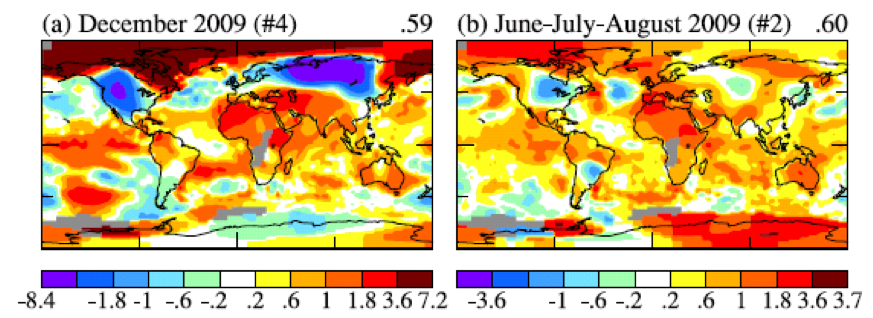
Contrarians were also confusing local and global. They were committing the logical fallacy of over-generalizing when they inferred from observations on the U.S. east coast the condition of weather globally. They don't seem to understand that it's possible to be unusually cold in some areas but unusually hot in the rest. For example, looking at a global map of temperature anomalies for the month of December 2009 (data from NASA), we can see that it was unusually cold in the U.S. and Siberia, but unusually warm in the rest of the world:

clip_image002

Finally, contrarians were confusing weather and climate. On the short term of weather (days, months) it is entirely possible to have unusually cold temperatures; warming just makes them slightly less probable. But over the long term of climate (years, centuries, millennia) the trend is towards increasing average global temperatures.

So when arguing that snowstorms on the U.S. east coast refute global warming, contrarians were confusing precipitation and temperature, local and global, weather and climate. Is it possible to get any more confused about global climate change?

For more information see http://www.npr.org/templates/story/story.php?storyId=123671588

For humorous takes see http://www.thedailyshow.com/watch/wed-february-10-2010/unusually-large-snowstorm
and
http://www.colbertnation.com/the-colbert-report-videos/264085/february-10-2010/we-re-off-to-see-the-blizzard

Thursday, May 14, 2009

Change Your Transportation

Transportation has a huge environmental impact, so society must focus on reducing that impact. Consider the environmental impact of a single automobile that travels an average of 100,000 miles in its lifetime. There is the damage that results from the manufacturing of the car and the mining and processing of the raw materials; from the drilling, transporting, and refining of the oil and gas that it uses; and from the emission of green house gases, NOx that contributes to acid rain, and ozone that causes photochemical smog. There are many other problems associated with automobiles. Driving a car is one of the riskiest activities we engage in, and cars make walking and bicycling much more dangerous on shared roads. Much of our country has been paved over by roads and parking lots, which has increased flooding risks but also uglified our landscape (I love Joni Mitchell’s song “They Paved Paradise and Put up a Parking Lot”). Driving in heavy traffic is very stressful, often leading to episodes of “road rage”. Yes, driving in the countryside without other cars can be very relaxing and enjoyable, but how often does that happen today, and is it worth all of the problems it creates? My prediction is that the most significant lifestyle change in the U.S. in the next two decades will be the abandoning of the car culture. That lifestyle won’t disappear completely, but it will become less prevalent as the price of fuel dramatically increases (due to peak oil and carbon taxes). The change may be traumatic, as 88% of workers in the U.S. travel to work by car, making the U.S. particularly vulnerable to peak oil [1]. People will choose smaller cars, cars that do not run on fossil fuels, or other modes of transportation including moped, bicycle, and mass transit. They will move closer to their jobs to decrease their transportation costs (I hope to buy a home within walking distance of my work before peak oil makes the cost unaffordable). They will take fewer long trips, and they will go to school closer to home. They will travel less for work, as companies try to cut costs. Telecommuting will become even more widespread, and in many cases, videoconferencing will make travel to meetings unnecessary. All of these changes will reduce traffic congestion and pollution, increase our national security by decreasing our dependence on foreign oil, reduce CO2 emissions contributing to global warming, and I would argue, increase our health (more walking) and quality of life (less time wasted in traffic, better scenery).

Change What You Drive

The technology of automobiles hasn’t changed dramatically over the last 100 years. Most still use a standard internal engine fueled by gasoline. Throughout my life, U.S. auto manufacturers have presented prototypes of cars that were supposed to change the way we drive, but none of them ever came to fruition. Production and leasing of the EV-1 in the 1990’s signaled a potential shift to electric cars, but GM aborted that foray into new technology by confiscating all of the cars and destroying them, as documented in the film “Who Killed the Electric Car?”. However, contrary to general wisdom and the claims of some environmentalists, electric cars currently are not better for the environment. That is because the electricity used to power them comes primarily from the burning of fossil fuels, especially coal. Also, they are inherently less efficient, because any time you convert energy from one form to another you lose some energy. Converting fossil fuels into electricity to fuel automobiles is much less efficient than using them to fuel the car with an internal combustion engine directly. The same argument holds true for the now heralded hydrogen cars, which use electricity to produce hydrogen gas H2, which in a fuel cell in the car reacts with oxygen gas O2 to produce H2O, releasing energy in the process. Although the hydrogen-fueled car emits only water, the process of producing the hydrogen requires lots of energy that usually comes from the burning of fossil fuels, which emits large amounts of CO2 and other pollutants. So how can we make cars less harmful to the environment? First we must convert our primary source of energy from fossil fuels to renewable forms like wind and solar. Then we should use the electricity that is produced to fuel plug-in gas-electric hybrid cars, or eventually to produce H2 gas for hydrogen-fueled cars.

Hybrid cars like the Toyota Prius have already raised the bar for energy efficiency. Hybrids have both a gasoline engine and electric motor. They produce electricity through regenerative braking, and automatically shut off the engine when idling. Another promising development is cars that run on biofuels such as ethanol and biodiesel. Flex cars can use ethanol or gasoline, but this is not a new technology, as it dates back to the original flex-fuel vehicle, the Model T, built in the 1910s. Many have concluded that production of ethanol from corn is not energy efficient, with some estimates showing that it requires more fossil fuel energy to produce the ethanol than is obtained from burning it. In addition, use of corn for ethanol production has increased the price of corn worldwide, which is a serious problem for the poor who depend on it for food. An increase in the price of corn causes increases in the price of all products for which corn is used as a feedstock. This problem of using food for fuel can be avoided by producing ethanol using switchgrass and wheat straw, which are also more energy efficient than corn.

So what can you do now? First, make every effort to decrease the number of miles you travel. Combine your errands. Never idle you car. Make sure your car is in tune and properly inflate the tires to maximize gas mileage. Carpool whenever possible. Make purchases online rather than driving to the store. Accelerate and decelerate slowly, and try to maintain a constant top speed. Ask your boss if you can telecommute one day per week. Vacation locally, or consider purchasing carbon offsets for the miles that you travel for vacation [2].

When the time comes to change your ride, buy a fuel-efficient hybrid as soon as you can, or even better, switch to mass transit. Encourage your employer to pay for your mass transit costs (like my employer, Vanderbilt University, they may be willing to do so because it means they will save money by building fewer parking garages). Imagine how much money you would save if you didn’t have monthly car and car insurance payments.

In the future, I envision a decentralized system of energy production for fuel-efficient homes and cars. Picture a windmill in your yard, and solar panels on your roof. The wind and the sun that power these energy sources are free and limitless. The electricity that they produce could be used to power your home and your plug-in electric car, or to produce hydrogen for the fuel cell in your car, all with zero CO2 emissions or pollution.

1. Brown, L., Plan B 3.0: Mobilizing to Save Civilization. 2008, New York, NY: W.W. Norton & Co., Inc.

2. Jeffery, Y., L. Barclay, and M. Grosvenor, Green Living for Dummies. 2008: For Dummies.

Wednesday, May 13, 2009

Book Abstract

The environmental impacts of increasing human population, consumption, and technology are now widely recognized and global in scale. Humanity is now bumping up against the limits defined by earth’s carrying capacity. Rising costs of many natural resources reflect the combined effects of shrinking supplies and increasing demand. Global production of oil has peaked and is now declining, portending long-term cost increases for fuel and food. Global production of other resources such as marine fish are also declining. Global warming threatens supplies of food and water and may make many locations uninhabitable. Overconsumption and pollution have led to water shortages in many countries. The global reserve of grain has shrank for the last eight years, and during that time the price of grains has increased 2-4x (*check). The global ecological footprint is now 1.3 Earths, meaning that the growing human population and economy have overshot the capacity of earth to regenerate resources and absorb waste by 25%. Humanity was last sustainable in the 1980's, and most global human welfare indicators have declined since the 1980's. The only solution to these multiple threats is for humanity to adopt sustainable living practices that help to preserve People, Prosperity, and the Planet and guarantee that future generations can live as well as we do today. First, we must switch energy production from fossil fuels to renewable energy sources such as wind and solar. This soft approach of decentralized use of renewable resources that do not emit CO2 is preferred over the hard approach of centralized energy production using non-renewable resources because it is sustainable and increases our energy security, and it would make the use of electric and hydrogen-fueled cars truly CO2-free. A drastic reduction in the number of coal-fired power plants can reduce the problems of CO2 emissions, acid rain, and unsafe fly ash and coal slurry ponds. Power plants that continue to burn fossil fuels could capture and sequester CO2 in the ground. Water conservation and decentralized purification or privitization can help ensure adequate, safe drinking water supplies.

In the last 100 years, cheap oil has fueled rapid global and particularly U.S. economic growth and helped us to produce the food needed by an exploding human population. As oil production drops, oil prices will rise, and so will the cost of food and nearly every product on the market. Of greatest concern is the potential increasing cost and scarcity of food. Current agricultural practice requires 10 calories of oil energy for production of one calorie of food energy. Global warming, decreasing biodiversity, and water scarcity will compound the problems of energy and food shortages. In this declining world, people will need to adapt to living with fewer resources and less wealth.

The changes that are required to make our society sustainable may be too great to achieve through action of a centralized government, particularly because the U.S. government relies on continuous economic growth and is beholden to corporate interests. On the other hand, decisions made collectively by individuals can greatly reduce the ecological footprint of societies. High prices will force people to make sustainable lifestyle choices, including purchasing fuel-efficient vehicles and decreasing miles traveled by moving to high-density housing close to the workplace. This will lead to a reversal of the decades-long migration from cities to the suburbs, eventually resulting in the rebirth of cities and decay of the suburbs. Anticipating these changes can help individuals make smart investment decisions.

The goal of this book is to convince you that change is coming. You can try to ignore or deny change, but you will be better off if you anticipate change and adapt to it. Because the change will involve resource shortages, you can best adapt by limiting your resource use. Stop living large! Reduce your consumption, and reuse and recycle everything. By reducing your ecological footprint and living sustainably, you can be happy while living on less, and because you will incur less damage on your environment, it will be able to provide you with more. On the other hand, if you continue to take more from the environment, it will have less to give you in the future. You can be happier if you simplify your life and live sustainably. Once you have reformed your own lifestyle, you can help to reduce the ecological footprint of others. Protest the opening of any new coal-fired power plants. Convince your community to switch to compact fluorescent lights or even ban incandescent lights. Try to move your workplace toward sustainability by starting recycling programs and discouraging the use or sale of disposable products such as bottled water. The more positive changes you make, the better chance our society has for survival, and the better life will be for us and our children.

Tuesday, April 21, 2009

The Evils of Coal

*I am rushing to post a few blogs for my Sustainability students to read before their final exam, so this entry is only partially complete.

*Note: An excellent recent article in the New York Times makes many of the points that I hope to make in this book. See:

"New Limits to Growth Revive Malthusian Fears" <http://online.wsj.com/article/SB120613138379155707.html>

From the global warming perspective, you might think that decreasing oil supply would be good because it would lead to decreasing CO2 emissions. Unfortunately, we are likely to turn to other fossil fuels that emit more CO2 per unit energy (*give table with CO2 per unit energy). And the dirtiest fuel we have available is coal.

Coal companies are now under pressure, and in classic corporate fashion are responding with an ad campaign that makes a joke of the truth. The ad I saw on TV last night emphasized in audio and text that coal is a clean fuel. Actually, it’s the dirtiest fuel I can think of. If you have ever held a piece of coal, perhaps on Christmas in a year you were “naughty”, you know that it is dirty. You touch it and your hands turn black. If you burn it you will see lots of dirty smoke, and when you’re done burning it you will have a pile of ashes. It’s very similar to charcoal; both form by partial oxidation (burning) of organic matter, usually cellulose-rich plant material such as wood, and both are dirty. Coal was the preferred fuel of the 19th century in England, when everything was covered with a layer of black soot. It was not coincidence that cancer was discovered in England at that time. A doctor noticed that chimney sweeps often had testicular cancer. This was because the sweeps were usually orphans pressed into hard labor, who were forced to take off all of their clothes so they could fit inside a chimney. They would climb the chimneys to clean them, and their bodies were always covered in black soot.

One of the first laws against air pollution came in 1300 when King Edward I decreed the death penalty for burning of coal.  At least one execution for that offense is recorded.  But economics triumphed over health considerations, and air pollution became an appalling problem in England.  ~Glenn T. Seaborg, Atomic Energy Commission chairman, speech, Argonne National Laboratory, 1969

But the most dangerous effect of burning coal is not the visible carcinogenic pollutants that are released when it is burned, nor the fly ash that remains after burning; it is the huge amount of CO2 that is released to the atmosphere. Coal is fossilized plant matter, so the reverse of Eq. 1 shows what happens when we burn it. Coal releases more CO2 per unit energy than any other form of fuel (see Table ?). So not only does use of coal lead to mountaintop removal, failure of coal slurry retention ponds (Martin County, KY 2000), pollution, and failure of fly ash retention ponds (e.g., Kingston, TN 2008), it also leads to maximum possible CO2 emissions and global warming. I’m sorry, what were the selling points for coal? Oh, that we have a lot of it? Well, we have a lot of sewage too, but that doesn’t mean we would want to use it for anything.

Let me give you some examples of how coal companies operate. Massey Coal is an example of the worst of American corporations. The movie “Sludge” shows how a subsidiary of Massey, Martin County Coal, released 306 million gallons of coal slurry into the Coldwater Fork of Wolf Creek in eastern KY in 2000, which contaminated local drinking water. A Martin County Coal representative told residents that the slurry posed no health threats because everything in the slurry could be found in the periodic table. Whoa, that was reassuring. Once the Bush administration took office, the investigation into the cause was shut down, the one dissenter was fired, and Massey was ordered to pay a fine of only $110,000, which amazingly was later lowered to only $1000 (*check). Yes, that’s what we pay those government regulators for. In 2008 Massey had accrued fines of roughly $2.4 billion for violations of the Clean Water Act; in 2008 they agreed to pay $20 million to the U.S. EPA. Also in 2008 Massey paid $4.2 million in civil and criminal penalties resulting from a mine fire in West Virginia in 2006, the largest financial settlement in the history of the coal industry (http://en.wikipedia.org/wiki/Massey_Coal). Recently I heard on the radio that Massey is involved in a lawsuit that has reached the U.S. Supreme Court. It seems a competitor, Harman Mining, refused to sell a coal mine to Massey, so Massey bought all of the property surrounding that mine and prevented access to the property. The competitor sued in court and won $50 million, but Massey appealed it to the State Supreme Court. Massey’s chief executive Don Blankenship arranged donations of $3 million to get Brent Benjamin elected to the West Virginia Supreme Court of Appeals (the $3 million was spent on a character assassination campaign against Benjamin’s opponent). When Massey’s appeal made it to the Court of Appeals Benjamin refused to recuse himself from the case, and ended up casting the deciding vote in favor of Massey. Gee, do you think he was biased? Do you think Massey bought the court’s decision? Why do we allow the public election of judges in this country, anyway? The U.S. Supreme Court head the case in March 2009, and we are currently waiting to see if they reinstate the judgement against Massey.

Here is some dirt on Massey CEO Don Blankenship from Wikipedia (http://en.wikipedia.org/wiki/Massey_Coal): “On November 22, 2008 the Williamson (Daily News (Williamson, WV) reported that Massey CEO Don Blankenship compared the editor of the Charleston Gazette, James A. Haught, to Osama bin Laden at a public speech to the Tug Valley Mining Institute on Nov 20 [59]. In the videotaped speech, Blankenship called House Speaker Nancy Pelosi, Senator Harry Reid and former Vice President Al Gore "crazies" and "greeniacs" [60]. He referred to the support of President Jimmy Carter for energy conservation in the 1970s to communism: "Buy a smaller car? Conserve? I have spent quite a bit of time in Russia and China, and that's the first stage."

On April 3, 2008, ABC News reported that CEO Blankenship attacked an ABC News cameraman at a Massey facility near Belfry, Kentucky as the camerman attempted to question Blankenship about photos published in the New York Times [61] showing Blankenship on vacation in Monaco with West Virginia Supreme Court Justice Elliott "Spike" Maynard. "If you're going to start taking pictures of me, you're liable to get shot," Blankenship stated in the video[62]. Following the incident, Justice Maynard lost his bid for re-election to the West Virginia Supreme Court in the West Virginia primary election [63].

Clean coal is an oxymoron, similar to “healthy cigarettes”. Coal is the dirtiest form of energy we have. When Obama refers to clean coal, he means that all of the CO2 is captured and sequestered.

See Clean Coal Air Freshener parody: http://www.youtube.com/watch?v=W-_U1Z0vezw

Clean Coal: http://www.youtube.com/watch?v=PLZ-hvVVGmY&NR=1

Sunday, April 12, 2009

Book Outline

Introduction

What is sustainability?

Why should I try to live sustainably?

Unsustainable Societies

The Collapse of Ancient Civilizations
Ghost Towns

What is the Evidence that our Current Lifestyle is Unsustainable?

How Should I Start Living Sustainably?·

What are the near-term challenges to sustainability?

Population Growth

Globalization

Energy

Energy Resources: Introduction

Energy Supply and Demand

Sustainable Energy Policy

Peak Oil
Global Warming

The Evils of Coal

Water

Food

Air

What are the Solutions?

Stabilize Population (brief)

Switch to Renewable Energy

Wind
Solar
Biofuels
Why Not Nuclear?

Change the energy infrastructure

Hydrogen for energy transportation

Change the Economics

Economics and Capitalism

Personal Financial Considerations

The Role of Corporations

Change the Way You Live: Living for the Future

Reduce Your Consumption
Reduce Your Waste
Change Your Home
Move to High-Density Housing Close to Your Workplace
Design Your Home Wisely
Sustainable Architecture
Make your home efficient
Energy Conservation
Water Conservation
Change Your Transportation
Change What You Drive
Change How You Drive
Use Mass Transit
Change What You Eat and Drink
Change How You Use Your Land
Sustainable Landscaping
Organic Gardening
Be Good to the Environment
Steps I have taken to reduce my impact on the environment

The Role of Education

Where is the U.S. Headed?

What if the Worst Happens?

Survivalism

What is Most Likely to Happen
References

Saturday, April 4, 2009

Global Warming Conclusion (Incomplete)

*Note: make sure you click on the hyperlinks to see the figures. For the sake of expediency I am temporarily using figures from authors (primarily Mann and Kump, 2009), but will soon replace the most important figures with my own versions.

*Note: Some sections of this blog are simply notes, placeholders for sections that I still must write. Some of the notes follow those of one of my colleagues, Jonathan Gilligan, who is an expert on global warming. But I am anxious to start posts on other subjects, so this will be the final blog on global warming, even though I haven't completed the first draft on that topic.

How Will Global Warming Affect us in the Future?, or What changes are likely to occur in the near future, and what will be the consequences?

How Sensitive is the Climate to Changes in CO2 concentration?

"Climate scientists compare model predictions with estimated changes in average temperatures in the northern Hemisphere derived from proxy data. The proxy temperature estimates match the model simulations well when the assumed equilibrium climate sensitivity is 2-3°C, meaning that a doubling of atmospheric CO2 concentrations will lead to a roughly 2-3°C warming of the globe (this is the famous hockey-stick figure produced by Mann):

Northern Hemisphere Temperature Changes over the Past Seven Centuries

The most likely changes in the near future are represented by the IPCC (2007) "middle of the road" A1B emissions scenario (pg. 86). CO2 emissions will peak in the year 2050 (pg. 104a), and atmospheric CO2 conc. Will level off at ~550 ppm (pg. 104b). The corresponding increase in temperature between 2000 and 2100 is 3 deg. C (pg. 88), causing sea level to rise ~0.8 m = 31.5 /12=2.625 ft. (pg. 99). This will cause the global loss of 2223 km2 of land, $944 billion and 145 million lives (pg. 111).

Known Consequences: Sea Level Rise

Projected sea level rise

  • Sea level rise: 4” in 20th century, 8-28” in 21st; Large areas will become flooded, including much of south Florida and many inhabited Pacific islands (entire countries). Flooded coastline
  • Increases in coastal erosion: Up to 260 ft on open beaches
  • Landward shift of existing estuaries
  • Disastrous impact on existing developments along coastal zones

Potential Impacts of Global Warming

  • Doubling greenhouse gas concentrations ↑ avg. global temp 1.5–9°C (IPCC 2007).
  • Global warming leads to significant changes in rainfall, soil moisture
  • Agricultural activities and world food supplies affected greatly by climatic factors
  • Global warming affects the frequency, intensity, and distribution of natural hazards such as hurricanes and other storms
  • Higher incidence of weather extremes (high T, floods and drought); causes ↑ in weather-related deaths)
  • Migration of plants and animals to higher latitudes
  • Economic losses from seal level rise and storms; could bankrupt insurance companies
  • ↑ in infectious diseases and respiratory illnesses
  • Countries that contribute the most to climate change will suffer the least.

Reducing the Impact of GW

  • Identify the historic changes that have occurred
  • Predict the potential changes in the future
  • Political commitment: Reconcile the conflicts between the
    • environmental need for reduction of greenhouse gases
    • economic demands for more fossil fuel
  • Mitigate: reduce the emission of CO2 until it stabilizes at 550 ppm (scenario A1B)
    • Use fossil fuels releasing less CO2
    • Use alternative renewable energy
    • Conserve energy
    • Store CO2 in forests, soils and rocks (sequestration of CO2)
  • Economists say that cost of emissions reductions will be less than the economic damage in the absence of mitigation
  • SCC = Social Cost of Carbon: cost to society of emission of one metric ton of carbon (equiv. to 10,000 miles of driving). Integrated assessment models estimate that SCC = $30; this cost would be made up by a 9 cent per gallon tax on gas.
  • Is it fair for rich developed nations to decide whether action is worth taking, when it is the poor developing countries that will suffer the most?

Summary

The approach many people take to climate change is similar to the approach they take when driving in a lane that is about to close. Prudent people change lanes when they see the warning sign; the probability that they will be able to change lanes without slowing down is high because they have a lot of time and therefore opportunities to change lanes. However, some people won't change lanes until they are forced to when their lane ends. Because they didn't make good use of the warning sign, they have only one chance to change lanes. The probability of their being able to change lanes without slowing down or stopping is low, and they may find it very difficult to change lanes and get back up to speed. They may even get in an accident. They miss most of the opportunities to make change easy. Likewise, if we keep driving down the same path and don't heed the warning signs about global warming, and change our lifestyles only when we are forced to, we will miss most of the opportunities to make change easy, and we may be forced to drastically slow down (greatly decrease our consumption rates and quality of life) in order to make the change.

People who say that we don't have to worry about making changes to the earth, or that the changes we make may even prove beneficial, should think of this analogy: the earth is a complex system that we don't understand. Making changes to it without knowing the consequences is like an untrained mechanic bashing the working engine of a flawless Ferrari with a wrench in hopes of improving it's performance. The Ferrari is a complex system of working parts, and almost certainly any change that is made to a Ferrari in perfect working condition will have deleterious effects. In fact, breaking one part of the engine can lead to other parts breaking down if it is kept operating (and we can't stop the earth system from operating in order to repair it). An induced oil leak in the Ferrari would cause a breakdown of the lubrication system, and the resulting friction would lead to overheating and deformation of the mechanical parts, leading to an irreversible failure of the engine system. Our tweaking of the much more complex earth system, with its many working connected parts, could lead to the failure of individual parts, or in the case of a domino effect failure of complete subsystems (atmospheric or oceanic circulation patterns, ecosystems, etc.). The precautionary principle states that we would be unwise to make global-scale changes without having any idea of what the consequences will be. As Donald Rumsfeld said, there are the known knowns, the known unknowns, and the unknown unknowns. In the case of global climate, we know there are known unknowns, and there are almost certainly some unknown unknowns.

Humans have adapted to the earth's surface environment over several million years; Homo sapiens have existed since the beginning of the Holocene epoch 10,000 years ago. During that time the earth's climate has been relatively stable (*check). However, the rates of change of atmospheric CO2 concentration and global temperature are greater than at any time in earth's history, and if continued will outpace the ability of plants and animals to adapt by migration and certainly by evolution (which occurs at a much slower pace). Humans may be able to adapt through use of technology, but much of human society cannot afford the costs of these technologies, so the death rate in poor undeveloped countries will skyrocket. This is one of the great injustices of global warming: those most responsible for global warming (e.g., U.S. citizens) are likely to suffer the least from it. We are wealthy, so we can afford to buy and operate another air conditioner, to import bottled water and food, etc.. Another injustice is intergenerational: we may be making many areas of the earth uninhabitable for our offspring. Almost certainly, life will be more difficult for the next generation, who will be burdened not only with the consequences of global warming, but also an enormous financial debt (witness the exploding budget deficit of the federal government) and shortages in key resources such as oil. The current generation must look for ways to soften the blow that will be delivered to our offspring as a result of our actions and decisions. Most parents make sacrifices for their children’s welfare; the truly responsible parents also make sacrifices for their children’s future (e.g., saving money for them to go to college). We must now make other kinds of sacrifices, ones that will make our lifestyles more sustainable and therefore easier for our children to maintain. We will discuss this in great detail in the coming chapters.

Wednesday, April 1, 2009

Global Warming: Part II

Development of a Scientific Consensus

*Note that my references are incomplete; I am struggling to get my Bibliography software to work on my computer.  Here I have written what I felt, but I may later have to edit out some of the harsh criticisms in order to avoid the appearance of bias. - John

Although I study the earth, scientific research today is very compartmentalized, so that scientists are often not aware of developments even in closely-related subdisciplines. In some respects, this compartmentalization was necessary to allow some scientists to focus their energies on developing knowledge in narrow domains. This has led the public to perceive many areas of research as irrelevant: “why would anyone spend their life learning the reproductive cycle of fruit flies?” However, these seemingly small problems are all inter-related, and understanding in one narrow area often promotes advances in other areas. The truly large problems like global warming consist of countless overlapping problems. To develop a comprehensive understanding of a global problem requires that scientists from many subdisciplines must collaborate. The trend in scientific research in recent years has been to promote interdisciplinary research, because it is the areas of overlap between subdisciplines where progress is often made. This is because, when forced to communicate, scientists in closely-related fields are confronted with unfamiliar ideas, and they must reconcile their understanding with that of their colleagues, who often have a different perspective on the bigger problem.

Because of the compartmentalization of science and the fact that I was not involved in climate research, I was not aware of the early research on global warming. It wasn’t until the mid- to late-1990’s when I was teaching an introductory Environmental Geology class that I started tracking the issue, first in newspaper reports and then in the scientific literature. My recollection is that the issue had not yet become thoroughly politicized, and I personally pride myself on my objectivity, so I believe that I was able to interpret the scientific data in an unbiased manner. I concluded in the late 1990’s that global warming was occurring; then in the early 2000’s I first became confident that humans were contributing, and then that they were the primary cause of warming.

The development of the climate science communities’ understanding of the global warming issue tracked my own. In 2001 the IPCC concluded that warming was occurring at that time, that “There is a discernible human influence on global climate”, and that the mean surface temperature will ↑ 1.5° to 6.0° during the 21st century. President Bush was skeptical & asked the U.S. National Academy of Sciences (the most prestigious scientific organization in the U.S.) for an independent report, which was published in 2001 and fully supported the conclusions of the IPCC report[1]. In 2003 (?) the American Geophysical Union published its position paper which stated that “In view of the complexity of the Earth climate system, uncertainty in its description and in the prediction of changes will never be completely eliminated…AGU believes that the present level of scientific uncertainty does not justify inaction in the mitigation of human-induced climate change and/or the adaptation to it.” In 2004 the American Association for the Advancement of Science concluded that “even if measures to reduce global warming are put into place today, some increase will still occur and ways will be needed to adapt to it; that adapting will be challenging, costly and imperfect; that ecosystems around the world are already being affected by global warming; and that acting in advance of problems is necessary to reduce damage.” Finally, in 2007 the IPCC released its 4th report, for which the committee received the 2007 Nobel Prize. It stated that “"Warming of the climate system is unequivocal...Most of the observed increase in global average temperatures since the mid-20th century is very likely due to the observed increase in anthropogenic greenhouse gas concentrations", where “very likely” means a greater than 90% probability. Yet for all of the reports, and the huge amount of research that informed the report writers, and the enormous amounts of money spent on that research, the U.S. government chose to ignore and even distort the findings of the reports. My question is, why pay scientists to do the research and then ignore their advice?

I will refer to those who continue to deny the reality of global warming as climate contrarians. Hansen (2006) points out that “contrarian” is a better description than “skeptic” because healthy skepticism is necessary for good science. In contrast, contrarians ignore all evidence except that which supports their beliefs, and that evidence usually turns out to be anecdotal. MIT climatologist Richard Lindzen has accused global warming supporters of advocating a “religion”, but it is contrarians who ignore all of the evidence and rely on faith. My guess is that many of the contrarians are also creationists, because both show contempt for science and are adept at ignoring evidence.

In his book “State of Fear” author Michael Crichton claimed that anthropogenic global warming is a hoax perpetrated by scientists to increase their funding. It is accepted that scientists sometimes overstate the significance of their results to gain publicity and funding; however, it’s extremely cynical to think that nearly all scientists studying climate change are fabricating their data. Crichton’s mentor Richard Lindzen, one of the last respectable scientists who remains a climate contrarian, made the same claim in a 2006 editorial (*reference), but in fact the climate change advocates he referred to wanted the government to increase funding for research into alternative energy sources, not for their field of climate science. In fact, Lindzen and other contrarians have been back-pedaling for years, first claiming that warming was not occurring, then that it was occurring but that humans were not the cause, then that humans are the cause but that it is not an important issue (Begley 2007, Newsweek). Another prominent contrarian is Fred Singer, Professor of Environmental Science at the University of Virginia until 1994. Singer may have been at the cutting edge of climate science research decades ago, but now he is not even a scientist; rather, as President of an organization he founded called Science and Environmental Policy Project, he is a lobbyist who oil companies pay to spread uncertainty about climate change. In an ironic twist, he was involved in an effort to discredit the claim that second-hand smoke causes cancer (http://en.wikipedia.org/wiki/Fred_Singer). In March 2009 there was a meeting of the Climate Change skeptics in Chicago, and I read in the paper how a beleaguered Singer was trying to set his contrarian colleagues straight on some of the science, reminding them that yes, CO2 is a greenhouse gas; that is a fact and we can’t legitimately claim otherwise. I hope Singer is enjoying the company of the dwindling number of contrarian wackos.

Why do a handful of prominent scientists like Lindzen resist accepting the consensus of the scientific community? I can think of three possible explanations: they simply delight in being contrarians; their scientific judgment is biased because they are unable to separate the political and scientific dimensions of the issue; or they are being paid by oil companies or other vested interests to publicly voice their opposition to the consensus. I like to think that Lindzen is not guilty of the latter, but decades ago there were many scientists who accepted payments from tobacco companies to make fraudulent claims. From the oil company perspective, it is a very effective strategy to pay relatively small amounts of money to a few respected and vocal dissidents in order to lead the public to believe that scientists are undecided on the issue, when in reality a consensus has existed for years. I’ve read that as a survivor of the Holocaust Lindzen tends to favor the underdog, and the same may be true of Singer, who had to flee Austria during the Nazi occupation (Begley, 2007).

Hansen (2006) gives one of many examples of the dishonesty of global warming contrarians when he describes a paper by Patrick Michaels, who deliberately deceived his readers into believing that Hansen’s (1988) global warming scenarios were inaccurate. To support this false claim, Michaels (*ref.) compared global mean temperatures measured between 1988 and 1997 with the only one of Hansen’s three “predictions” made in 1988 that did not agree with the data, which was a scenario for extreme warming. Hansen’s middle-of-the-road best estimate agreed with the data almost perfectly, but readers of Michael’s paper were led to believe that global climate models were completely inaccurate. Because many global warming contrarians now seem to be knowingly promoting false information, it might be tempting to scientists and global warming activists to stretch the truth or make false claims to promote their cause. The other side has an unfair advantage because they allow themselves to lie. Do not give in to this temptation. First, scientists must not tarnish the reputation of science and their host institutions by lying. Integrity is the most critical trait of a good scientist, and scientists who knowingly promote falsehoods should no longer be allowed to wear that noble title. Furthermore, it is not necessary to resort to falsehoods when the truth is on your side. I am an optimist who believes in the old adage “the truth shall prevail”; however, I often get frustrated because it takes so long to prevail.

Why did it take so long for a scientific consensus to develop? Because Earth's climate is a very complex system with many feedback loops; makes it very difficult to confidently predict future climate. Furthermore, science can’t prove anything; it can only increase our level of confidence that humans are causing global warming.

Response of the Public and Politicians to Global Warming

Denial and the politicization of global warming unfortunately has slowed our societies response to a potentially terrible threat. It is unclear to me why conservatives became the global warming skeptics as opposed to liberals. Global warming should not be a political issue, but rather a scientific and moral issue. As evidence mounts that global warming is human-induced, conservatives dig in their heels and deepen their denial. Rather than face the facts and make some hard decisions, they would rather bury their heads in the sand and label an entire field of human endeavor as fraudulent. Conservatives have adopted a conspiracy theory that requires that nearly every scientist in the world, each of who has devoted their lives to the search for truth, is knowingly contributing to a lie. They claim that all of the data has been fabricated. How cynical can you get?

I asked my Sustainability class if they could explain why, until recently (2009), most Republican members of Congress tended to be contrarians. They hypothesized that the Republican party generally promoted legislation favorable to large business such as oil companies, and many were given political contributions by those companies. Due to the efforts of oil companies to spread doubt, most Republican congresspeople honestly believed there was no consensus on global warming, but others likely knew that warming was happening and either dismissed it as unimportant or allowed their votes to be swayed by oil money. But why did party members who are not politicians and therefore did not get “paid off” by oil companies so fervently believe that global warming was a hoax? How could so many subscribe to a belief that defied all of the evidence? It’s hard not to draw an analogy to religion. However, with religion, it’s easier to understand “faith”, because those beliefs are indoctrinated in people at an early age, and there is a very large, well-funded system to support their beliefs. Where does the faith of global warming contrarians come from? It comes from a very large, well-funded system of oil companies and politicians. But those oil companies and politicians did not speak directly to the voters and inculcate those beliefs. They had intermediaries who spoke to the masses, similar to the role that priests play in organized religion. In conservative politics the intermediaries who speak to the masses are in the media (note that media forms part of the word intermediary), and they have a powerful influence on listeners beliefs. It is well known that conservative talk show host Rush Limbaugh talks not to the facts, but to the beliefs of his listeners (see Al Franken’s books “Lies and the Lying Liars who Tell Them” and “Rush Limbaugh is a Big, Fat Idiot”). My brother Mike once told me that people don’t tune in to Limbaugh’s show to get information, but rather to hear excuses, e.g., “I don’t have to make sacrifices to reduce my carbon footprint because Rush Limbaugh says that global warming is a hoax.” What’s scary is the fervency of their beliefs and the anger they express when they talk about government funding of “junk science” (it’s so easy to dismiss any evidence you don’t agree with as “junk science”). They act like religious fundamentalists, but we aren’t talking about religion, are we?

Rush Limbaugh claims to be a patriot who only wants what’s right for this country. But when Barack Obama took office in 2009, Limbaugh said repeatedly that he hoped Obama’s economic policies would fail. Yes, he wanted America’s economy to go down the toilet just to prove that he was right and Obama was wrong. It is more important to Limbaugh that he be right than for America to succeed. Do you think Limbaugh will ever admit that he was wrong on global warming?

Rush Limbaugh and his audience should know by now that they have been bamboozled by big oil. The subtlety and effectiveness of the oil companies campaign against global warming science is frightening. The general belief in the U.S. is that you can accomplish anything if you have enough money, and the oil companies have proved it. The evidence suggests to me that lobbying by oil companies delayed political action on global warming by at least ten years, allowing them to earn record profits. They also eliminated competition (see the movie “Who Killed the Electric Car”). Governments around the world could learn a lot from the disinformation campaigns of big oil companies like Exxon-Mobil. Unfortunately, the world will not be a better place if they do. If you think that oil companies do not have such power, consider that Exxon Mobil is larger than the economies of 180 nations (Speth, p. 62). It has great power, and uses it to fight government regulation and oversight. Auto manufacturers were the same until recently, when they plunged into near bankruptcy and were essentially taken over by the U.S. government in 2009.

Another example of corporate shortsightedness and dishonesty is given by American auto manufacturers, in particular GM. These companies’ efforts to swindle consumers, mislead politicians, and silence consumer advocates like Ralph Nader are legendary (see the movie “Ralph Nader: An Unreasonable Man”). Over the years, there have been many good reasons to downsize cars, the generally unknown problem of peak oil being only one of them. Government and States (particularly California) have tried to regulate the industry and encourage or force them to build smaller, more efficient cars. Auto manufacturers fought them every step of the way. Companies like GM would regularly develop prototypes of such cars, only to shelve them. In one case they actually built and leased a remarkable electric car called the EV-1, but after successfully pressuring California into dropping their stricter emissions standards, the EV-1 program was shut down. Then, in an unbelievable display of corporate arrogance, GM forced the leasers to give up their beloved, nearly brand-new cars so that GM could make the cars disappear (in junkyards) and the public forget about electric cars (see the move “Who Killed the Electric Car?”). Once the price of gas went up to $4 per gallon in 2008, GM could not sell their gigantic Humvee’s and SUV’s, and taxpayers are now handing GM billions of dollars to stay afloat. Why are we all paying for the monstrous mistakes that GM executives made? Nearly everyone knew that this would eventually happen, but GM was always focused on short-term profits to maintain high executive bonuses and keep investors happy. Clearly, executives of auto manufacturers like GM never gave a thought to the long-term viability of their companies. Now that the U.S. government is spending billions of dollars to keep GM afloat, President Obama is insisting that they develop of sustainable business plan. Shouldn’t investors and the corporate boards have been demanding that all along? How could all of these people be so irresponsible?

It’s time to end the denial and take action. An April 2006 poll showed that 70% of Americans are willing to make sacrifices to stop global warming. Our country needs to invest in insurance against global warming. We spend trillions of dollars per year for national defense as an insurance policy against external aggression, but we spend zero dollars to insure ourselves against the threats posed by global warming (Pollack, 2005). In this case, the old adage “An ounce of prevention is worth a pound of cure” is appropriate: it is usually a lot cheaper to prevent a problem than to deal later with its consequences.


[1] Note that in his second term Bush admitted that the earth was warming and that we were probably contributing, but he chose to do nothing about it.

Tuesday, March 31, 2009

Global Warming: Introduction

The intertwined problems of population growth, water shortages, and food shortages have been recognized for over one hundred years, and no one disputes that they are important global problems. However, until very recently much of the public was unaware of the related problems of peak oil and global warming. As a result, I will spend more time focusing on these less familiar problems.

At the time of this writing (2009), there is growing public acceptance of the reality of human-induced global warming. I would argue that the scientific community reached consensus in the late 1990’s on the reality of global warming, and in the early 2000’s on the idea that warming is primarily human-induced. As expected for an issue this complex, it is taking longer for the public to reach a consensus. This is not surprising, as the culprit is fossil fuel use, and there are extremely powerful and wealthy business concerns that have campaigned against this consensus to protect their profits. This situation closely parallels that of the tobacco companies in the 1970’s, who paid lobbyists and scientists large sums of money to spread falsehoods about the link between smoking and cancer (see the book “Thank You For Smoking” for an insightful and amusing illustration of how corporations conspire to hide the truth). Unfortunately, this has led to a politicization of the global warming issue. Although Al Gore did an admirable job of raising public awareness on this issue (for which he won the Nobel Prize in 2006?), his political associations led many to close their minds to the possibility that he was right. However, Al Gore did not invent the theory of global warming, nor did he participate in any of the scientific investigations; he was merely publicizing an issue that was hidden from view. Most scientists are not very good at public outreach, and they need well-known figures like Al Gore to carry their message to the masses. This effort has been only partly successful, so now it is up to scientists like me to help the public understand the reality and the importance of issues like global warming and peak oil.

The concept of global warming is really quite simple. Energy in the form of sunlight passes through earth’s atmosphere and heats the surface; the surface warms and gives off heat. Without greenhouse gases like CO2 in the earth’s atmosphere, that heat would radiate into space and be lost, and the average surface temperature of the earth would be only 0°F, meaning that all water on the earth’s surface would be frozen, and life would not be possible. Fortunately, the greenhouse gases in our atmosphere absorb and trap the heat, increasing the average observed surface temperature of the earth to a very hospitable 59°F. We are fortunate to have greenhouse gases in our atmosphere. However, like Goldilocks we need it not too cold and not too hot, but just right. If the concentration of greenhouse gases gets too high, it will be too hot for us.

Recognition of the greenhouse effect goes back to Joseph Fourier in the early 19th century, and the role of carbon dioxide (CO2) was identified in 1859 by John Tyndall. It was Svante Arrhenius in 1896 who predicted that human activities could contribute to the greenhouse effect, but it wasn’t until the 1970’s that scientists like Roger Revelle and Wallace Broecker began to raise the alarm. Their concern was based on measurements by Charles Keeling, who showed that CO2 concentration in the atmosphere was increasing at an alarming rate:

Fig. 1: http://en.wikipedia.org/wiki/File:Mauna_Loa_Carbon_Dioxide-en.svg

Although there are seasonal fluctuations related to plant growing seasons (see inset of Fig. 1), the long-term trend shown in red is of steadily increasing CO2 concentration. The measurements in Fig. 1 were made at the famous Mauna Loa observatory in Hawaii, but similar measurements have been made at many other observatories and show the same trend. So how is this related to human activity? In the Peak Oil section, we described how oil contains the energy of sunlight that fell on earth millions of years ago, trapped in organic molecules that were manufactured in plants through photosynthesis. The simplified chemical reaction is:

Eq. 1: 6 CO2 + 6 H2O + energy from sunlight = C6H12O6 + 6 O2

The glucose molecule C6H12O6 represents the organic matter that stores the energy in fossil fuels. When we combust fossil fuels, we undo the work of photosynthesis, promoting the reverse reaction by heating the organic matter in the presence of atmospheric oxygen so they react and liberate the stored energy. The troubling product of this combustion is CO2, which accumulates in earth’s atmosphere, leading to the steadily increasing atmospheric CO2 concentrations exemplified by Keeling’s curve (Fig. 1).

Another example of this delicate balance maintained by earth’s atmosphere is the oxygen concentration of the atmosphere. From Eq. 1 above we can see that combustion consumes O2 while producing CO2. Thus, we would predict that if combustion of fossil fuels are now the primary source of atmospheric CO2, then with time increasing CO2 should be balanced be decreasing O2 concentration in the atmosphere:

*Insert link to figure

The current atmospheric O2 concentration of 21% is just right for trees: If O2 rose to 25%, forests would burn after every lightning strike, but if it fell to 13%, we wouldn’t be able to start a fire. In fact, it is life that regulates the composition of the atmosphere, as illustrated vividly by James Lovelock’s conception of Gaia, which posits that earth behaves like an organism because it’s components act in concert to maintain life-support systems at optimal levels. Just as our body maintains a constant temperature of 98.6°F, the earth can maintain global temperatures within a narrow range that is conducive to life. How? Eq. (1) gives us some insight. Because temperature and atmospheric CO2 concentration are positively correlated, when CO2 is increased, then temperature increases, and the combined effect is to induce plant growth through photosynthesis (Eq. 1). This causes plants to extract greater amounts of CO2 from the atmosphere, thereby decreasing atmospheric CO2 concentration and therefore temperature. In effect the earth system works to counteract environmental changes, a process called negative feedback (similar to LeChatlier’s principle in Chemistry). Thus, life helps to regulate the composition of atmosphere and therefore helps maintain an optimal temperature, and the earth system of which life is a part is self-regulating (homeostatic). Essentially, the solid earth and atmosphere (geochemistry) and life (paleontology) have co-evolved.

If life maintains the composition of the atmosphere at an optimal level, why worry about greenhouse gas (CO2) emissions?

· They may exceed the capacity of the system to maintain constant temperature and composition

· They may kill coral reefs and other marine organisms

CaCO3 + H2O + CO2 = 2 HCO3- + Ca2+

· They could shut down the “ocean conveyor belt” and cause drastic cooling of Europe

· Severe weather events such as El Nino and hurricanes may become more frequent and intense

· Specific regions may become uninhabitable due to desertification

How do we know that the new CO2 added to earth’s atmosphere derives from human use of fossil fuels, rather than some other natural source such as volcanic degassing? There are several lines of evidence that clinch the case, two of which involve the use of carbon isotopes. When plants grow through photosynthesis (Eq. 1), they preferentially extract the light isotope 12C from the atmosphere, so organic matter has a low 13C/12C ratio. Volcanic degassing would not change the 13C/12C ratio of the atmosphere, but returning organic carbon back to the atmosphere through burning of fossil fuels should lead to a decrease in the 13C/12C ratio of the atmosphere, which is what we observe. Another carbon isotope found in the atmosphere is 14C, which is radioactive and has a half-life (the amount of time it takes for half of the 14C to decay) of 5700 years (*check; it continuously formed by cosmic rays in the earth’s upper atmosphere). Modern plants incorporate 14C from the atmosphere and are therefore slightly radioactive. However, the organic matter from plants that grew millions of years ago that is now contained in fossil fuels has no remaining 14C, so burning fossil fuels (as opposed to modern biomass) should cause a decrease in atmospheric 14C concentration, which is again what is observed[1].

So we can agree that CO2 is a greenhouse gas, and that human activity has increased the CO2 concentration in the atmosphere. This should lead to warming of the atmosphere, which will thermally equilibrate with the land surface and oceans through heat transfer, causing them to also warm. Thus, the entire earth will warm, as is evident in the following plot:

A5Landscape.indd

We can fit a straight-line to all of the data to obtain the red curve, which shows a ~150-year trend of increasing global average temperature. If we fit a line to the data from the last 25 years, we obtain the yellow line that has a steeper slope than the red line, suggesting that the rate of heating was higher in the last 25 years than observed over the 150-year period. This acceleration of warming to rates higher than ever recorded in geologic history is what has scientists concerned.

Global warming is documented by many global changes. Instrumental records (corrected for the urban “heat island” effect) and natural evidence (shrinking and thinning of Arctic ice, loss of Antarctic ice shelves, receding of most Alpine glaciers globally, lengthening of growing season, migration of animals & plants to higher latitudes, borehole measurements) all show that the earth’s surface has warmed 0.4-0.8°C (~1°F) during the 20th century. The probability that warming is real is > 99% (IPCC, 2007).

Why is the greenhouse effect so hard for humans to detect (Pollack, 2005)?

  • It is difficult for humans to focus on small incremental changes worldwide when big things are happening at home.
  • Our senses are tuned to detect rapid change (e.g., lobster in boiling water).
  • We can easily detect changes in weather (short-term), but not changes in climate, which is the long-term characterization of the average weather.
  • It becomes harder to interpret human-induced changes in climate when they are superimposed on longer-term natural changes (Milankovitch cycles, continental drift, and oceanic circulation patterns).
  • We are tempted to interpret short-term departures from the norm as long-term trends.
  • Small changes such as a 1° increase in average global temperature can have a large impact because the earth, like our bodies, is a complex, finely-tuned machine that cannot tolerate small changes in temperature.

What is Causing the Warming?

Possible causes of climate change include variable sun, strengthening greenhouse, increased atmospheric aerosols, and volcanic eruptions. Computer simulations based on real-world measurements show that the natural drivers, solar variability and volcanic eruptions, have actually caused earth’s surface temperature to decrease during the 20th century. Aerosols also cause cooling. Therefore, the only remaining cause of global warming is increased greenhouse gas concentrations from burning of fossil fuels.

*More to come...


[1] Note that it is the changing 14C content of the atmosphere that makes accurate 14C dating of material less than 100 years old impossible.