Showing posts with label Sustainability. Show all posts

Thursday, December 6, 2012

Living Sustainably: The Rule of Halves

You've probably heard hundreds of tips on how to live more sustainably. Who can remember all of those tips, or even worse remember to do what they say? And the prescriptions sound complicated and time consuming. Many people feel overwhelmed when considering how to reduce their ecological footprint, so they throw their hands up in despair and give up on sustainable living. Don't despair! I have a simple guideline, a rule of thumb you can use to become twice as sustainable: cut everything you own and use in half! I call it the rule of halves. Move to a house half the size of your current house. Cut the number of cars in your family in half, and cut the size of your cars in half. Cut the number of miles you travel by car in half. Cut how much meat you eat in half. Buy energy star appliances that use half the electricity. Cut the size of your lawn in half. Cut the number of televisions in your house in half, the number of computers and printers in half, the amount of clothing in half. For most Americans these steps should be easy, because we currently have more of these things than we need. Don't throw away what you give up: donate it for others to use. And abstain from buying more stuff to replace the stuff you get rid of: you won't have room for it in your smaller house anyway. Soon you will realize that you don't need all of that stuff, and that your life is more enjoyable because you spend half as much time shopping for and maintaining stuff. People in Europe and Japan have half the ecological footprint of Americans, yet they have the same level of wellbeing and are at least as happy.

So be proud of your small house and your small car! Small is beautiful. If you follow the rule of halves consistently you will cut your energy and material use, your ecological footprint, and your costs in half and make your lifestyle more sustainable.

Saturday, August 4, 2012

Does urbanization make a society more sustainable?

A recent iCreate Sustainability debate (http://www.icreate-sustainability.org/discussion/topic/show/559843) asked "Does Global Urbanization Lead Primarily to Undesirable Consequences?" In the "Yes" column is Environmental Magazine, whose writers "suggest that the world's cities suffer from environmental ills, among them pollution, poverty, fresh water shortages, and disease." So does urbanization increase or decrease levels of sustainability?

To answer this question we will use the ecological footprint, which is the best measure of sustainability. It is well known that cities have lower per-capita ecological footprints than suburban and rural areas. For example, citizens of Manhattan have the lowest ecological footprint in the U.S. (see Stewart Brand's 2009 book "Whole Earth Discipline"). Environmental problems may appear to be caused by urbanization because the environmental impact of humans is concentrated in cities as a result of high population density. If urban residents migrated to rural areas, their aggregate environmental impact would be greater. However, their impact would be less obvious because it would be spread out over a larger area. The concentration of environmental impact in urban areas leads to the misconception that cities are the cause of negative environmental impacts.

One important unanswered question: Does urbanization lead to higher fertility? This question is important because overpopulation is one of the primary reasons we are currently in a state of global ecological overshoot. The 2010 World Bank report "Determinants and Consequences of High Fertility: A Synopsis of the Evidence" states "Fertility is almost always lower in urban as compared to rural areas." (see http://siteresources.worldbank.org/INTPRH/Resources/376374-1278599377733/Determinant62810PRINT.pdf). So the evidence is clear: urbanization slows population growth and decreases the per-capita ecological footprint. Together these reinforcing effects greatly slow the rate of growth of the environmental impact of societies over time.

Wednesday, August 1, 2012

Ineffective Consumer Guides: Energy Star Labels

I've heard for several years that Wal-Mart was becoming more sustainable, but a purchase I just made makes me doubt that. I bought a Haier mini-fridge for my daughter's college dorm. When I opened the box in her dorm I found the US EPA Energyguide label taped to the refrigerator, inside the box. The label showed that the fridge was at the high end of the cost range for similar models, meaning it is the least energy efficient. It bothers me that Wal-Mart is selling the most energy inefficient model, but it bothers me even more that the information was hidden inside the box. The label should be on the outside of the box so it can inform consumers; hiding it inside the box seems like a deliberate attempt to hide from the consumer that the fridge is not energy efficient. So who is at fault? Certainly Haier shares some blame for making such an energy-inefficient product and for placing the label inside the box. However, Wal-Mart sets the rules for their vendors, and their rules should include that the products they sell must be energy efficient, and that the Energyguide labels should be clearly displayed. Finally, the US EPA shares blame: their rules should require that the label be displayed outside the box or printed on the box.

Thursday, February 17, 2011

Global Climate Change: Theory and Evidence

Perhaps the greatest challenge to sustainability is Global Climate Change (GCC). Burning fossil fuels releases carbon dioxide (CO2), a known greenhouse gas, into the atmosphere. This has led to a steady rise in the concentration of CO2 in the atmosphere. At the same time, average global temperature has risen 0.76°C (1.4°F) since 1850, a phenomenon known as Anthropogenic Global Warming (AGW). “Business as usual” models project global temperatures to rise an additional 3°C (5.4°F) by 2100. The consequences of such rapid and dramatic global change are largely unknown, but preliminary estimates suggest that sea level will rise a little over 3 feet by 2100, and that weather hazards will become more severe. Economic losses are estimated in the trillions of dollars and loss of life in the hundreds of millions. A 3°C rise in average global temperature could put 30-50% of plants and animals at risk of extinction (IPCC 2007). Risks can be magnified if global climate passes a tipping point that leads to irreversible change. The high level of uncertainty about the effects and consequences of GCC demands that we apply the precautionary principle and reduce carbon emissions. In this blog post we will review the theory behind AGW and the supporting evidence.

First we have to make clear what we mean by “climate.” Climate is what you expect, but weather is what you get. Climate is the long-term characterization of the 'average' weather. It changes over decades, while weather changes on a daily and even hourly basis. We often overgeneralize, in space and time, the short-term changes in weather. An example of overgeneralizing in a geographic sense is "we had a wet summer, so everyone in the U.S. had a wet summer." We overgeneralize in a temporal sense when we say "this week is the coldest I can remember; we must be entering a new Ice Age.” We make both types of mistake when we generalize short term changes in local weather to long-term changes in global climate, e.g., "this summer in Nashville is the hottest I can remember; it must be global warming.”

GCC has happened often during earth’s long history. Much of what we know about these changes comes from the study of ancient climates as preserved in rocks, sediments, and ice cores. These changes resulted from natural processes such as variation in solar output, in the earth’s orbit around the sun, in the spatial distribution of the continents, in oceanic circulation patterns, and the rates of volcanic activity. However, never has climate change resulted from human activity, until now. The greenhouse gas carbon dioxide (CO2), which is emitted during burning of fossil fuels, is believed to be responsible for a sudden rapid increase in average global surface temperatures in the last century. Average global temperature has risen by 0.76°C (1.4°F) since 1850 and is projected to increase another 0.5-1.0°C (0.9-1.8°F) due to greenhouse gases we have already added to the atmosphere (Dawson and Spannagle 2009). These changes are irreversible over a timescale of 1,000 years because it would take longer than 1,000 years for the artificially warmed oceans that moderate climate to cool off (Solomon, Plattner et al. 2009). Because the rate of temperature change is greater than at any other time in the last 22,000 years when natural processes determined the global temperature (Joos and Spahni 2008), we infer that a new, non-natural process is responsible for these changes, so we name it anthropogenic global warming (AGW).

The idea of global warming is really quite simple. Energy in sunlight passes through earth’s atmosphere and heats the surface, which warms and gives off heat. Without greenhouse gases like CO2 in the earth’s atmosphere, that heat would radiate into space and be lost, and the average surface temperature of the earth would be only -18°C (0°F), meaning that all water on the earth’s surface would be frozen (Faure 1998). Life would not be possible. Fortunately, the greenhouse gases in our atmosphere absorb and trap the heat, increasing the average observed surface temperature of the earth to a very hospitable 15°C (59°F). We are fortunate to have greenhouse gases in our atmosphere. However, like Goldilocks we need it not too cold and not too hot, but just right. If the concentration of greenhouse gases gets too high, it will be too hot for us.

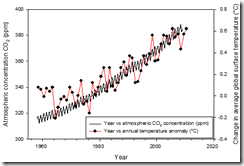
Recognition of the greenhouse effect goes back to Joseph Fourier in the early 19th century, and the role of carbon dioxide (CO2) was identified in 1859 by John Tyndall. No scientists dispute that CO2 is a greenhouse gas: scientists have repeatedly verified that through experiment. It was Svante Arrhenius in 1896 who predicted that human activities could contribute to the greenhouse effect, but it wasn’t until the 1970’s that scientists like Roger Revelle and Wallace Broecker began to raise the alarm. Their concern was based on measurements by Charles Keeling, who showed that CO2 concentration in the atmosphere was increasing at an alarming rate. Atmospheric concentrations of CO2 (Figure 1) show both seasonal fluctuations related to plant growing seasons, and a long-term trend of steadily increasing CO2. So how is this related to human activity? In the Peak Oil chapter, we described how oil contains the energy of sunlight that fell on earth millions of years ago, trapped in organic molecules manufactured by plants using photosynthesis. The simplified chemical reaction is:
clip_image001

Figure 1. Atmospheric concentration of carbon dioxide at Mauno Loa, Hawaii, USA (ppm) and average annual global surface temperature anomaly (°C) between 1958 and 2010. Temperature data from Hansen (2010), atmospheric CO2 concentration data from Keeling (2009).

Eq. (1) CO2 + H2O + energy from sunlight = CH2O + O2

The molecule CH2O represents the organic matter that stores the energy in fossil fuels. When we use fossil fuels, we undo the work of photosynthesis, promoting the reverse reaction by heating the organic matter in the presence of atmospheric oxygen so that they react and liberate the stored energy, a process called combustion. The troubling product of this combustion is CO2, which accumulates in earth’s atmosphere, leading to the observed steadily increasing atmospheric CO2 concentration (Figure 1).

Equation (1) illustrates the delicate balance between plant photosynthesis (forward reaction) and combustion (reverse reaction) that determines the concentrations of oxygen and carbon dioxide in the earth’s atmosphere. From Eq. 1 above we can see that combustion consumes O2 while producing CO2. Thus, we would predict that increasing CO2 concentration should be balanced by decreasing O2 concentration in the atmosphere, which is what we observe (IPCC 2007).

The current atmospheric O2 concentration of 21% is just right for trees: If O2 rose to 25%, forests would burn after every lightning strike, but if it fell to 13%, we could not start a fire. In fact, it is life that regulates the composition of the atmosphere, as illustrated vividly by James Lovelock’s conception of Gaia. He posits that earth behaves like an organism because its components act in concert to maintain life-support systems at optimal levels. Just as our body maintains a constant temperature of 98.6°F, the earth can maintain global temperatures within a narrow range that is conducive to life. How does it accomplish this? Eq. (1) gives us some insight. Because temperature positively correlates with atmospheric CO2 concentration, when CO2 is increased, then temperature increases, and these changes combine to create a greenhouse that promotes plant growth through photosynthesis (Eq. 1). This causes plants to extract greater amounts of CO2 from the atmosphere, decreasing atmospheric CO2 concentration and therefore temperature. This is an example of a balancing negative feedback loop. Thus, life helps to regulate the composition of the atmosphere and maintain an optimal temperature, and the earth system of which life is a part is self-regulating (homeostatic). Essentially, the solid earth and atmosphere (geochemistry) and life (paleontology) have co-evolved.

The rapid increase in human population coupled with the rapidly rising rate of combustion of fossil fuels since the Industrial Revolution has destroyed the balance. Where atmospheric concentrations of CO2 and O2 were in a steady state prior to the Industrial Revolution, they are now rapidly changing. As noted by E.F. Schumacher in “Small is Beautiful (1973),” “The system of nature, of which man is a part, tends to be self-balancing, self-adjusting, self-cleansing. Not so with technology.” As we pump increasing amounts of CO2 into the atmosphere and temperature rises, the earth acts more and more like a greenhouse and plants grow faster, acting as a sink for CO2 according to Eq. (1). However, this negative feedback is not sufficient to keep atmospheric CO2 concentrations from increasing (Figure 1). Although life absorbs some CO2 we emit through fossil-fuel burning, it won’t absorb all of it. Atmospheric CO2 concentration will continue to increase, but not as much as it would without photosynthetic plants. Another negative feedback is dissolution of atmospheric CO2 in seawater. As atmospheric CO2 concentrations rises, increasing amounts of CO2 dissolve in the oceans to form carbonic acid according to:

Eq. (2) H2O + CO2 = H2CO3

Increasing concentrations of this weak acid cause the pH of seawater to decrease. This is a major problem for organisms that extract Calcium Carbonate (CaCO3) from seawater to build shells, because Calcium Carbonate dissolved readily in acidic water. Coral reefs are the backbone of coastal marine ecosystems that have very high biodiversity, yet these reefs are rapidly dying across the world’s oceans, in part due to ocean acidification. How sad that these corals, which have been some of earth’s most successful creatures, having survived for hundreds of millions of years, now face extinction because of anthropogenic CO2 emissions. If the world’s coral reef ecosystems collapse, so will most of the world’s coastal fisheries, leading to the loss of the primary protein source for most low-income coastal communities.

How do scientists know that the excess CO2 in the atmosphere did not come from decaying plant matter or burning of modern vegetation? Because the proportion of atmospheric carbon that is radioactive 14C has been declining steadily, indicating that ancient carbon is being added to the atmosphere[i]. How do we know that the CO2 didn't come from volcanoes? Because the 13C/12C ratio of the atmosphere has been steadily decreasing. Volcanic CO2 has high 13C/12C, and only plant matter has low 13C/12C, so the decrease in atmospheric 13C/12C must come from burning plant matter[ii].

So we can agree that CO2 is a greenhouse gas, and that human activity has increased the CO2 concentration in the atmosphere. This should lead to warming of the atmosphere, which will thermally equilibrate with the land surface and oceans through heat transfer, causing them to also warm. Thus, the entire earth will warm, as is evident in (Figure 1). The rate of heating was higher in the last 25 years than over the previous 150 years. This acceleration of warming to rates higher than ever recorded in geologic history is what has scientists concerned (Joos and Spahni, 2008).

Global warming is documented by many global changes. Instrumental records (corrected for the urban “heat island” effect) and natural evidence (shrinking and thinning of Arctic ice, loss of Antarctic ice shelves, and receding of most Alpine glaciers globally[iii]; lengthening of growing seasons, migration of animals and plants to higher latitudes, and borehole measurements) all show that the earth’s surface has warmed 0.4-0.8°C (~1°F) during the 20th century. The probability that warming is real is > 99% (IPCC 2007). For example, the warmest eight years recorded since record-keeping began about 150 years ago all occurred within the twelve years preceding 2011. In fact, since 1850 the 24 warmest years have been as follows, from warmest to coolest: 2010, 2005, 2009, 2007, 2002, 1998, 2003, 2006, 2004, 2001, 2008, 1997, 1995, 1990, 1991, 2000, 1999, 1988, 1996, 1987, 1983, 1981, 1994, and 1989. The 24 warmest years have all occurred since 1980. It is nearly impossible for these observations to occur by chance.

It’s also important to know that CO2 is not the only important greenhouse gas; others include methane CH4, Nitrous Oxide N2O. Together, these gases increase the average global surface temperature by 34°C. The heating power of a greenhouse gas (radiative forcing) is proportional to the reduction of infrared radiation leaving earth caused by a unit increase in concentration of gas in the atmosphere. The cumulative effect of a greenhouse gas depends on its radiative forcing and how long it stays in the atmosphere, termed the “residence time.” The total Global Warming Potential (GWP) therefore depends on both the radiative forcing and residence time of a GHG in the atmosphere (scale normalized to CO2): CO2 = 1, CH4 = 21, N2O = 290, CFC’s = 3000-8000 (Faure 1998). GHG emissions are usually reported as CO2 equivalents CO2e. So, for example, emission of 1 kg of CH4 would be equivalent in terms of GWP to 21 kg of CO2, so CO2e = 21 kg. The GWP of CFCs are large because their atmospheric concentrations are near zero, they absorb infrared radiation between 8000-12,000 nm where CO2 is ineffective, and they have long atmospheric residence times (Faure 1998)[iv].

(Figure 2) compares the relative importance of GHGs to global warming by plotting the percentage of total CO2e associated with each type of GHG emission. Although CO2 is the weakest of the GHG, it has the largest effect on global warming because we emit such large volumes of CO2 during fossil fuel burning. Thus, AGW mitigation measures must first focus on reducing CO2 emissions.

Global Anthropogenic Greenhouse Gas Emissions in 2004.

Figure 2. Global Anthropogenic Greenhouse Gas Emissions in 2004 expressed as the percentage of total CO2e. Data from IPCC 4th Assessment Report: Climate Change 2007: Synthesis Report, http://www.epa.gov/climatechange/emissions/globalghg.html

Of course anthropogenic GHG emissions are not the only cause of GCC. Natural causes of GCC include variable sunlight intensity, strengthening greenhouse, increased atmospheric aerosols, and volcanic eruptions. Computer simulations based on real-world measurements show that the natural drivers, solar variability and volcanic eruptions, have actually caused earth’s surface temperature to decrease during the 20th century. Aerosols also cause cooling. As a result, observed global surface temperatures cannot be explained by natural forces alone (Figure 3). Therefore, the only remaining cause of global warming is increased greenhouse gas concentration from fossil fuel burning. (Figure 1) shows an excellent positive correlation between atmospheric temperature and CO2 concentration from 1880 to the present, consistent with the idea that increased CO2 is associated with increases in temperature. Data from ice cores collected in Antarctica demonstrate that this correlation stretches back 420,000 years (Petit, Jouzel et al. 1999). Plotting CO2 concentrations versus temperature anomalies recorded in the ice cores demonstrates that the trend for the “Anthropocene” is distinctly different from the natural trend, showing unequivocally that the atmosphere-climate system has been highly perturbed by human activities (Figure 4). The positive correlation between temperature and atmospheric CO2 concentration shown in (Figure 1) and (Figure 4) suggests, but does not prove, a cause and effect relationship[v]. However, we can say with a high level of confidence that when atmospheric CO2 concentration is high, average global surface temperatures are high, and since the atmospheric CO2 concentration is now higher than at any time during the past 420,000 years, we can expect that temperatures will rise to levels higher than at any time during the past 420,000 years as the global climate system adjusts to the new, higher level of CO2 in the atmosphere.

clip_image004

Figure 3. Comparison of average global surface temperatures that were observed with those predicted by models that accounted only for natural climate forces and not human forces. From Mann and Kump (2009).

clip_image006

Figure 4. State–space view of Antarctic ice-age cycles. From Etkin (2010).

References

Archer, D., M. Eby, et al. (2009). The Atmospheric Lifetime of Fossil Fuel Carbon Dioxide. Annual Review of Earth and Planetary Science. 37: 117-134.

Dawson, B. and M. Spannagle (2009). The Complete Guide to Climate Change, Routledge.

Etkin, B. (2010). "A state space view of the ice ages—a new look at familiar data." Climatic Change 100(3): 403-406. http://dx.doi.org/10.1007/s10584-010-9821-x.

Faure, G. (1998). Principles and applications of geochemistry: a comprehensive textbook for geology students, Prentice Hall.

Hansen, J. E., R. Rued, et al. (2010) "NASA GISS Surface Temperature (GISTEMP) Analysis." Trends: A Compendium of Data on Global Change DOI: 10.3334/CDIAC/cli.001. http://cdiac.ornl.gov/trends/temp/hansen/hansen.html.

IPCC (2007). Climate Change 2007: The Physical Science Basis. Contribution of Working Group I to the Fourth Assessment Report of the Intergovernmental Panel on Climate Change. Cambridge, U.K. and New York, NY, USA, Cambridge University Press.

Joos, F. and R. Spahni (2008). "Rates of change in natural and anthropogenic radiative forcing over the past 20,000 years." Proceedings of the National Academy of Sciences 105(5): 1425-1430. http://www.pnas.org/cgi/content/abstract/105/5/1425

Keeling, R. F., S. C. Piper, et al. (2009) "Atmospheric CO2 records from sites in the SIO air sampling network." Trends: A Compendium of Data on Global Change DOI: 10.3334/CDIAC/atg.035. http://cdiac.ornl.gov/trends/co2/sio-keel.html.

Mann, M. E. and L. R. Kump (2009). Dire Predictions: Understanding Global Warming. New York, DK Publishing, Inc.

Petit, J. R., J. Jouzel, et al. (1999). "Climate and atmospheric history of the past 420,000 years from the Vostok ice core, Antarctica." Nature 399(6735): 429-436.

Solomon, S., G.-K. Plattner, et al. (2009). "Irreversible climate change due to carbon dioxide emissions." Proceedings of the National Academy of Sciences 106(6): 1704-1709. http://www.pnas.org/content/106/6/1704.abstract.


[i] 14C has a half-life of 5700 years, so plant matter that is older than roughly 6 half-lives or 8*5700=45600 years has essentially no 14C.

[ii] Note that it is the changing 14C content of the atmosphere that makes accurate 14C dating of material less than 100 years old impossible.

[iii] see http://www.ted.com/talks/lang/eng/james_balog_time_lapse_proof_of_extreme_ice_loss.html

[iv] Some confusion about GWP values exists because they are sometimes quoted for different timescales. Some studies only look at a 100 year timescale and find that the GWP of CH4 is 73, i.e., methane is 73 time more potent than carbon dioxide. However, if we take the longer term view required by sustainability of, say, 1000 years, the GWP of CH4 drops to 23 because CO2 persists in the atmosphere longer than methane. See Archer, D., M. Eby, et al. (2009). The Atmospheric Lifetime of Fossil Fuel Carbon Dioxide. Annual Review of Earth and Planetary Science. 37: 117-134.

[v] One complication is that, when viewed at high temporal resolution, ice cores show that atmospheric CO2 increases lag behind temperature increases by several centuries, possibly suggesting that increased temperatures cause high atmospheric CO2 rather than the reverse. However, there is a good explanation for this relationship, one that relies on increases in solar insolation to trigger warming episodes that then become amplified by increases in atmospheric CO2. Variations in insolation (solar intensity) due to Milankovitch cycles are not sufficient to explain the large (6° C) temperature variations of the ice ages. However, they can trigger temperature excursions. If insolation increases, then atmospheric temperature will increase slightly. This causes the solubility of CO2 in seawater to decrease; the ocean begins to add CO2 to the atmosphere, which further increases temperature due to the greenhouse effect, which leads to more degassing, creating a positive feedback loop. This is reinforced by another positive feedback loop in which continental ice sheets melt and recede, exposing land with a lower albedo, leading to increased absorption of solar radiation and heating. The oceans take about a thousand years to overturn and degas, so the CO2 concentration in the atmosphere will not peak until roughly a thousand years after the heating episode began.

Thursday, February 10, 2011

Green Construction

A Guest blog by Krista Peterson

Green construction is a new form of construction that is safer for people and the environment and is cheaper over the long term than old construction. Its use follows an era in which residential and commercial buildings were constructed both cheaply and quickly to please owners. Instead of focusing on quality, the goal was most certainly quantity. The materials used in the building of these shoddy and quickly-constructed structures were typically very unfriendly to the environment and contained hazardous products including fibrous asbestos1.

Fibrous asbestos is the only known cause of the disease mesothelioma, which is a rare form of cancer that affects the linings of the heart, chest and abdomen. When asbestos fibers become airborne they can be inhaled or consumed – via eating or drinking – and they will eventually cause a variety of harmful and fatal health problems. Mesothelioma symptoms often resemble the common cold and other basic chest and lung ailments, which makes the victims life expectancy substantially shorter because of the common misdiagnosis.
Asbestos was used in more than 3,000 products during the 20th century, as it was inexpensive and present in large quantities. Perhaps the most common use of asbestos was for insulation. Fortunately, construction workers can now use safer choices to insulate a building. These include:
1. Cotton Fibers – A highly popular material used in the construction of “green” buildings, insulation made of cotton fiber is made using denim and other forms of batted recycled material. As with cellulose, cotton fiber is treated using mild chemicals to make the material fireproof. However, the fiber is completely nontoxic and does not produce any gases.
2. Cellulose – Formed from 85% recycled material, cellulose is a fancy way of defining old shredded newspaper. This material has quickly become one of the most popular forms of eco-friendly insulation throughout the world. The cellulose is treated using safe chemicals to increase its resistance to heat and to prevent growth of mold. It is completely nontoxic and has been shown to decrease utility bills by as much as 20% annually.
3. SPF or Spray Polyurethane Foam – This type of insulation is ideal for those who suffer from allergies as it is sprayed within the areas that need to be insulated. The foam fits very snugly and does not allow mold to grow. These are several different types of foams that are sold but it is agreed that water-based icynene is the best. It contains no polybrominated diphenyl ether that is toxic. This type of foam also lacks hydrochlorofluorocarbons that are greenhouse gases and can catalyze the destruction of stratospheric ozone. On average, the use of SPFs can decrease utility bills by around 35%.

Other substances that were toxic were also used in building construction, which would affect both the health of those who were working to construct the site and those who worked in or resided in the building. Fortunately, the dawn of the 21st century brought many different options when it came to replacing these old products that were used and proven hazardous to human health. These replacements greatly improved the indoor air quality and the general environment for working and living conditions. Additionally, buildings that were well-constructed and were built to be environmentally friendly typically needed less energy to function and consumed less water. This saved environmental resources, and pleased tenants and landlords as the costs of water and electricity were decreased. Thus, green construction is smart construction because it is healthier, eco-friendly, and in the long term more cost-effective than conventional construction.


1. Asbestos is a family of six minerals. The fibrous amphibole forms (amosite, crocidolite, anthophyllite, tremolite, and actinolite) are known to be carcinogenic. However, the cancer risk presented by the most commonly used form of asbestos, chrysotile, is low or nonexistent; see Ross (1984) Definitions for Asbestos and Other Health-related Silicates, American Society for Testing Materials Special Publication 834, pp. 51-104.

Monday, August 23, 2010

Solar Cookers for Haiti

I recently purchased a panel reflector solar cooker for $130. The HotPot was designed and developed by Solar Household Energy (www.she-inc.org) and is manufactured by Integrated Logistics Solutions (www.ils.com.mx) in Monterrey, Mexico. Its design uses simple scientific principles. The reflector focuses sunlight on a black pot containing food. The pot is enclosed in a transparent glass "greenhouse" that traps the heat absorbed by the black pot. The HotPot is excellent for slow-cooking vegetables, rice, legumes, and fish (and meat for my wife). Twice per week I buy locally grown organic produce at the Farmers Market, come home, cut it up, and toss it in the HotPot. It can cook up to 9 pounds of most foods within 3 to 4 hours. Preparation usually takes no more than 15 minutes of cutting and tossing into the pot. No liquids need to be added except for rice and beans because water is "sweated" out of the food. Cooking is even easier; I just set it outside facing the sun, and then rotate it twice to track the sun across the sky. Afterward I simply fold up the reflector, wash the black pot, and store them with the glass pot. Solar cooking requires no fossil fuel energy, is good for the environment, and requires minimal cleanup. In addition, the dishes I prepare are healthy and are excellent as leftovers.

solar_cooker

Solar cookers can help solve two of the biggest problems in Haiti, deforestation and lack of clean water. Deforestation primarily results from poor people chopping down trees to make charcoal to fuel their stoves. Women often spend many hours every day collecting wood to make charcoal. A simple solution is to provide solar cookers with instructions to the women in each household. Haiti has abundant sunshine, and to become sustainable the Haitian people need to make use of this valuable, free resource. Solar cookers eliminate the need to cut down trees for charcoal. The time saved could be used by women and girls to improve the situation, perhaps through education. An additional benefit is that solar cookers can be used to effectively pasteurize water, thereby preventing water-borne diseases. Solar cookers are an extremely cost-effective solution to the problems of deforestation and water contamination. Solar Cookers International (http://www.solarcookers.org/) has an aid program to distribute solar CooKits, pots and Water Pasteurization Indicators (WAPIs) in Haiti. This is an example of high-impact philanthropy, meaning charitable donations are used to maximize benefits by leveraging existing resources.

Friday, August 20, 2010

The Simpleton’s Guide to Sustainability

From general to specific. Items in lists within good cells improve to the left from good to better to best. Any suggestions for additions or deletions?

Bad

Good

Destroy

Preserve

Dependent

Self-sufficient

Ignorance

Knowledge

Opinion

Fact

Waste

Conserve (reduce, reuse, recycle)

Spending

Saving

Consuming

Producing

Fat

Thin

Monoculture

Polyculture

Deficit

Surplus

Hidden costs

Triple bottom line accounting

Disposable

Reusable, recyclable, biodegradable

Noisy

Quiet

Polluting

Clean

Toxic

Benign

Clear-cutting

Selective harvesting

Coal

Solar and wind energy

Personal Automobiles

Public transportation

Beef

Soybeans, farm-raised herbivorous fish

Escalators, elevators

Stairs

Jet-ski

kayak or canoe

Powerboat

Sailboat

Snowmobile

Snowshoes

Downhill skiing

Cross-country skiing

Recreational vehicles

Tents and Cottages

Industrial agriculture

Organic Community Supported Agriculture

Using a treadmill

Walking outside

Driving

Running or bicycling

Travel for meetings

Videoconferencing

Daily commute to work

Telecommuting

Tuesday, August 17, 2010

Cutting government services doesn’t always save money

People are familiar with the concept that cutting corners often ends up costing more money in the long run: this applies to homes, cars, nearly every consumer purchase. But the same holds true with government services, which we purchase with our tax dollars. Many want the cheapest government possible, so the trend in the past few decades has been towards decreasing taxes. That trend combined with the recession beginning in 2008 has led to drastic cuts in government services. Those cuts, however, often lead to problems that cost money to remedy. One of many examples is the problem of violent patients in emergency rooms (Julie Carr Smyth, AP, 8/11/2010). Cash-strapped states have closed state hospitals and addiction programs and cut mental health jobs. As a result, ER visits for drug- and alcohol-related incidents increased from ~1.6 to ~2 million between 2005-8, and incidents of violence in ER rooms jumped from 16,277 to 21,406 between 2006-8. In response, hospitals have had to pay for expensive deterrents such as 24-hour guards, bulletproof glass, installation of "panic buttons", coded ID badges and scanners, and metal detectors. From a sustainability perspective, it makes more sense to invest in prevention of substance abuse and mental illness than in security systems to protect people from addicts and the mentally ill. Treatment and prevention increase social capital and may increase economic capital through cost savings; security and deterrence systems do not increase any form of capital.

Friday, June 25, 2010

Globalization and culture

Much of the backlash against globalization stems from a fear that it will lead to a homogenization of culture. This process has operated throughout history, but electronic media and global transportation have accelerated the process because they have removed barriers to the exchange of information. Without barriers, random processes cause the entropy of the global social system to increase, eventually leading to homogenization. It's like the classic experiment that explains entropy and diffusion. Divide a box into two chambers and fill each with a different gas. When you remove the divider, Gas A molecules begin to diffuse into the Gas B chamber, and vice-versa. The entropy, or disorder, of the system increases as the two chambers change composition from pure gas to increasingly similar mixtures of A and B molecules. When the process is complete, the two chambers have the same compositions. Both entropy and stability are at their maximum values.

Likewise, geographic and communication barriers have historically divided world cultures. A diverse array of cultures developed in isolation, which led to decreased stability and increased conflicts. The modern removal of communication barriers inevitably reversed the process of cultural divergence by increasing the efficiency of information exchange and removing cultural obstructions. Theoretically, the subsequent cultural 'blending' will ultimately (over long periods of time) lead to cultural homogenization and societal stability, but in the short term the process can be disruptive and painful. However, the force driving this process is relentless, so stopping the process would be difficult or impossible, and undesirable since it leads to an increase in stability. As long as humanity has affordable global travel and digital communication, fighting against cultural homogenization on a global scale would be futile. The only way to slow or prevent it is to slow or stop the exchange of information, which is neither desirable nor acceptable.

Just as a homogeneous mixture of two gases is more stable than the segregated pure gases, cultural homogeneity should encourage stability. Removal of cultural differences and barriers increases understanding, which decreases fear and hatred, which increases stability. However, we also previously argued that decreased diversity leads to decreased resilience. A system is most resilient when diversity is at a maximum. For example, ecosystems with high biodiversity are more resilient than those with low biodiversity. In a farm or garden, a polyculture is more resilient than a monoculture. Reasoning by analogy, high cultural diversity corresponds to greater resilience. Cultural diversity makes it more likely that society will find solutions in the face of global threats such as global warming. In the past, some cultures were better prepared to deal with adversity, while other less adept civilizations collapsed. For example, in contrast to the Easter Islanders who practiced unsustainable logging practices until no trees remained, Japanese leaders successfully dealt with timber shortages in the mid-17th century. They invoked Confucian principles of limiting consumption and accumulating reserve supplies to develop sustainable forest management (Diamond 2005). In our global society, one culture may provide the seed of knowledge or understanding that will lead to the preservation of global civilization. What if that culture were wiped out during cultural homogenization? Global homogenization of culture would decrease the resilience of humanity.

Therefore, sustainability requires stability and diversity. We must maximize the two at different spatial scales. A community containing people with similar cultures and beliefs can be stable; a country containing diverse communities can be resilient if those communities respect each other’s differences. To promote sustainability, society should adopt policies that reduce intracommunity diversity and increase intercommunity diversity. For example, many cities in the northeast like Buffalo, where I grew up, have multiple ethnic neighborhoods (Polish, Italian, and Irish in Buffalo), and these neighborhoods have coexisted peacefully for more than one hundred years.

Thursday, May 20, 2010

Simple Science is Sometimes the Best Science

Many people think that important science always involves sophisticated mathematics, high-powered supercomputers, or expensive technical instruments. A recent book demonstrates that this is not always the case. David MacKay, Professor of Physics at Cambridge University, published a very influential book in 2009 titled "Sustainable Energy: Without the hot air", available for free download at http://www.withouthotair.com/. A review in Physics World stated it is 'a book every budding physicist should read - and perhaps also ... the one every working physicist would like to have written.' This book has probably had a greater impact on science and society than any other scientific publication in the last couple of years, but it involves physics no more complicated than application of Newton's laws of motion. MacKay uses data, logic, and simple math to arrive at important conclusions. He systematically calculates the maximum amounts of energy that can be produced by renewable energy sources in Britain and shows that it is not physically possible to meet Britain's energy needs using renewable energy alone. This conclusion is very important, but MacKay also shows why some forms of renewable energy such as solar are much more promising than others such as biofuels. His conclusions will help determine where future scientific research funds will be funneled and therefore what path research on renewable energy will take. Though the science MacKay used is simple, the conclusions are important enough that he was appointed as the chief scientific advisor to the UK Department of Energy and Climate Change shortly after the book was published. Britain is now conducting studies to decide whether to support large-scale deployment of tidal power, the form of renewable energy that MacKay most strongly endorsed for Britain in his book.

The enormous impact of MacKay's book may help dispel some misconceptions about science. Important science doesn't need to be expensive or complicated, and sometimes it is published in books rather than scientific journals (remember "The Origin of Species" by Charles Darwin and "Philosophiæ Naturalis Principia Mathematica" by Isaac Newton?). Society needs clear-headed thinkers like David MacKay to show us how to address some of the pressing scientific problems of our time such as global climate change and peak oil. And the general public can learn a lot about the future of society by reading MacKay’s book.

Sunday, May 2, 2010

Economic growth can be too fast, leading to attacks against children in China

Change as rapid as China is experiencing is destabilizing. Imagine you are Chinese peasant whose lifestyle does not change while everything changes around you. Your friends who became wealthy will no longer be friends with you; the girl you hoped to marry now spurns you because her family is now wealthy. The landmarks you grew up with have been torn down and replaced with modern buildings. You feel alienated and disempowered. What do you do? Perhaps these changes can explain the strange rash of copycat crimes in China that started in March 2010, when a man stabbed eight children to death while they waited for a bus outside their elementary school in the southeastern city of Nanping. At his trial the man said he was angry because he was jilted by a woman and treated badly by her wealthy family. On April 28 he was put to death, and on the same day the second attack occurred: a man in the southern city of Leizhou wounded 15 students and a teacher in a knife attack. The third attack occurred the next day in the eastern city of Taixing when a man slashed 28 children, two teachers and a security guard with an 8 inch knife. The following day a fourth attack occurred in Beijing, where a farmer attacked kindergarten students with a hammer, then burned himself to death.

According to experts, "outbursts against the defenseless are frequently due to social pressures... and growing feelings of social injustice in the fast-changing country. An avowedly egalitarian society only a generation ago, China's headlong rush to prosperity has sharpened differences between haves and have-nots (Bodeen, AP, 4/29/2010)". Change can be too fast for systems and people to adapt; even seemingly positive change like rapid economic growth is unsustainable because it is destabilizing and causes social upheaval.

Monday, February 22, 2010

Taxes can promote sustainability

The majority of U.S. citizens favor low taxes because they want to decide how to spend their money rather than letting the U.S. government decide. However, most Americans don't realize that taxes are useful not just for raising revenue but also for discouraging undesirable choices.  For example, gas taxes discourage gas consumption, which reduces our payments to countries that sponsor terrorism, reduces pollution and emission of GHG, and increases national security by preparing America for future gas shortages. If the proceeds from these taxes are used to remedy other chronic societal problems, and in doing so increase the quality of life of all Americans, we get a win-win situation. For example, the three E's of sustainability are environment, economy, and equity. Raising gas taxes is an investment in the environment, and it improves the economic situation of the federal government, making it more sustainable. If the revenue is used to provide health insurance and education to poor children, we've made a wise investment in human capital and increased equity, making our society more sustainable. Many people would rather not have to pay the gas tax, and use the money they save to buy stuff like HDTV's.  But that use of money is not in the best interests of society, or even of those individuals.  I believe that the benefits of having a healthy, educated citizenry far outweigh the benefits of having more unnecessary stuff. Would you give up the chance to upgrade to an HDTV if it meant you might live longer (due to reduced pollution)? That you would pay less for your healthcare because hospitals would not have to charge the insured to cover the uninsured? That as an employer you could more easily find well-educated workers, which would improve your bottom line? That all Americans would benefit because a better educated citizenry would make our country more competitive in the global marketplace and our workers more valuable in the global workforce? And since we are now competing globally, a better educated, healthier workforce would make all U.S. companies more competitive and richer, which would make their employees richer, which would increase the amount of tax revenues flowing to the government, which might result in future tax reductions.  Thus our choice to raise gax taxes and invest the money in people rather than stuff improves environment, economy, and equity, making the whole country more sustainable.  Yes, not all taxes reap so many benefits, but we have to acknowledge that they have the potential to, and therefore be willing to pay them, recognizing that they are simply another form of investment.  Wouldn't you rather invest in people rather than stuff?

Wednesday, February 17, 2010

The Failure of the U.S. Government to Address Sustainability

The U.S. Government will fail to adequately address sustainability issues, and American citizens will have to abandon the top-down approach and rely on a bottom-up approach to solving these problems that affect our national security. I say this because Congress and the public have become so polarized along ideological lines that compromise and political progress have become impossible. As a result, moderate members of Congress are choosing to leave rather than run for reelection. On February 16, 2010 when moderate Evan Bayh (D-Ind.) announced that he would not seek reelection after two terms, he stated that "there is too much narrow ideology and not enough practical problem-solving" on Capitol Hill (Kellman and Jackson, AP, 2/17/2010). Nowhere was this more apparent than when the Senate in January rejected a bipartisan deficit commission that could have forced Congress to make painful budget decisions. Members of Congress are unable to agree to reduce capital outflows, but they refuse to increase capital inflows by raising taxes because that is politically unpopular. Most telling was the fact that some Republicans who originally supported the commission changed their votes after President Obama endorsed it. Clearly these members of Congress were acting in the interests of their political party rather than of the country they serve.

By rejecting the establishment of a commission that could have taken the heat for such unpopular decisions, Congress essentially sealed the economic fate of the federal government. This plot shows the federal deficit over time. The total area under the annual deficit bars is a measure of the total deficit, i.e., the economic overshoot = outflows - inflows, which is also shown by the cumulative deficit line that is now approaching $6 trillion. The federal budget is seriously out of balance, but even worse, in most cases these deficits were planned. Unbalanced proposed budgets are passed every year now.

clip_image001

In this plot I've shaded Republican administration years red and Democratic administration years blue. Notice that until Barack Obama took office in 2009 the red area was much greater than the blue area, meaning that until 2009 Republican administrations contributed more to the deficit than Democratic administrations. Of all of the Presidents since 1970 only Bill Clinton managed to balance the budget, ringing up surpluses in his last three years of office. In contrast, President George W. Bush changed the budget surplus of his first year in office, which was budgeted by Clinton, and turned it into record deficits within two years.

As a result of the economic recession in President Obama's first year in office in 2009 the annual federal budget deficit rose to the highest level ever. It remains to be seen if the benefits of the money spent on the economic stimulus package to stave off the recession outweigh the harms resulting from the increase of the deficit, but if the trend continues, the federal government will soon be unable to meet its financial obligations, and this will likely result in an economic collapse. Most economists predict that interest payments on the budget deficit will consume 80% of all federal revenues by 2020 (Tom Raum, AP, 2/15/2010).

And it will only get worse. In January the U.S. Supreme Court, dominated by political ideologues, voted to eliminate any limits to political contributions by corporations or lobbies. Most American citizens believe that members of Congress are already in the pockets of corporations. Now these corporations will have unlimited influence. The fate of bills will be decided by who has the deepest pockets. And when it comes to the three ABCs of unsustainability, who do you think will win when Congress tries to regulate Automobile, Beef, and Coal producers? Will members of the Senate ever vote to limit CO2 emissions when wealthy oil companies are paying them not to?  Congress is losing its integrity and its independence. Soon it will lose its economic power and therefore its influence. We can't rely on Congress to fix our problems.

Wednesday, June 17, 2009

Eco-Cities and Eco-villages

When people think of “green”, they think of forests and grasslands with few people. But for a given number of people, it is more green to all live in one small space rather than spread out. High population density leads to many efficiencies: resources and wastes only have to be transported to one location rather than many; distances to work, school, and stores are shorter; electrical power is transmitted shorter distances, meaning less line loss and greater efficiency. Water and sewage pipes, cable, phone, and power lines all become shorter per capita as housing density increases, making basic services more affordable and less resource-intensive. High-density housing in mixed-use developments also makes sustainable living easier because public transportation becomes feasible, and people can walk and bike to work and school. In fact, residents of Manhattan use less energy and fewer resources than anywhere else in America ([1], pp. 228-9). And if people take up less space by living in cities, that leaves more space for ecosystem services and preservation of biodiversity. Finally, because more than half of the world's population now lives in cities, it makes sense to focus on making cities more sustainable.

Some cities in North America have been at the forefront of planning for sustainability. One of the greenest cities in the world is Vancouver, British Columbia. I was there in summer of 2008 and was truly impressed by the beauty of the natural setting but also by the forward-thinking policies of the government and developers. The majority of Vancouver’s residents live downtown in high-rises and compact communities [1], p. 231). The city is designed for pedestrians and bicycles, and many residents have given up their cars. I rode all over the city in buses and found it remarkable easy and enjoyable. By avoiding urban sprawl, Vancouver has become one of the world’s most livable cities. Preparations for the 2010 Olympic Games that it is hosting are making Vancouver even more impressive.

Not everyone can live in the city. How can we make smaller communities sustainable? Enter the concept of the eco-village. Just by coincidence I live very close to one of the most widely publicized eco-communities in the world, The Farm, located in Summertown, TN (http://www.thefarm.org/). It includes the Farm Ecovillage Training Center, which offers regular courses on sustainable living. The Farm was founded in 1971 when a group of hippies left San Francisco looking for the right place to start their experiment in communal living. The right place was the area with the cheapest land, and that's why they ended up in middle Tennessee.

I went there for a tour one day, during which they briefly described the history of the farm. It started as a socialist society, but eventually the practice became unsustainable because there were too many freeloaders. So in the mid-1980's they abandoned socialism, causing a large segment of the residents to leave. They now have a cooperative system in which they work together to develop shared resources and pay dues. It now seems to operate as a sustainable capitalist community, with many of the residents operating businesses that manufacture radiation detectors, publish books, sell mushroom growing kits, produce video, and offer midwife services and classes. The residents regularly offer classes on mushroom farming, yoga, organic gardening, and other topics. But touring the Farm was somewhat disappointing to me. The residents are good at self-promotion on the web, but the Farm itself is a small collection of run-down buildings and unused fields. As a farm it is a dismal failure, with most of the land left to pasture but no animals (they are all vegetarians) and only one commercial crop, soybeans, which they make into soy milk and ice cream (which is quite delicious). I think the reason is that though they were idealistic, the hippies were ignorant about farming practices, and also many/most of them do not like manual labor. I wanted a demonstration of how they managed to live sustainably, but I never got a glimpse, making me suspect that their community isn't truly sustainable. Even the mushroom growing demonstration was simply a slideshow accompanied by partially coherent, rambling pronouncements on politics by someone who seemed to have partaken of too many mushrooms in his lifetime (I fell asleep). We never even saw where they grow the mushrooms! I could view a slideshow on my computer without driving 40 miles. But to their credit, the residents of The Farm live more simply and have much smaller ecological footprints than most Americans. They understand that you don’t have to have a lot of money and “stuff” to be happy.

Perhaps a more successful eco-village is Gaviotas, located in the llanos (grasslands) of Colombia and well-described by Alan Weisman in his book “Gaviotas: A Village to Reinvent the World” [2]. Like The Farm, it was founded in 1971, but it seems they made greater progress because the founder, Paolo Lugari, had the foresight to bring a team of scientists and engineers to tackle the problems of sustainable living. This team came up with many novel solutions, including a special water pump that could extract groundwater from greater depths and with less effort than with traditional pumps. This pump was connected to a see-saw to put the energy of children’s play to good use. They also developed solar water heaters, the sale of which became a major source of income. Finally, the planting of 1.5 million trees returned part of the llanos back to its preexisting state of tropical jungle by trapping the moisture in a microclimate [2]. The villagers of Gaviotas tap the trees and sell the resin. The genius of the residents of Gaviotas enabled them to succeed in a harsh climate in a country bordering on anarchy.

So when choosing a place to live, you should seriously consider the city. Your ecological footprint will be smaller if you live there.  And when gas prices and transportation costs skyrocket, you’ll be glad that you moved there.

1. Steffen, A., ed. World Changing: A User's Guide for the 21st Century. 2006, Abrams: New York, NY. 596.

2. Weisman, A., Gaviotas: A Village to Reinvent the World. 1999: Chelsea Green Publishing Company 1-890132-28-4.

Tuesday, June 16, 2009

Collect and Purify Water

During short- and long-term emergencies, the most critical resource for you and your family will probably be potable water, especially if you live in an arid region. To prepare for such emergencies, and also to conserve water, you can practice rainwater harvesting.  Rainwater harvesting is one of the easiest ways to move towards self-sufficiency. Because we need water to survive, it is important not to rely completely on the system to provide it; redundancy is desirable in critical life-support systems such as water supply [1].

Because evaporation purifies water, rainwater is usually the purest water in the hydrologic cycle; you can therefore use it to water gardens without treatment. The simplest solution is to place a rain barrel (usually a 55-gallon drum with a valve) underneath the downspout of a rain gutter; the barrel should be placed as high as possible, keeping in mind that any support structure such as a stack of cinder blocks must be able to withstand the 450 pounds of a full barrel. Connect a hose to the valve and place it in your garden. The greater the height difference between the rain barrel valve and the hose outlet in the garden, the greater the pressure that drives the flow, and therefore the faster the water will come out of the hose. Rain barrels should have screens at the top to prevent debris or animals from entering the barrel [2]. Detains on how to construct a rainbarrel are given in [1], or you can purchase one prefabricated.

If during an emergency bottled or municipal tap water are not available and you plan to use rainwater for drinking or food preparation, you will need to go through some extra steps to make sure the water is not contaminated. Waterborne diseases cause nearly 15 million deaths each year. Disinfection kills the pathogens (bacteria, protozoa, parasites, and viruses) that can cause disease. Sterilization kills all living organisms in the water, bad or good. Purification removes potentially harmful chemicals in the water. A simple example makes the distinctions clear. You can disinfect water by pasteurizing it, which requires heating it to 149°F (65°C) for six to twenty minutes ([3], pg. 174). To sterilize the water, simply heat it to a hard boil in a covered pot. Boiling the water requires more energy for heating than pasteurization, but you can reduce the amount of energy required by tightly covering the pot to reduce heat loss. Pasteurization and boiling kill pathogens but do not remove dissolved chemicals such as the salts in seawater. To purify the water, you can remove the dissolved chemicals by boiling the water in an uncovered pot and collecting the condensed steam. Again, this is a very energy-intensive process. Below we will look at a few safe alternatives that require less energy.

The first step in water purification is to filter out suspended sediments that can hold chemical and biological contaminants by forcing the water through clean cheesecloth [2] or by temporarily placing the turbid water in a container to let the sediment settle out. Next, you need to remove biological contaminants that can cause disease. Boiling for ten minutes is the easiest solution. However, if you don't have enough fuel to treat all of your water this way, a more energy-efficient method is to use solar disinfection, termed SODIS ([1], [3]). Ultraviolet light kills the pathogens, and becomes more effective at high temperatures. Simply fix some shelves to a piece of metal painted black, then place bottles filled with water on the shelves and expose them to sunlight for six hours. You can paint the back of the bottles black so they will more effectively absorb sunlight and heat up to higher temperatures, killing the pathogens in as little as one hour [1]. In emergencies or while backpacking you can use iodine tablets, tincture of iodine 2%, betadine, or chlorine bleach to chemically treat water; see Lundin [3] and many other sources for detailed instructions on how to do this safely. There are other ways to kill pathogens, but most of them use high-tech devices such as UV lamps that need to periodically replaced or require electricity and are therefore unsustainable.

After filtering the water and killing the pathogens, most water will be safe to drink. For example, collected rainwater generally has very low concentrations of chemical contaminants, so it usually does not need to be treated to remove them. This is fortunate because it is much more difficult to remove dissolved inorganic chemicals from water. However, if you have reason to believe that your water contains chemical contaminants, you can use sunlight to evaporate the water and then collect the purified condensed water, a form of solar "still" ([4] pg. 471). The Watercone has an ingenious design that allows it to purify 1.6 quarts per day; it can even desalinate seawater ([5], pp. 193-4); see http://www.mage-watermanagement.com/. Or you can set up a still to collect steam produced by boiling water, as described above.

Following the simple procedures described above can help you provide potable water for you and your family during short- and long-term emergencies.

1. Kellogg, S. and S. Pettigrew, Toolbox for Sustainable City Living. 2008, Cambridge, MA: South End Press. 241

2. Bates, A., The Post-Petroleum Survival Guide and Cookbook: Recipes for Changing Times. 2006: New Society Publishers. 236 978-0-86571-568-4.

3. Lundin, C., When All Hell Breaks Loose: Stuff You Need to Survive When Disaster Strikes. 2007, Layton, Utah: Gibbs Smith. 449

4. Tawrell, P., Camping & Wilderness Survival. Second ed. 2006, Lebanon, New Hampshire: Paul Tawrell. 1080 978-0-9740820-2-8.

5. Steffen, A., ed. World Changing: A User's Guide for the 21st Century. 2006, Abrams: New York, NY. 596.

Monday, June 15, 2009

Composting

Household garbage often contains a large amount of organic debris that contains stored energy. One of the easiest and most satisfying ecological practices is to compost your waste and produce valuable humus, the organic-rich component of soil that is rich in nutrients and microbes and is essential for fertile soil. At our first house my wife and I bought a large plastic container for composting, but at our second house we used a more environmentally friendly and cheaper approach by building a compost container out of stakes and metal screens used for gardens (Fig. Compost_pile). If designed and maintained properly, compost bins do not usually smell badly, but to be safe we placed ours at the back of our yard. The disadvantage is that we have to walk a few hundred yards to dispose of waste in our compost pile, so we reduce the number of trips by using a small container that we fill and then carry to the compost pile. This is about the only effort required for passive composting, which takes about one year to completely breakdown organic debris into humus. Active composting can produce humus much more quickly, but requires much more effort, and in general I prefer the easy approach. We occasionally stir and water the pile, and then remove soil from the bottom of the pile for our gardens. And we follow some simple rules. First, we add no meat or fatty foods like butter that can attract animals and smell when they spoil. We try to use ½ green, wet material such as tree and bush trimmings and grass clippings that are nitrogen-rich, and ½ brown, dry material (decayed leaves, straw, wood chips) that is carbon-rich ([1], pp. 111-121), in addition to any compostable food waste we produce (banana and orange peels, used coffee grinds and tea leaves, eggshells, corn husks, artichoke leaves, and spoiled fruit and vegetables). We add these materials in layers. It’s better to have too much brown than green material, as too much green can cause formation of molds and bad smells. We don’t add weeds to our compost so as to avoid adding their seeds to our gardens when we add composted soil. Compost bins do not need sunlight, so we placed ours in a shady corner of our yard.

Start your compost pile by mixing together yard litter and foodstuffs, mixing in a small amount of soil that contains the necessary microorganisms, and adding a little water. Little may happen in the first few weeks, but once the microorganisms multiply and establish healthy colonies they will start digesting the waste, extracting energy for their metabolic processes and releasing some of the energy as heat. You will know that your compost pile is working when you feel it giving off heat. When oxygen is present the breakdown of organic matter can be described by the reverse of our model chemical reaction for photosynthesis:

C6H12O6 + 6O2 = 6 CO2 + 6 H2O

The heat comes from the energy of the sun, temporarily stored in organic molecules by plants utilizing photosynthesis. Essentially the same reaction occurs in our bodies when we consume food; respiration releases the energy stored in the food so our bodies can use it. Oxygen is present under aerobic conditions, and the microorganisms use it to breakdown (oxidize or combust) the organic molecules to extract their energy, but if the oxygen they use is not replaced, then eventually it will all be consumed, and under such anaerobic conditions the above reaction grinds to a halt. What happens next is that anaerobic fermentation reactions begin to breakdown the organic molecules and produce alcohol, the same process that we use to make bread and beer with yeast (the alcohol escapes from the bread during cooking). Anaerobic respiration also produces lactic acid in our muscles when we strenuously exercise: the body cannot replace the oxygen fast enough, so it begins to break down sugars and fats anaerobically (http://www.scientificamerican.com/article.cfm?id=why-does-lactic-acid-buil). The problem with alcohol production in the compost pile, however, is that alcohol is a disinfectant, so it sterilizes the pile, wiping out the microbial communities. And anaerobic respiration tends to produce odors from compounds like hydrogen sulfide, which gives the “rotten egg” smell you associate with swamps, where it is produced in the same way.

Finished compost should be dark brown. If it is black, your compost pile does not have enough oxygen; you need to add less water, and aerate the pile by turning it over. A simple approach to solve both of these problems is to place perforated PVC pipes, ones that are slightly greater in length than the diameter of your pile, at various heights in the pile. The pipes will suck air in to provide oxygen to aid decomposition, and drain off excess water.

Creating your own soil by composting is one more way to move yourself toward sustainability and independence [1]. And composting, combined with recycling, has greatly reduced the amount of waste we put in garbage cans.

1. Kellogg, S. and S. Pettigrew, Toolbox for Sustainable City Living. 2008, Cambridge, MA: South End Press. 241

Sunday, June 14, 2009

Buy Green and Encourage Sustainable Design

Besides avoiding purchases of disposable products and junk that is designed to break, and repairing rather than replacing, you should try to purchase products that are designed sustainably, made from renewable resources, and manufactured locally (to reduce carbon emissions from transportation and to help your local economy). When contemplating a purchase, ask yourself, “Do I really need this product? Will it add value to my life? Was the product manufactured in an eco-friendly way? Will its use harm the environment?”

When making purchases, avoid greenwashing, the practice of attaching a green label to a product that is not eco-friendly ([1], pp. 38-9). A perfect example is the Ortho Ecosense line of insecticides http://www.scotts.com/smg/brand/ecosense/brandLanding.jsp, where the word "Ecosense" is displayed in large green letters, but in smaller letters underneath it says "not intended to imply environmental safety either alone or compared to other products". So why are the letters in green and the prefix "Eco" in the name? Because it helps sell the product, even if for the wrong reasons.

New sustainably designed products are hitting the market, but if no one buys those products, then we will lose the opportunity to help make the market more eco-friendly. Consumers have the power to make the market more green by choosing eco-friendly products.

Simple rules should guide the design of sustainable products. Consumers should look for products that follow these rules. For example, Edwin Datschefski (in “The Total Beauty of Sustainable Products”, Rotovision, 2001) states simply (see [1], p. 86) “that things must be cyclic, solar, and safe”, and that “an object’s total beauty should not be undermined by hidden impacts.”

There are many examples of home interior products that are designed sustainably.  Bamboo is becoming a popular choice for wood flooring because this fast-growing wood is beautiful, durable, and renewable. For carpeting check out DuPont’s Smart-Strand, which is made from corn, is recyclable and biodegradable, and costs no more than comparable nylon carpeting. Using renewable corn instead of non-renewable oil to make the plastic saves a gallon of gas for every seven square yards of carpet.  Eco by Cosentino is a durable surface made of 75% recycled content composed of post-industrial or post-consumer materials bound by an environmentally friendly resin which comes in part from corn oil (See http://www.pr.com/press-release/158589). Vetrazzo’s recycled glass countertops contain 85% recycled glass by weight. The glass comes from curbside recycling programs, post-industrial usage, windows, dinnerware, stemware, automotive windshields, stained glass, laboratory glass, reclaimed glass from building demolition, and other unusual sources such as decommissioned traffic lights. Ivy Coatings make a zero VOC, non-toxic paint that can help improve indoor air quality.  Finally, Ultra Touch Insulation is made from recycled denim jean (also http://www.pr.com/press-release/158589).

Designing sustainably takes creativity. As stated by the inventor Edwin Land, creative and effective design requires the “sudden cessation of stupidity” ([1], p. 84). When you encounter a creative sustainable design for the first time, the usual reaction is to say, ‘why didn’t anyone think of this before?” because it is better in every respect than the old design, and yet it is simple. A design I recently encountered, the parking lot swale, elicited that reaction from me. Parking lots often flood because asphalt and concrete are impermeable. They need a sink for water to flow into and infiltrate into the ground during heavy rain events. The only permeable surfaces in parking lots are the islands, which are usually raised beds surrounded by concrete barriers. Water does not flow to the islands because it does not flow uphill. A smart and simple alternative is to make the islands depressions into which water will flow (Fig. Parking_swale_schematic.jpg). The depressions do not need to be surrounded by concrete barriers, and they effectively drain water from the parking lot (Fig. Parking_lot_drainage.jpg). And the parking spots themselves can be partially carpeted with grass (Fig. Green_parking_lot_Ikea.jpg) or porous concrete. These measures reduce the risk of flooding, allow water to infiltrate and recharge the aquifer, reduce the “heat island” effect caused by the high heat absorption and thermal mass of asphalt, and reduce the amount of rainwater shunted into storm systems, which saves energy used to pump and treat the water. Also, by increasing the amount of plants, they help increase water retention, remove pollutants, act as windblocks and noise mufflers, and beautify the parking lot. And all of these benefits come for free, because the sustainable design costs no more than the old unsustainable design.

One of the goals of the sustainability movement is to close the manufacturing loop. Currently most products track a linear path from resource extraction to manufacture to use to disposal. In a closed loop products are never disposed of; they are either reused or recycled. How do we know if sustainable practices were followed at each step in the lifecycle of a product? One way is to see if the product has been certified. For example, a Cradle to Cradle (C2C) platinum certified product is produced sustainably, and at the end of its usable life can be recycled, or is biodegradable, as described in “Cradle to Cradle: Remaking the Way We Make Things” by William McDonough and Michael Braungart (North Point Press, 2002).

1. Steffen, A., ed. World Changing: A User's Guide for the 21st Century. 2006, Abrams: New York, NY. 596.

Wednesday, June 10, 2009

Our Relationship with Nature

*Please note: I haven’t been posting recently because there have been so few comments that I was not convinced anyone was reading my entries. If you read this entry, please post a comment (click the “Comment” link at the end). You don’t even have to write anything; I just want to use the number of comments to estimate how many people are reading. If no one is reading these, then I’m not going to bother posting any more. Thanks, John

Till now man has been up against Nature; from now on he will be up against his own nature.  ~Dennis Gabor, Inventing the Future, 1964

There is a basic antagonism between the philosophy of the industrial age and the philosophy of the conservationist. – Aldo Leopold

Environmental problems develop when there is an unhealthy relationship between humans and the environment. The ways people approach, treat, and think of nature depend on their self-image. According to Wilson [1] there are two competing types of human self-image, exemptionalist and naturalist. Exemptionalists believe that humans exist apart from environment and hold dominion over it. In western civilization, most believe that God made the environment for our benefit, and that we have the freedom to use it as we see fit. Using technology, we can improve our current environment or adapt to any new environments. In contrast, naturalists believe that humans have perfectly adapted to our environment through millions of years of evolution, but that we are now rapidly destroying that environment. However, we can only be happy when we live in our original, natural environment because it is prescribed in our genes. The basic principle of organic evolution called habitat selection states that species prefer and gravitate to the environment in which their genes were assembled. Thus, we are completely dependent on our environment, including other species.

Wilson supports the Naturalist view. He states that the failures of the Biosphere 2 project (http://en.wikipedia.org/wiki/BioSphere_2) show that we and our environment are fragile and that our current technology cannot be used to create artificial sustainable environments. Exemptionalists claim that new technologies (power of the human mind) and free-market economies will provide adequate resources for the growing population; however, Wilson points out that there are limits to the amounts of water, arable land, oil, and food (including seafood), that can support us, and all of this is complicated by global warming. Exemptionalists are taking a gamble when they advise pressing forward with current policies and assume that technology will provide solutions to these growing problems before they become disasters. Ecologists like Wilson don’t like these gambles because they know that if we lose, we lose everything.

Wilson [1] believes that economists, who generally take the exemptionalist point of view, promote policies that are inconsistent with sustainability. Their economic models ignore human behavior, and they ignore the environment. A big problem is that they assume that there are adequate resources for all countries to have the same standard of living as the U.S.. However, the U.S. can only maintain its standard of living by using the resources of other countries (“economic miracles are not endogenous”), which we will demonstrate in detail later. Finally, economists do not use full-cost accounting, i.e., they don’t include the loss of natural resources. In this book I advocate a naturalist approach to solving environmental problems and achieving future sustainability.

The different approaches to nature are illustrated in J.R.R. Tolkien’s “The Lord of the Rings” trilogy. Elves lived symbiotically with nature and are presented as pure and good, while the ugly and evil orcs used resources like trees in a non-renewable way and transformed their environment into a wasteland. Clearly, to Tolkien it was evil to destroy the beauty of nature. In the Lord of the Rings some humans sided with elves and some with orcs, just as today humanity is divided between naturalist and exemptionalist camps (I’m not trying to say that exemptionalists are as ugly as orcs).

I am a naturalist rather than an exemptionalist, so I believe it is most effective to work with rather than against nature. You must always keep in mind that Nature is a powerful force; it is constantly at work, and while your short bursts of work may be more intense, and the use of energy from oil can magnify your efforts, eventually Nature will win because it has limitless time. How did streams cut through mountains to create water gaps? How did ancient mountains almost completely erode away? In ”The World Without Us”, Alan Weisman [2] describes what would happen to our structures (cities, buildings) if humans disappeared. It wouldn’t take long for nature to completely erase the evidence of our existence.

1. Wilson, E.O., Consilience: The Unity of Knowledge. 1998, New York, NY: Vintage Books. ISBN 367 0-679-45077-7.

2. Weisman, A., The World Without Us. 2007, New York, NY: Picador. ISBN 416 978-0-312-42790-0.

Tuesday, May 26, 2009

Industrial Agriculture

The American farm is not what it once was. Agriculture is now a commercial operation, not a family operation. On the modern industrial farm, monocultures (a single crop, usually corn) have replaced polycultures, and farm animals are often nowhere to be found. In the past, we took animal waste and used it to fertilize the crops that fed the animals; this comprised an efficient closed loop system. Now we house animals in feedlots, where the waste is no longer a resource but a pollutant, and at the farm we have to use fossil-fuel fertilizer in place of manure.

Unfortunately industrial agriculture is now firmly entrenched in the U.S.. Pollan [1] gives an excellent introduction to the problems of industrial agriculture, which is entirely reliant on fossil fuels, less healthy for us and the environment, consumes more resources, and is therefore less sustainable than old-style agriculture. As noted before, it now takes 10 calories of fossil-fuel energy to produce one calorie of food, whereas in the 1940's it only took 0.4 calories to produce on calories of food energy. Pollan [1] points out that unless we make the food system more dependent on renewable solar energy than non-renewable fossil fuel energy, it will be difficult or impossible to make progress in the U.S. on health care, energy independence, or climate change.

The use of monocultures and loss of agricultural biodiversity in industrial agriculture is particularly troubling. For example, long ago there were many varieties of bananas grown in the tropics. But consumer preference soon led to the predominance of a single cultivar (bananas are grown by propagation because they are seedless) named Gros Michel. That cultivar was wiped out in the 1950’s by Panama disease (http://en.wikipedia.org/wiki/Bananas) and was replaced by the Cavendish, which is very popular because it is grown year-round and has long shelf-life. However, because of the way it is grown, it lacks genetic diversity, which makes it vulnerable to disease, and it therefore could be wiped out like its predecessor Gros Michel. Growers are concerned that the Cavendish could be wiped out in a pandemic, perhaps caused by the black sigatoka fungus, within the next twenty years, and there are no similar plants to replace it. This would be a huge loss because the banana is the most popular fruit and the fourth most important food crop worldwide ("A future with no bananas?". New Scientist. 2006-05-13. http://www.newscientist.com/channel/earth/dn9152-a-future-with-no-bananas.html). Thus, high biodiversity gives us food security.

Like our monoculture lawns, monoculture crops are unnatural and therefore require lots of energy to maintain. Modern grain crops are annuals rather than perennials, and modern varieties did not develop over millions of years in perfect tune with the local climate. Rather, they were developed quickly through breeding and genetic engineering to grow fast, not to be hardy. They are not as well adapted to the local environment as the weeds, which is why the weeds take over if we don't fight on behalf of the crop. The less hardy and well-adapted a crop is, the more energy that is required to make it grow. To reduce the amount of oil-derived energy used to produce crops you must work with rather than against nature. Use perennials as crops rather than annuals. Choose natural varieties that are well-adapted to the local environment (known as heirlooms), even if they have lower yields. The resulting increase in genetic diversity will increase our food security. And decreasing our reliance on oil in agricultural production now will better prepare farmers and our society for the post-oil world. We will discuss these solutions in more detail later in the section on Organic Agriculture, but where you can have the most influence on changing the food production system is in the choices you make as a consumer.

Consumers drive the food production system. Americans want cheap food, and they tend to prefer sweet and highly processed foods. Also, they don’t want to know how their food was produced, and they don’t want to have to cook; it’s too much effort. So why do we often feel fat and stupid? Our ancestors used to spend much of their day growing, preparing, and cooking food. Today food is an afterthought. Most parents don’t ask the question “what will we have for dinner tonight” until they get home from work. They don’t have the time or energy to pick fresh vegetables and prepare a balanced meal. For breakfast, our grandparents took the time to make eggs, bacon and toast every morning; our parents replaced that with the convenience of cereal and milk. Now we don’t even leave enough time to eat a bowl of cereal, often rushing out the door with an instant breakfast or a protein bar.

To me the protein bar symbolizes everything that’s wrong with American food culture. Families used to sit together at the table, talk, and enjoy their food. Now we don’t have time for that, so we choose to rush off to the car with a bar that looks like a turd and tastes like cardboard. Protein bars are highly processed, so we don’t recognize the taste of any of the ingredients. And no wonder! If you read the list of ingredients, you will find that it is extraordinarily long, and that you don’t recognize the names of most of the ingredients. Most of them are synthetic chemicals. If you gave your grandparents a protein bar they would probably frown, take one bite and spit it out. They would not consider a protein bar to be food because it contains no recognizable ingredients, and therefore has no recognizable taste. And when you told them how much it cost per ounce, they would laugh at you. The more processing it takes to make a food, the more expensive it becomes per ounce, and the more profit the food manufacturer makes. So of course, food companies try hardest to sell their most highly processed foods by heavily advertising them. So why do people buy them? For the convenience (I think protein bars would survive a nuclear war), and because we think they are good for us. However, in my experience the people who rely on highly processed foods such as protein bars are less healthy than people who eat “real” food. Protein bars are just another type of fast food, and we all know that fast food is unhealthy. The trend towards increasing proportions of fast food and processed foods in our diets has led to an epidemic of obesity and type II diabetes in the U.S..

One of the most damning indictments of industrial agriculture is that it is unethical. People sometimes joke about where the meat in their hot dog came from, usually agreeing “you don’t want to know”. We sometimes hear from animal rights groups about atrocities committed in slaughterhouses, but those groups have lost credibility in the eyes of much of the public, and the average person can’t just walk into a slaughterhouse to verify the claims. It’s amazing to me that animal feedlots have not been subjected to greater public scrutiny. Part of the problem may be that the American public still has a soft spot in their hearts for farmers, and they don’t want to hassle them, but again it is not family farmers but large corporations that run CAFOs. Why do the media and the public handle them with kid gloves? I’ve read about reporters being turned away at the doors of CAFOs (e.g., [2]), but that never stopped investigative journalists in the past. As a result, I don’t know as much about CAFOs, slaughterhouses, and food processing as I should (I almost wrote “As I would like”, but I’m not sure I would like to know, which may explain the public being satisfied to be left in the dark). But I have read about what happens to egg-laying chickens [2], and it so upset me that ever since I read about it I have paid 4x as much for cage-free eggs.

In conclusion, the food production system in the U.S. is seriously flawed because it harms human health, it degrades the environment, and it is unethical. It is broken because the federal government’s subsidy system rewards the overproduction of corn. These subsidies make processed foods made from corn inexpensive, leading to the expansion of fast food companies such as McDonald’s. In fact, McDonald’s is probably the primary beneficiary of farm subsidies. The goal of our food production system is to maximize productivity, so we subsidize Happy Meals but not healthy meals. In 1973 we decided as a country to produce as many calories per acre as possible, and that is when America started getting fat. We now live in the "age of plenty", eating more calories than in 1970 but spending only half as much of our salaries on food (currently on average we use 16-17% of our salaries to buy food compared to about 30% in 1970). On the plus side, industrial agriculture requires fewer people to produce food, freeing people to do other things, and very few people in the U.S. are starving. But is industrial agriculture good for us? And is it good for the environment? I think the answer to both questions is no.

Pollan [1] lists some simple principles for improving agriculture in the U.S.. Improved Food Policies should: 1) strive to produce a healthful diet for all people; increase the quality and diversity of calories rather than the quantity. 2) aim to improve the resilience, safety, and security of our food supply. 3) reconceive agriculture as part of the solution to environmental problems like climate change. He notes that "while there are alternatives to oil, there are no alternatives to food". To make food production more sustainable he recommends that we resolarize farms, reregionalize the food system, and rebuild America's food culture. He ends by listing "21st century's most urgent errands: to move into the post-oil era, to improve the health of the American people, and to mitigate climate change." As noted by Brown [3], “"The wildcard in the food prospect is climate change. Crop ecologists estimate that for each 1-degree-Celsius rise in temperature above the norm during the growing season, we can expect a 10-percent decline in grain yields."

What changes can we make in agriculture to make sure that it can feed the 10 billion people predicted to be on the planet in 2010? Is it even possible to adequately feed that many people? It depends on what they eat [4]. If everyone on earth becomes a vegetarian, then it may be possible.

Until the Green Revolution the limiting factors on agricultural yield were nutrient availability and soil moisture. Using energy from oil, farmers erased these constraints by applying oil-derived fertilizers and pumping water for irrigation. An eleven-fold increase in fertilizer use combined with a three-fold increase in irrigated area and the adoption of high-yielding hybrids of corn, wheat, and rice led to a tripling of world grain harvest [3] (Fig. World Grain Production and Consumption). However, in many areas this high-intensity agriculture is unsustainable because it relies on the non-renewable resources oil and deep groundwater. Like oil, on a human timescale deep groundwater is a single-use resource: once we use it, it's gone. And oil and water shortages are appearing nearly simultaneously, giving farmers a double-whammy. This may cause grain production to actually decrease in the near future. Since demand continues to increase due to the annual addition of roughly 70 million people per year and the expanding use of grains as biofuels, the outlook is for increasing grain prices and increasing numbers of hungry poor people. In addition to grain shortages, we must also worry about the decline in the world fish harvest due to the recent collapse of some marine fisheries. The per capita wild fish harvest is now lower per capita than at any time since the early 1960’s (Fig. World Wild Fish Harvest Per Person). Catastrophists point to these trends and claim we are facing a global food crisis, but their predictions in the past have frequently proved inaccurate. For example, catastrophist Brown made the following food supply predictions that are obviously inaccurate: "Farmers...can no longer keep up with rising demand; thus the outlook is for chronic scarcities and rising prices" (Brown 1974); "Global food insecurity is increasing...the slim excess of growth in food production over population is narrowing" (Brown 1981). However, we have to admit that the current trends are troubling, and that we have to come up with new solutions to prevent a global food crisis and sustainably produce an adequate food supply for 10 billion people.

Perhaps the biggest problem in affluent countries like the U.S. is that we now take food for granted. As observed by Smil [4]: “When judged by the allocation of labor force, ours are predominantly service economies. They depend, however, no less than millennia ago, on adequate food production. I find it astonishing that this truism is so widely, and so easily, discounted. Saving, as so many economists do, that agriculture does not matter as much as it used to because it now accounts for just a few percentage points of the GDP betrays a touchingly naive trust in arbitrary accounting procedures and the most profound ignorance of the real world. Our postmodern’ civilization would do quite well without Microsoft and Oracle, without ATMs and the WWW—but it would disintegrate in a matter of years without synthetic nitrogen fertilizers, and it would collapse in a matter of months without thriving bacteria. Our first duty is to take care of these true essentials.”

How can we expand agricultural yield in a sustainable way? One approach is to breed crop varieties that we can grow in arid and cold regions that are currently not farmable. Another is to multicrop, i.e., to grow two or three crops each year rather than harvesting one and then leaving the land bare and unproductive for the rest of the year. China has used some of these methods to greatly increase their food production. Some catastrophists like Brown predicted widespread starvation in China in the 1980's-1990's (see [4]), but China is now a grain exporter.

To avoid future global starvation we need to stabilize world population, change our buying and eating habits (pay the true cost of food by being willing to pay extra for organic foods), move down the food chain by becoming vegetarian (eat foods from lower trophic levels in the food chain), stop growing crops for fuel, develop less energy-intensive forms of agriculture such as no-till farming, and use water in a sustainable way (no deep groundwater mining) by raising water productivity [3]. These topics will be explored in later chapters.

1. Pollan, M., The Food Issue: Farmer in Chief, in New York Times. 2008: New York, NY

2. Pollan, M., The Omnivore's Dilemma: A Natural History of Four Meals. 2007.

3. Brown, L., Plan B 3.0: Mobilizing to Save Civilization. 2008, New York, NY: W.W. Norton & Co., Inc.

4. Smil, V., Feeding the World: A Challenge for the Twenty-first century. 2000, Cambridge, Mass.: MIT Press.