Friday, June 25, 2010

Globalization and culture

Much of the backlash against globalization stems from a fear that it will lead to a homogenization of culture. This process has operated throughout history, but electronic media and global transportation have accelerated the process because they have removed barriers to the exchange of information. Without barriers, random processes cause the entropy of the global social system to increase, eventually leading to homogenization. It's like the classic experiment that explains entropy and diffusion. Divide a box into two chambers and fill each with a different gas. When you remove the divider, Gas A molecules begin to diffuse into the Gas B chamber, and vice-versa. The entropy, or disorder, of the system increases as the two chambers change composition from pure gas to increasingly similar mixtures of A and B molecules. When the process is complete, the two chambers have the same compositions. Both entropy and stability are at their maximum values.

Likewise, geographic and communication barriers have historically divided world cultures. A diverse array of cultures developed in isolation, which led to decreased stability and increased conflicts. The modern removal of communication barriers inevitably reversed the process of cultural divergence by increasing the efficiency of information exchange and removing cultural obstructions. Theoretically, the subsequent cultural 'blending' will ultimately (over long periods of time) lead to cultural homogenization and societal stability, but in the short term the process can be disruptive and painful. However, the force driving this process is relentless, so stopping the process would be difficult or impossible, and undesirable since it leads to an increase in stability. As long as humanity has affordable global travel and digital communication, fighting against cultural homogenization on a global scale would be futile. The only way to slow or prevent it is to slow or stop the exchange of information, which is neither desirable nor acceptable.

Just as a homogeneous mixture of two gases is more stable than the segregated pure gases, cultural homogeneity should encourage stability. Removal of cultural differences and barriers increases understanding, which decreases fear and hatred, which increases stability. However, we also previously argued that decreased diversity leads to decreased resilience. A system is most resilient when diversity is at a maximum. For example, ecosystems with high biodiversity are more resilient than those with low biodiversity. In a farm or garden, a polyculture is more resilient than a monoculture. Reasoning by analogy, high cultural diversity corresponds to greater resilience. Cultural diversity makes it more likely that society will find solutions in the face of global threats such as global warming. In the past, some cultures were better prepared to deal with adversity, while other less adept civilizations collapsed. For example, in contrast to the Easter Islanders who practiced unsustainable logging practices until no trees remained, Japanese leaders successfully dealt with timber shortages in the mid-17th century. They invoked Confucian principles of limiting consumption and accumulating reserve supplies to develop sustainable forest management (Diamond 2005). In our global society, one culture may provide the seed of knowledge or understanding that will lead to the preservation of global civilization. What if that culture were wiped out during cultural homogenization? Global homogenization of culture would decrease the resilience of humanity.

Therefore, sustainability requires stability and diversity. We must maximize the two at different spatial scales. A community containing people with similar cultures and beliefs can be stable; a country containing diverse communities can be resilient if those communities respect each other’s differences. To promote sustainability, society should adopt policies that reduce intracommunity diversity and increase intercommunity diversity. For example, many cities in the northeast like Buffalo, where I grew up, have multiple ethnic neighborhoods (Polish, Italian, and Irish in Buffalo), and these neighborhoods have coexisted peacefully for more than one hundred years.

Thursday, May 20, 2010

Simple Science is Sometimes the Best Science

Many people think that important science always involves sophisticated mathematics, high-powered supercomputers, or expensive technical instruments. A recent book demonstrates that this is not always the case. David MacKay, Professor of Physics at Cambridge University, published a very influential book in 2009 titled "Sustainable Energy: Without the hot air", available for free download at http://www.withouthotair.com/. A review in Physics World stated it is 'a book every budding physicist should read - and perhaps also ... the one every working physicist would like to have written.' This book has probably had a greater impact on science and society than any other scientific publication in the last couple of years, but it involves physics no more complicated than application of Newton's laws of motion. MacKay uses data, logic, and simple math to arrive at important conclusions. He systematically calculates the maximum amounts of energy that can be produced by renewable energy sources in Britain and shows that it is not physically possible to meet Britain's energy needs using renewable energy alone. This conclusion is very important, but MacKay also shows why some forms of renewable energy such as solar are much more promising than others such as biofuels. His conclusions will help determine where future scientific research funds will be funneled and therefore what path research on renewable energy will take. Though the science MacKay used is simple, the conclusions are important enough that he was appointed as the chief scientific advisor to the UK Department of Energy and Climate Change shortly after the book was published. Britain is now conducting studies to decide whether to support large-scale deployment of tidal power, the form of renewable energy that MacKay most strongly endorsed for Britain in his book.

The enormous impact of MacKay's book may help dispel some misconceptions about science. Important science doesn't need to be expensive or complicated, and sometimes it is published in books rather than scientific journals (remember "The Origin of Species" by Charles Darwin and "PhilosophiƦ Naturalis Principia Mathematica" by Isaac Newton?). Society needs clear-headed thinkers like David MacKay to show us how to address some of the pressing scientific problems of our time such as global climate change and peak oil. And the general public can learn a lot about the future of society by reading MacKay’s book.

Sunday, May 2, 2010

Economic growth can be too fast, leading to attacks against children in China

Change as rapid as China is experiencing is destabilizing. Imagine you are Chinese peasant whose lifestyle does not change while everything changes around you. Your friends who became wealthy will no longer be friends with you; the girl you hoped to marry now spurns you because her family is now wealthy. The landmarks you grew up with have been torn down and replaced with modern buildings. You feel alienated and disempowered. What do you do? Perhaps these changes can explain the strange rash of copycat crimes in China that started in March 2010, when a man stabbed eight children to death while they waited for a bus outside their elementary school in the southeastern city of Nanping. At his trial the man said he was angry because he was jilted by a woman and treated badly by her wealthy family. On April 28 he was put to death, and on the same day the second attack occurred: a man in the southern city of Leizhou wounded 15 students and a teacher in a knife attack. The third attack occurred the next day in the eastern city of Taixing when a man slashed 28 children, two teachers and a security guard with an 8 inch knife. The following day a fourth attack occurred in Beijing, where a farmer attacked kindergarten students with a hammer, then burned himself to death.

According to experts, "outbursts against the defenseless are frequently due to social pressures... and growing feelings of social injustice in the fast-changing country. An avowedly egalitarian society only a generation ago, China's headlong rush to prosperity has sharpened differences between haves and have-nots (Bodeen, AP, 4/29/2010)". Change can be too fast for systems and people to adapt; even seemingly positive change like rapid economic growth is unsustainable because it is destabilizing and causes social upheaval.

Wednesday, March 31, 2010

A Message to Science Educators and Students about Global Climate Change

A recent poll of climate scientists by the University of Illinois found that 97% now accept that human activity is causing climate change (http://www.cnn.com/2009/WORLD/americas/01/19/eco.globalwarmingsurvey/index.html). Yet many high school and university science educators who are not climatologists remain skeptical, and pass that skepticism on to their students. What science educators need to realize is that they are teaching their students to be skeptical not about one scientific theory, but the entire scientific process. If science educators don't accept the overwhelming consensus of scientific experts, why should their students or the public? My concern isn't so much whether students learn and accept the scientific consensus on global warming; my concern is that they will conclude that science isn't a legitimate source of knowledge, and that it shouldn't play a role in public policy decisions. If scientists don't trust science, if they don’t believe it is the most effective method for discerning the truth, then why should anyone else? Frankly, I feel sorry for science educators who dedicate their lives to a process that they don't trust. They do science and their students a disservice by not having an unbiased expert present the facts so that their students can form their own opinions.  All of us should avoid giving opinions on subjects we are not qualified to evaluate.

Now climate contrarians are allying with creationists to keep the teaching of global climate change and evolution out of the public schools (see “Darwin Foes Add Warming to Targets”, Kaufman, published March 3, 2010 http://www.nytimes.com/2010/03/04/science/earth/04climate.html). For over a century creationists and their predecessors have fought against earth scientists about the age of the earth, biologists about evolution, and astronomers about the age of the universe. Now the same anti-science groups are fighting climatologists about global climate change. Scientists in these fields need the support of other scientists; we need them to take the time to learn about these issues; we don't need them to undercut science by voicing their opinions rather than presenting the facts to students.

Students of science: Don't believe anyone who states opinions about scientific issues without presenting supporting facts, including me. If your teacher or Professor makes an unsubstantiated statement challenging the consensus scientific view, be it on evolution, global climate change, or any other topic, challenge them to explain what evidence they base their opinions on. On global climate change, ask them why they think they know better than the 97% of climatologists who believe the evidence shows that the earth is warming. Ask them how all of those climatologists could be wrong. If the response is not based on science, but on something else like politics or religion, call them on it. If they claim that the scientific experts in that field are unreliable or have all committed fraud, ask them why you should trust any scientific authority.

Monday, February 22, 2010

Taxes can promote sustainability

The majority of U.S. citizens favor low taxes because they want to decide how to spend their money rather than letting the U.S. government decide. However, most Americans don't realize that taxes are useful not just for raising revenue but also for discouraging undesirable choices.  For example, gas taxes discourage gas consumption, which reduces our payments to countries that sponsor terrorism, reduces pollution and emission of GHG, and increases national security by preparing America for future gas shortages. If the proceeds from these taxes are used to remedy other chronic societal problems, and in doing so increase the quality of life of all Americans, we get a win-win situation. For example, the three E's of sustainability are environment, economy, and equity. Raising gas taxes is an investment in the environment, and it improves the economic situation of the federal government, making it more sustainable. If the revenue is used to provide health insurance and education to poor children, we've made a wise investment in human capital and increased equity, making our society more sustainable. Many people would rather not have to pay the gas tax, and use the money they save to buy stuff like HDTV's.  But that use of money is not in the best interests of society, or even of those individuals.  I believe that the benefits of having a healthy, educated citizenry far outweigh the benefits of having more unnecessary stuff. Would you give up the chance to upgrade to an HDTV if it meant you might live longer (due to reduced pollution)? That you would pay less for your healthcare because hospitals would not have to charge the insured to cover the uninsured? That as an employer you could more easily find well-educated workers, which would improve your bottom line? That all Americans would benefit because a better educated citizenry would make our country more competitive in the global marketplace and our workers more valuable in the global workforce? And since we are now competing globally, a better educated, healthier workforce would make all U.S. companies more competitive and richer, which would make their employees richer, which would increase the amount of tax revenues flowing to the government, which might result in future tax reductions.  Thus our choice to raise gax taxes and invest the money in people rather than stuff improves environment, economy, and equity, making the whole country more sustainable.  Yes, not all taxes reap so many benefits, but we have to acknowledge that they have the potential to, and therefore be willing to pay them, recognizing that they are simply another form of investment.  Wouldn't you rather invest in people rather than stuff?

Wednesday, February 17, 2010

The Failure of the U.S. Government to Address Sustainability

The U.S. Government will fail to adequately address sustainability issues, and American citizens will have to abandon the top-down approach and rely on a bottom-up approach to solving these problems that affect our national security. I say this because Congress and the public have become so polarized along ideological lines that compromise and political progress have become impossible. As a result, moderate members of Congress are choosing to leave rather than run for reelection. On February 16, 2010 when moderate Evan Bayh (D-Ind.) announced that he would not seek reelection after two terms, he stated that "there is too much narrow ideology and not enough practical problem-solving" on Capitol Hill (Kellman and Jackson, AP, 2/17/2010). Nowhere was this more apparent than when the Senate in January rejected a bipartisan deficit commission that could have forced Congress to make painful budget decisions. Members of Congress are unable to agree to reduce capital outflows, but they refuse to increase capital inflows by raising taxes because that is politically unpopular. Most telling was the fact that some Republicans who originally supported the commission changed their votes after President Obama endorsed it. Clearly these members of Congress were acting in the interests of their political party rather than of the country they serve.

By rejecting the establishment of a commission that could have taken the heat for such unpopular decisions, Congress essentially sealed the economic fate of the federal government. This plot shows the federal deficit over time. The total area under the annual deficit bars is a measure of the total deficit, i.e., the economic overshoot = outflows - inflows, which is also shown by the cumulative deficit line that is now approaching $6 trillion. The federal budget is seriously out of balance, but even worse, in most cases these deficits were planned. Unbalanced proposed budgets are passed every year now.

clip_image001

In this plot I've shaded Republican administration years red and Democratic administration years blue. Notice that until Barack Obama took office in 2009 the red area was much greater than the blue area, meaning that until 2009 Republican administrations contributed more to the deficit than Democratic administrations. Of all of the Presidents since 1970 only Bill Clinton managed to balance the budget, ringing up surpluses in his last three years of office. In contrast, President George W. Bush changed the budget surplus of his first year in office, which was budgeted by Clinton, and turned it into record deficits within two years.

As a result of the economic recession in President Obama's first year in office in 2009 the annual federal budget deficit rose to the highest level ever. It remains to be seen if the benefits of the money spent on the economic stimulus package to stave off the recession outweigh the harms resulting from the increase of the deficit, but if the trend continues, the federal government will soon be unable to meet its financial obligations, and this will likely result in an economic collapse. Most economists predict that interest payments on the budget deficit will consume 80% of all federal revenues by 2020 (Tom Raum, AP, 2/15/2010).

And it will only get worse. In January the U.S. Supreme Court, dominated by political ideologues, voted to eliminate any limits to political contributions by corporations or lobbies. Most American citizens believe that members of Congress are already in the pockets of corporations. Now these corporations will have unlimited influence. The fate of bills will be decided by who has the deepest pockets. And when it comes to the three ABCs of unsustainability, who do you think will win when Congress tries to regulate Automobile, Beef, and Coal producers? Will members of the Senate ever vote to limit CO2 emissions when wealthy oil companies are paying them not to?  Congress is losing its integrity and its independence. Soon it will lose its economic power and therefore its influence. We can't rely on Congress to fix our problems.

Tuesday, February 16, 2010

Do snowstorms disprove global warming?

The two snowstorms that hit the U.S. east coast in the past few weeks have been touted by many climate change contrarians as proof that the theory of global warming is incorrect. Much of the focus was on Washington, DC, because that's where media people and contrarian politicians are concentrated. Here I examine the many errors associated with this line of thinking.

First, contrarians argued that snow equals cold, and therefore that an unusually large amount of snow means unusually cold. Of course this is a logical fallacy: anyone who has lived in a snow-prone area like my hometown of Buffalo, NY knows that unusually cold means less snow, because very cold air holds less moisture. Large snowfalls are usually associated with warm, moisture-rich air. In Washington DC it is usually cold in enough in January and February to snow, so what was unusual about the two snowstorms was how much snow fell, not how cold it was. Thus, people were confusing precipitation and temperature. In fact, the theory of global warming predicts more intense storms, because the atmosphere has more energy, and greater amounts of precipitation, because the atmosphere is warmer and therefore can hold more moisture. The storms on the east coast resulted from warm moist air from the Gulf of Mexico moving northeast and hitting cold dry air from Canada. This caused the warm moist air to cool, and because cold air can hold less moisture than warm air, the excess moisture fell as snow. This was expected because El Nino has been active off the U.S. west coast, and this typically causes more precipitation in the southern and eastern U.S. (note that El Nino events are expected to become more frequent and intense as warming continues).

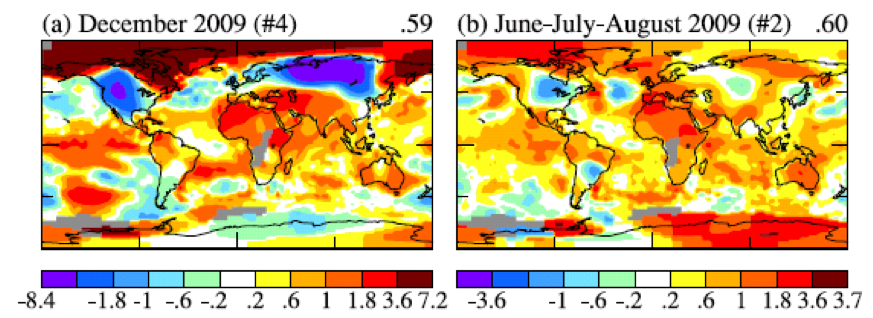
Contrarians were also confusing local and global. They were committing the logical fallacy of over-generalizing when they inferred from observations on the U.S. east coast the condition of weather globally. They don't seem to understand that it's possible to be unusually cold in some areas but unusually hot in the rest. For example, looking at a global map of temperature anomalies for the month of December 2009 (data from NASA), we can see that it was unusually cold in the U.S. and Siberia, but unusually warm in the rest of the world:

clip_image002

Finally, contrarians were confusing weather and climate. On the short term of weather (days, months) it is entirely possible to have unusually cold temperatures; warming just makes them slightly less probable. But over the long term of climate (years, centuries, millennia) the trend is towards increasing average global temperatures.

So when arguing that snowstorms on the U.S. east coast refute global warming, contrarians were confusing precipitation and temperature, local and global, weather and climate. Is it possible to get any more confused about global climate change?

For more information see http://www.npr.org/templates/story/story.php?storyId=123671588

For humorous takes see http://www.thedailyshow.com/watch/wed-february-10-2010/unusually-large-snowstorm
and
http://www.colbertnation.com/the-colbert-report-videos/264085/february-10-2010/we-re-off-to-see-the-blizzard